ARTICLE:
physorg.comAUTHOR:
Lisa ZygaCOMMENTARY:
Allen MacNeillFirst the news item, followed by some commentary:
****************************************************
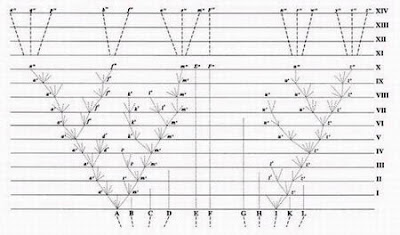
There is only one figure in
On the Origin of Species, and that is a tree diagram. As Darwin’s model for the theory of evolution, he used the Tree of Life (TOL) to clearly and visually explain the interrelatedness of all living things, implying that from one common ancestor (the root) sprung branches, which produced smaller offshoots as genetic progeny, etc.
In this model, similarities between species reveal a common ancestor, and differences result from (and explain) Darwin’s main catalysts: competition and natural selection, which generate improvement in future generations. As a simile, the TOL served a vital purpose for introducing the theory of evolution to the community in an understandable way. Although there is no external evidence to support the idea that evolution is inclusively hierarchical, many evolutionists believe the TOL provides an accurate general representation of the history of life, which could potentially be completely reconstructed by knowing the relevant data.
In recent times, however, a minority of biologists and evolutionists have questioned the accuracy of the TOL hypothesis, including W. Ford Doolittle and Eric Bapteste. In a recent paper in the Proceedings of the National Academy of Sciences, “Pattern Pluralism and the Tree of Life Hypothesis,” the scientists investigate the shortcomings of the TOL, as well as propose alternative models that would better explain how to classify the history of evolving life forms.
Much of the initial concern over TOL was provoked by biologists studying the complex relationships among prokaryotes, the most primitive life forms that include bacteria and archaea. Prokaryotes have a much simpler DNA structure than eukaryotes (all other life forms). Because of this, prokaryotes often transfer their DNA via processes such as lateral gene transfer as opposed to vertical gene transfer (direct transmission form parent to progeny) which is the basis for the “phylogenetic” (evolutionary relatedness) TOL scheme.
“Surely a tree is the right model for most multi-cellular animals and plants,” Doolittle explained to PhysOrg.com. “Thus the TOL is great for fossils and museums and dinosaurs and most of visible life, over the last billion years. But unicellular eukaryotes and prokaryotes represent the bulk of the biomass and diversity of life on earth, as well as the first two-thirds of its history.”
In their paper, Doolittle and Bapteste highlight research that shows other causes of genetic modification, suggesting that evolutionary history is more complex than described by the TOL. For example, recombination, gene loss, duplication, and gene creation are a few of the processes whereby genes can be transferred within and between species, causing variation that’s not due to vertical transfer. These transfer methods give results that don’t fit on the TOL, including species that cannot be traced to a common ancestor.
While such diverse methods might appear to obviously point to a more complex nonhierarchical evolutionary scheme, Doolittle and Bapteste explain that the TOL thinking persists due to confusion between the roles of “process” and “pattern.” The above methods are processes and are widely accepted by modern evolutionists, whereas the TOL is a pattern that, as Doolittle and Bapteste explain, has been ingrained in biologists’ minds from early education as a single, unifying model. As the researchers explain of the current biology scene, “We may be process pluralists, but we remain pattern monists.”
If this combination of thinking seems to clash, Doolittle and Bapteste suggest that the Western philosophical tradition of thinking in universal patterns has caused biologists to cling to classification without realizing it. The authors point out that many algorithms used to study evolutionary hierarchies impose or extract the TOL structure due to their intrinsic design. TOL is a paradigm that has stuck. But Doolittle sees ways to alter this mentality.
“Sure we can [re-train Western thinking]. That's what ‘postmodernism’ is about,” he said. “I would agree that the need to classify might be built in, but the coupling of this practice to a specific theory about what classifications are ‘natural’ is surely not.
As an alternative to the TOL, the scientists suggest that relationships among life forms may be represented by whatever model fits for a certain purpose, a certain taxonomic group, or a certain scale. In contrast to pattern monism, they call this belief “pattern pluralism.” While parts of evolution certainly are tree-like, other parts may be nets or webs or other complex models. Most importantly, however, there seems to be no “theory of everything” in evolution, no metanarrative to unify all life forms.
“In 2006, our understanding of evolution at the molecular, population genetic, and ecological levels is rich and pluralistic in character,” the scientists conclude, “and does not require (or justify) a monistic view of the phylogenetic pattern.”
As for any blow to Darwin’s ego, the scientists point out that he never wrote about reconstructing the tree in an attempt to relate every living thing, but rather used the model as a general guide.
“I'd like to think he would adjust,” Doolittle said about Darwin. “After all, his theory was developed before there was any understanding of genetics and when bacteria were still believed to be spontaneously generated.”
REFERENCES CITED:
Doolittle, W. Ford, and Bapteste, Eric. “Pattern pluralism and the Tree of Life hypothesis.” PNAS, February 13, 2007, vol. 104, no. 7, 2043-2049.
****************************************************
COMMENTARY:
Ford Doolittle has been saying this for many years, and has been joined by Lynn Margulis, who has argued that the concept of "species" does not apply to prokaryotes.
But, that's not what I want to talk about. What I want to talk about is how "intelligent design theorists" quote-mine and otherwise distort reality to the point of outright lying. Why do I say this? Because former lawyer and professional propagandist,
Casey Luskin, has a
postat
Evolution News, propaganda outlet for the
Discovery Institute in which he says
"By invoking insufficient data, horizontal gene swapping, rapid evolution, and other ad hoc explanations, Darwinists reveal that neo-Darwinism is trying explaining away the data; it is not explaining the data. Perhaps the inability to construct robust phylogenetic trees using molecular data stems from the fact that common descent is simply wrong."
And the alternative? Why, magic of course. All of the living forms on Earth today were created, all at once, on Tuesday 25 October 4004 BC at 9 AM...or some other time in the past, exact date unspecified. Because, of course, that is the only alternative to common descent. Either you and your siblings are the offspring of your parents (i.e. common descent) or you aren't, and if the latter is true, then you must all have been created separately, not by your parents, but rather by God...excuse me, the Grand Omnipotent Designer. And with your memories of your childhood already inserted into your minds, so that the jarring discontinuity of your separate creations would not disturb you too much...would lead you, in fact, into the damning conclusion that you were, in fact, the offspring of your parents, and thus consign yourself to everlasting torment in the lake of fire.
Or not. You see, this is what the kind of egregious propagandizing of the folks of the Disco Institute leads to. Not discussion of the science of biology on its merits, on the basis of reason and evidence, but pure assertions without any alternatives at all (not that they want you to read in public, anyway).
I'm tired (our new baby is keeping Leah and me awake at night), and so I'll sign off now. But damn, people like Luskin just make me want to scream sometimes...
"Against stupidity, the gods themselves contend in vain."
- Friedrisch Schiller
--
AllenLabels: Casey Luskin, Discovery Institute, evolutionary phylogeny, Ford Doolittle, intelligent design, tree of life


