Wednesday, April 08, 2009

Platonic Ideal Forms Versus Evolutionary Developmental Biology


In a recent thread at Uncommon Descent,
Salvador Cordova
wrote:
"[The existence of] platonic forms would strongly suggest that [evolutionary] transitional [form]s don’t exist. And if there are only lawful morphological forms, transitional forms, even in principle, couldn’t exist. Transitional forms and Platonic Forms don’t fit well together in any theory. It appears the two are mutually exculsive.

In engineering we have many platonic forms. As engineers we are taught to recognize and implement certain canned architectures. A lot of systems biology is mapping biological forms to the forms engineers recognize.

[The] quest for “correct designs” ... makes sense in a world of ideal forms, platonic forms. We instinctively have platonic forms in our mind. We have a sense that a defect is a defect, that an error is an error.

In the Darwinian world, it’s all about selective advantage. A blind cave fish is “selectively advantaged”. Defect is only a relative term. However in the eyes of plato, a blind cave fish is less than the ideal, it is a broken form. In such case, natural seleciton helped to infuse the defect in the population and thus introduce a defect that is not consistent with the ideal pattern.

The notion of platonic forms does not seem to be compatible with Darwinian evolution. [Emphasis added]

The idea of Platonic ideal forms in biology is an old one. The now mostly defunct tradition of orthogenesis is essentially a version of Platonic ideal forms applied to biology (and an argument can also be made that Lamarck’s progressive theory of evolution by means of the inheritance of acquired characteristics is as well). However, and contrary to what some might expect, applying the concepts of orthogenesis to "intelligent design theory" ("ID") is problematic, because in its early 20th century form, orthogenesis was considered to be progressive, but not goal oriented (i.e. teleological).

In addition to the early orthogenesists, two other names stand out in this tradition: D’Arcy Thompson and Stephen Jay Gould. Both were primarily concerned with the origin and evolution of form, and both developed theories of evolution based on this. Even J.B.S. Haldane (one of the founders of the “modern evolutionary synthesis”) wrote in this tradition in his essay "On Being the Right Size". Haldane’s musings on the relationship between size and constraints on form have become known as “Haldane’s Principle”, and have recently been applied to urban planning.

The newly emerging science of evolutionary developmental biology (”evo-devo”) has some similarities to orthogenesis, especially insofar as both are attempts to explain why the evolution of overall form (i.e. phenotype) appears to be constrained to certain types of forms, rather than all possible forms. The orthogenesists asserted that there are certain forms that are much more likely than others. These forms are similar in some ways to Platonic forms, in that there is no necessarily materialistic explanation for the predominance of certain forms, at least according to the theory of orthogenesis.

Evo-devo explains the similarities within “formal types” with reference to shared developmental programs, especially among eukaryotes. This shared developmental programming is based on the hierarchical gene regulation systems, most of which are based on homeotic gene regulatory mechanisms. Similar developmental constrains appear to exist among plants and fungi, but not so much among prokaryotes and multicellular protists. So, looking for things that resemble Platonic ideal forms in biology will probably involve identifying and categorizing the various developmental “channels” which are produced by these homeotic gene regulatory systems.

None of this, of course, says how the various hierarchical gene regulation systems originally evolved. This is another of those “deep time” problems, such as the origin of life and the origin of the genetic code. As I have commented repeatedly in the past, I believe that questions about such origins are almost certainly unanswerable using current empirical methods.

I also personally believe that the question of the origin of Platonic ideal forms (if such things exist and are empirically distinguishable from the various “channels” produced by the action of homeotic gene regulatory mechanisms) is both an open question and one that is almost certainly not answerable using empirical methods.

For more on the question of Platonic forms in biology, see this and this.

For a critique of my analysis of Platonic ideal forms in biology, see this.

************************************************

As always, comments, criticisms, and suggestions are warmly welcomed!

--Allen

Labels: , , , , , , , ,

Friday, September 29, 2006

Punctuated Equilibrium and the EEA for Human Behavioral Adaptations


AUTHOR: Christopher Ryan

SOURCE: Evolutionary Psychology

COMMENTARY: Allen MacNeill

The following question was asked on the Evolutionary Psychology list:

"...[W]e look to the EEA for the origins of the design of the human mind (modules, and so on) precisely because the structures in question change so slowly. If, on the other hand, it is demonstrated that complex physiological (and, presumably, psychological) structures can arise and disappear in as few as twenty generations, then of what relevance is the EEA to our discussions here?...Does Gould's punctuated equilibria theory integrate such rapid evolutionary change? And is it accepted by the folks working in [evolutionary psychology]? If so, why do we spend so much time discussing adaptations that have likely been replaced long ago?"

To which I replied:

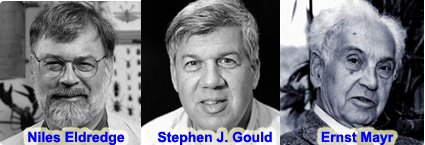
Eldredge and Gould, like the vast majority of other evolutionary biologists (beginning with Darwin and including such luminaries as Ernst Mayr) studied animals almost exclusively. It now appears that the equilibrium/stasis pattern that characterizes macroevolution in animals is at least partly an artifact of their developmental biology. Specifically, the hierarchical control of gene regulation in animals via homeotic genes makes possible surprisingly rapid phenotypic change without correspondingly large changes in genotype (i.e. the old "modern synthesis" has been superceded by the new "evo-devo").

Therefore, it is quite possible (indeed, likely) that relatively slight changes in genetic regulation of development have caused the remarkable changes in hominid phylogeny reflected in the fossil record. This has already been shown to be the case for the FOX-2-P gene, and just last month for the HAR-1-F gene (see "And the winner of the fastest gene award..."), slight changes in both of which have been correlated with significant changes in the human phenotype (both in the direction of greater neoteny, by the way).

So, it is quite possible that humans have changed significantly over the past 40,000 years, and perhaps not just via purely cultural means. It is still an open question just how much of our behavior is affected by our underlying genetics, and how quickly such relationships can change (and under what conditions). And, if new research in epigenetics is any indication, such changes may be even more common and rapid than has been heretofore suspected. Nutrition during early development, chronic stress (including chronic stress in utero), and exposure to certain environmental chemicals have all been implicated in altering gene regulation, and some such alterations have been shown to be heritable (shades of Lamarck!), thereby challenging further the "standard social science model" so vilified by Pinker and other EPers.

Therefore, the EEA for some current "modules" may not date to the Pleistocene, but rather to much later periods, including (but not limited to) events in historical times. Indeed, since relative reproductive success, rather than absolute numerical differences, is the basis for natural selection (and therefore adaptation), it may be that such seemingly cultural processes as warfare, migration (including forced migration via slavery), and religious practices involving both celibacy and increased procreation (via religious prohibition of contraception) may all have played significant roles in the shaping of the human behavioral phenotype via correlated alterations in the expression of genes affecting behavior.

In a nutshell, then, the answer is yes: since humans are animals (like those studied by Eldredge and Gould), it is quite possible that punctuated equilibrium theory is applicable to human evolution, including behavioral evolution, and that further investigations into the relationship between gene regulation, development, and human behavior may yield productive, testable hypotheses about such relationships.

At the risk of blowing my own horn, I have attempted to propose such a hypothesis for the evolution of the capacity for religious experience (see: "The Capacity for Religious Experience is an Evolutionary Adaptation to Warfare"):

"The pan-specific qualities of both religious experience and warfare indicate that they are both evolutionary adaptations. There is considerable variation between individuals with respect to their capacity for religious experience and motivation to participate in warfare. Selective advantages for participation in warfare accrue to both winners and losers as long as the benefits of participation exceed the average costs. These selective advantages, primarily in the form of differential reproductive success, accrue to males when they are on the winning side in a war, and often to females no matter which side they are on."

"Recent work on the evolutionary dynamics of religion have converged on a "standard model" in which religions and the supernatural entities which populate them are treated as epiphenomena of human cognitive processes dealing with the detection of and reaction to agents under conditions of stress, anxiety, and perceived threat. Religious experience at the individual level is characterized by depersonalization, coupled with submission to a super-individual force; the same is essentially the case for participation in warfare. The capacities for both religious experience and participation in warfare are adaptations insofar as they evolve by means of natural selection operating primarily at the level of individuals who are members of groups in which both kin selection and reciprocal altruism are also operative. It is likely that the overall patterns of supernatural organization exist as the result of coevolution between the memetic content of religious beliefs and the underlying neurological matrix within which such beliefs are maintained and transmitted in the context of specific ecological subsistence patterns."

--Allen

Labels: , , , , , , ,