Monday, October 30, 2006

To Whom Do We Owe Our Allegiance?



AUTHOR: Allen MacNeill

SOURCE: LewRockwell.com

COMMENTARY: Allen MacNeill

This isn't exactly "evolution-related," but I've got an essay up at LewRockwell.com, one of my favorite political websites. For those of you who haven't been there yet, LewRockwell.com is the most popular libertarian website on the Internet, and the third most popular political website overall. As the masthead proclaims, it's "anti-state, anti-war, and pro-free trade," and Lew describes himself as a "paleoconservative," to distinguish his brand of libertarian politics from the economically and morally bankrupt politics and policies of the "neocons." And, although I don't always agree with some of the viewpoints expressed by some of the commentators on his site, Lew has always acted like a gentleman and a scholar, and I agree so much with the political positions taken by him and his cohorts that I've decided that, if I'm going to dabble in politics at all (and I'd like to), I'll do it at LewRockwell.com. So, to save you all the effort of clicking over there, here is my first attempt at a libertarian political essay, mirrored in its entirety from LewRockwell.com:

To Whom Do We Owe Our Allegiance?

I pledge allegiance to the flag
of the United States of America
and to the republic for which it stands:
one nation indivisible,
with liberty and justice for all.
– Francis Bellamy (1892)

Our family has a flag. It's a variation of the flag of Robert the Bruce, king of Scotland. His was a red lion rampant on a field of gold. Ours is a golden lioness rampant on a field of purple. The problem is, to fly it correctly would require us to decide which flag should be flown higher - our family's flag or the star-spangled banner?

This is not a trivial problem. In fact, it goes to the heart of what is wrong with America today. To fly our family's flag correctly (even lawfully, in many jurisdictions), we should fly it in such a way as to make it clear to anyone seeing it that our family's flag - and therefore, by implication, our family - is subordinate to that of the United States government (and to the republic for which it stands). And therein lies the problem.

It is a basic tenet of libertarian conservatism that one's highest allegiance is to one's self and one's family. This principle is enshrined in the founding document of the United States of America. According to the Declaration of Independence, "[A]ll Men are created equal, [and] are endowed by their Creator with certain unalienable Rights, that among these are Life, Liberty and the Pursuit of Happiness -- That to secure these Rights, Governments are instituted among Men, deriving their just Powers from the Consent of the Governed, that whenever any Form of Government becomes destructive of these Ends, it is the Right of the People to alter or to abolish it, and to institute new Government, laying its Foundation on such Principles, and organizing its Powers in such Form, as to them shall seem most likely to effect their Safety and Happiness."

According to this viewpoint, individual people are sovereign entities, and governments are clearly subordinate to "the will of the people". Far from altering this relationship, the Constitution of the United States codifies these principles into law. It enumerates the very limited powers of the federal government, and then in the ninth and tenth amendments declares that "The enumeration in the Constitution of certain rights shall not be construed to deny or disparage others retained by the people" and "The powers not delegated to the United States by the Constitution, nor prohibited by it to the States, and reserved to the States respectively, or to the people."

What this means is that, except for the powers and responsibilities enumerated in the Constitution, the United States government has no power or sovereignty over the lives of its citizens. In brief, we own ourselves and the government is, at most, our servant.

Today, however, it is clear that to the government and an increasing number of the citizens of the United States this situation is reversed. The government believes (and, more importantly, acts as if) it owns us and we are its servants. This is why the symbolism of the flag is so important: the flag of the United States takes precedence over all others, including the flag of the family of Lyonesse. In other words, in the view of those who would presume to rule us, the president of the United States is our lord and sovereign and we are merely his vassals. He may take from us and from our families anything he desires: our land, our property, our children, even our very lives (via the death penalty and the military draft), and the only justification he needs to do this is the exercise of pure, naked, overwhelming force.

This is not the way it was supposed to be, friends. There was a time in America when the president viewed himself as a servant of the people and abjured all signs and symbols of sovereignty. Grover Cleveland refused to be treated any differently than ordinary citizens at state occasions and is remembered for vetoing a bill providing emergency relief to farmers following a natural disaster, on the grounds that to do so would legitimize the forcible taking of some citizen's money (via taxes) to benefit others. It may come as a surprise to some (especially today's Democrats, and most Republicans) that Cleveland was a Democrat...and moreover, by his behavior, a true democrat.

Now, however, the candidates from both parties freely and openly state their wholehearted support for a government and a presidency that clearly recognizes no restraint or challenge to its power except the use of violent force. Furthermore, the majority of the voting citizenry agrees, and supports those candidates for public office who most vigorously propound the doctrine of unlimited force.

For itself, the government asserts a sole monopoly on the use of force and recognizes no limits to its use. Every president since Lincoln has, in the context of war or the threat of war, justified the unilateral and unlimited use of military force and the suspension of individual sovereignty (in the context of the military draft) with sole reference to the supreme sovereignty of the president and the federal government. Nowhere in the Constitution nor any of its amendments is it stated or even implied that the States may not secede from the union, nor govern their own affairs, nor respect and protect the rights to private property of individual citizens. Yet ever since the administration of Lincoln, the federal government has unilaterally arrogated to itself all of these, and has enforced this usurpation through the use of deadly force.

In a world dominated by force alone, only force matters, and the only law is the law of force majeur: "might makes right". The founders of the American republic believed otherwise, and tried to structure the Constitution and the government it created so that there would be built-in limits to the unilateral use and abuse of power. They did so because they realized that a government founded on force, rather than the fully informed consent of the governed, is not a government at all. It is tyranny, pure and simple.

To our increasing sorrow, it is clear that tyranny is what we are rapidly approaching. To state the case succinctly, the recent history of the presidency, congress, the supreme court, many state governments, and both major political parties has been a history of repeated injuries and usurpations, all having in direct object the establishment of an absolute tyranny over the individual states and ourselves, the citizens of those states. Sound familiar?

But, if you've been paying attention recently, you already know most of this. The question is, what can we do about the accelerating slide toward tyranny? The first and most powerful thing we can do is to remember that crucial phrase in the Declaration: that governments, including ours, derive their just powers from the consent of the governed. So, as many did during the last election, we can withhold our consent: we can refuse to vote for those aspiring to be tyrants. We can also assert our personal and familial sovereignty over that of the tyrannical state by refusing to yield up to it that which it most desires: our land, our property, our children, and our lives.

In many cases, we can do this by simply ignoring Leviathan. Ever since George Bush stole the presidency in 2000, I've repeatedly found myself comforting my friends by pointing out to them that the party in power generally has little or no affect on our daily lives, especially out here in the hinterlands. So long as you pay as little taxes as you can legally get away with (yes, even the IRS has been forced repeatedly to admit that this is your constitutional prerogative), the dragon will pass you by, unseeing.

However, the time may come – indeed, it may soon be upon us – when the dragon will thirst for new blood. The wars in Afghanistan and Iraq (and Iran, and Syria, and North Korea, and – who knows – maybe northern Virginia) will necessitate the reinstatement of draft slavery. Then we must do what we did a generation ago, and the generation before that, and the generation before that, but this time in overwhelming numbers: we must march on Washington and speak truth to power. And that truth will be, as it was then, Hell no, we won't go!

And we can fly our families' flags: proudly, fearlessly, and freely, secure in the knowledge that there is where our highest and truest allegiance lies.

--Allen

Labels: , , , ,

Thursday, October 26, 2006

Scientists Endorse Candidate Over Teaching of Evolution


AUTHOR: Cornelia Dean

SOURCE: New York Times

COMMENTARY: Allen MacNeill

In an unusual foray into electoral politics, 75 science professors at Case Western Reserve University in Cleveland have signed a letter endorsing a candidate for the Ohio Board of Education.

The professors’ favored candidate is Tom Sawyer, a former congressman and onetime mayor of Akron. They hope Mr. Sawyer, a Democrat, will oust Deborah Owens Fink, a leading advocate of curriculum standards that encourage students to challenge the theory of evolution.

Elsewhere in Ohio, scientists have also been campaigning for candidates who support the teaching of evolution and have recruited at least one biologist from out of state to help.

Lawrence M. Krauss, a physicist at Case Western Reserve who organized the circulation of the letter, said almost 90 percent of the science faculty on campus this semester had signed it. The signers are anthropologists, biologists, chemists, geologists, physicists and psychologists.

The letter says Dr. Owens Fink has “attempted to cast controversy on biological evolution in favor of an ill-defined notion called Intelligent Design that courts have ruled is religion, not science.”

In an interview, Dr. Krauss said, “This is not some group of fringe scientists or however they are being portrayed by the creationist community,” adding, “This is the entire scientific community, and I don’t know of any other precedent for almost the entire faculty at an institution” making such a statement.

But Dr. Owens Fink, a professor of marketing at the University of Akron, said the curriculum standards she supported did not advocate teaching intelligent design, an ideological cousin of creationism. Rather, she said, they urge students to subject evolution to critical analysis, something she said scientists should endorse. She said the idea that there was a scientific consensus on evolution was “laughable.”

Although researchers may argue about its details, the theory of evolution is the foundation for modern biology, and there is no credible scientific challenge to it as an explanation for the diversity and complexity of life on earth. In recent years, with creationist challenges to the teaching of evolution erupting in school districts around the country, groups like the National Academy of Sciences, perhaps the nation’s pre-eminent scientific organization, have repeatedly made this point.

But the academy’s opinion does not matter to Dr. Owens Fink, who said the letter was probably right to say she had dismissed it as “a group of so-called scientists.”

“I may have said that, yeah,” she said.

She would not describe her views of Darwin and his theory, saying, “This isn’t about my beliefs.”

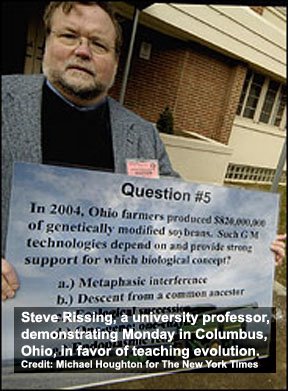
School board elections in Ohio are nonpartisan, but Dr. Owens Fink said she was a registered Republican. Her opponent, Mr. Sawyer, was urged to run for the Seventh District Board of Education seat by a new organization, Help Ohio Public Education, founded by Dr. Krauss and his colleague Patricia Princehouse, a biologist and historian of science, and Steve Rissing, a biologist at Ohio State University.

At the group’s invitation, Kenneth R. Miller, a biologist at Brown University, will be in Ohio today through the weekend campaigning for other school board candidates who support the teaching of evolution. Dr. Miller, an author of a widely used biology textbook, was a crucial witness in the recent lawsuit in Dover, Pa., over intelligent design. The judge in that case ruled that it was a religious doctrine that had no place in a public school curriculum.

After that decision, Dr. Owens Fink said, the Ohio board abandoned curriculum standards that mandated a critical look at evolution, a decision she said she regretted. “Some people would rather just fold,” she said.

But Dr. Miller said it was a good call, adding, “We have to make sure these good choices get ratified at the ballot box.”

COMMENTARY:

Once again Ohio is the battleground in the ongoing culture wars. A similar change in the composition of a state board of education happened in Kansas earlier this year. It will be interesting to see what happens in Ohio, especially in the context of what many are beginning to perceive as a "glacial shift" in Ohio politics, away from religious conservatism and the Republican party and toward a more tolerant and pluralistic libertarianism, as exemplified by Tom Sawyer (even his name resonates in American cultural history). Whether the Democrats can finally become vertebrates and take a principled position on this and related issues remains to be seen...

--Allen

Labels: , , , , , , , , , ,

Thursday, February 16, 2006

Evolution Measure Splits State Legislators In Utah


AUTHOR: Kirk Johnson

SOURCE: New York Times

COMMENTARY: Allen MacNeill (following the article)

SALT LAKE CITY, Feb. 3 ˜ Faith's domain is evident everywhere at the Utah Legislature, where about 90 percent of the elected officials are members of the Church of Jesus Christ of Latter-day Saints. Prayers are commonplace, and lawmakers speak of their relationship with God in ordinary conversation.

So it might be tempting to assume that legislation relating to the divisive national debate about the teaching of evolution in public schools would have a predictable outcome here.

Senate Bill 96 is proving that assumption wrong. The bill, which would require science teachers to offer a disclaimer when introducing lessons on evolution ˜ namely, that not all scientists agree on the origins of life ˜ has deeply divided lawmakers. Some leaders in both parties have announced their opposition to the bill, and most lawmakers say that with less than a month left in the legislative session, its fate remains a tossup.

One of the reasons why is State Representative Stephen H. Urquhart, a Republican from southern Utah whose job as majority whip is to line up votes in his party. Mr. Urquhart announced last week that he would vote against the bill.

"I don't think God has an argument with science," said Mr. Urquhart, who was a biology major in college and now practices law.

Mr. Urquhart says he objects to the bill in part because it raises questions about the validity of evolution, and in part because the measure threatens traditional religious belief by blurring the lines between faith and science.

Supporters of the bill, which passed the Senate on a 16-to-12 vote one day before Mr. Urquhart's announcement, still predict that it will pass in the House. They say the bill is not about religion, but science. Gov. Jon Huntsman Jr., a Republican and former Mormon missionary, has not said what he will do if the bill reaches his desk.

"I don't have to talk about religion ˜ it's of no meaning and it's not part of this discussion," said State Representative James A. Ferrin, a Republican and the sponsor of the bill in the House. "It's not about belief, it's about not overstepping what we know."

Opponents of the bill, including State Senator Peter C. Knudson, the Republican majority leader, openly laugh at talk like that.

"Of course it's about religion," Mr. Knudson said.

He and other lawmakers say that part of the debate here is in fact over what kind of religion would be buttressed by the legislation. Although the Origins of Life bill, as it is formally known, does not mention an alternative theory to evolution, some legislators say they think that voting yes could be tantamount to supporting intelligent design, which posits an undefined intelligence lurking behind the miracles of life and which differs greatly from the Mormon creation story.

"There are people who say, 'That's not my religion,' or that it will only confuse our children," said State Representative Brad King, a Democrat and the minority whip in the House, who also plans to vote against the bill. "For me, it's sort of that way," added Mr. King, whose father, a Mormon bishop, taught evolution at the College of Eastern Utah.

Others say that Mormonism, with its emphasis that all beings can progress toward higher planes of existence, before and after death, has an almost built-in receptivity toward evolutionary thought that other religions might lack. Still others oppose the state's inserting itself in matters of curriculum, which are mostly under the control of local school districts.

Advocacy groups who follow the battle over the teaching of evolution nationally say that what happens here could be important far beyond state borders.

"It's being watched very closely because of the very conservative nature of the state," said the Rev. Barry W. Lynn, the executive director of Americans United for Separation of Church and State, based in Washington. "If the legislation is rejected in Utah, it would be a very strong signal that the issue should be avoided elsewhere."

Missouri's legislature is considering a bill requiring "critical analysis" in teaching evolution. An Indiana lawmaker has called evolution a type of religion and proposed a bill banning textbooks that contain "fraudulent information."

Gov. Ernie Fletcher of Kentucky, a Republican, pointed out in his State of the State address earlier this month that alternative explanations for the origins of species can already be taught in Kentucky schools. A spokesman for Mr. Fletcher said he was not advocating alternatives to evolution, but merely pointing out the options.

The Utah bill's main sponsor, State Senator D. Chris Buttars, a Republican from the Salt Lake City suburbs, said he was not surprised by the debate it had inspired. He said ordinary voters were deeply concerned about the teaching of evolution.

"I got tired of people calling me and saying, 'Why is my kid coming home from high school and saying his biology teacher told him he evolved from a chimpanzee?' " Mr. Buttars said.

Evolutionary theory does not say that humans evolved from chimpanzees or from any existing species, but rather that common ancestors gave rise to multiple species and that natural selection ˜ in which the creatures best adapted to an environment pass their genes to the next generation ˜ was the means by which divergence occurred over time. All modern biology is based on the theory, and within the scientific community, at least, there is no controversy about it.

Even so, one important supporter of the bill, State Representative Margaret Dayton, a Republican and chairwoman of the House Education Committee, said her convictions had been underlined in recent days. "A number of scientists have been in touch with me, and I can verify that not all scientists agree," Ms. Dayton said.

Utah's predominant faith has also made its stance less predictable on other issues touching on religion in school ˜ notably school prayer. Enthusiasm for the idea has been muted or ambivalent, said Kirk Jowers, a professor of political science and director of the Hinckley Institute of Politics at the University of Utah. Professor Jowers pointed to the awareness among Mormons of their religion's minority status in the nation and world.

"It was kind of a realization that if you push to have prayer in school, then outside of Utah, the prayer would not typically be a Mormon's prayer, so is that road you want go down?" Professor Jowers said.

**********************************************************************************
COMMENTARY:

The Utah case is very special, in the same way that Utah is very special: if any state in the US could be considered a “theocracy,” it's Utah. Mormons control the state government and legislature and virtually all other governmental and social institutions. Despite this, they have generally resisted the temptation to intrude religion into politics. Voters in the state are generally quite conservative (voter registration is overwhelmingly Republican), but it would be difficult to pigeonhole them as the kind of conservative that toes the fundamentalist/creationist party line. True, one of their state senators, D. Chris Buttars (Republican) is clearly a creationist, but the Mormon mainstream is definitely not on the side of either creationism or “intelligent design.”

There is also a very deep tradition of self-reliance among Utah folk, which goes along with their conservatism. They don't like outsiders (like the guys in fancy suits from either the Discovery Institute or the National Center for Science Education) telling them what to think. There is also a burgeoning high technology industry in Utah, and much of the younger generation there would probably classify themselves as “sci-tech geeks” (at least the ones I know would). University educated, most of them would prefer that their state and its schools not be classified as favoring “supernaturalism” over science.

Furthermore, as is pointed out in the article, Mormon theology deviates quite substantially from fundamentalist Christianity. As might be expected from the largest and most successful religion founded in 19th century America (in upstate New York, just a short drive from here, no less), Mormonism is both forward-looking and open to “new revelation.” Unlike the fundamentalist creationist Christians, therefore, most Mormons don't necessarily view the Bible (nor the Book of Mormon) as literal truth, nor do they have the innate fear of science and technology shared by most fundamentalists.

And so, Senator Buttars notwithstanding, Utah could go either way in the “evolution wars.” It depends a lot on whether the “know nothing” contingent in the state legislature (led by Buttars) can sway enough of the public to force public opinion over to their side. Given the recent events in Pennsylvania and Ohio (both Christian and Republican strongholds, and both throwing out “intelligent design”), the outcome in Utah is far from a foregone conclusion.

--Allen

P.S. In the interests of full disclosure, even though I'm related to Brigham Young, I'm not a Mormon. When he was a boy, his family lived only a couple of miles from where my mother's family has lived for generations (my great-great grandmother was a Young).

**********************************************************************************
ORIGINAL PUBLICATION REFERENCE:

Location Online:
New York Times
URL: http://www.nytimes.com/2006/02/05/national/05evolution.html

Original posting/publication date timestamp:
Published: February 5, 2006

**********************************************************************************

Labels: , , , , , , , , , , ,

Tuesday, February 14, 2006

Ohio School Board Votes Down Lesson Plan Criticizing Evolution


AUTHOR: Allen MacNeill

SOURCE: Associated Press

COMMENTARY: Allen MacNeill...and you!

It's been a tough couple of months for the promoters and supporters of "intelligent design (ID)." Last December, ID supporters in Dover, Pennsylvania were handed a resounding defeat when Judge John E. Jones ( a conservative Republican Bush appointee) handed down a legal decision blocking the reading of statements supporting ID in Dover high school biology classes.

Next, a school in El Tejon, California that had allowed a course in "creation science" to be taught in a philosophy class decided to end the course prematurely and to agree not to offer it again, as part of an out-of-court settlement to a lawsuit brought by Americans United for Separation of Church and State.

Now late this afternoon, the Ohio state school board voted 11 to 4 to eliminate eliminate a lesson plan and science standards that supporters of evolutionary theory said opened the door to teaching intelligent design. Specifically, the board voted to delete material in the lesson plan that encouraged students to seek evidence for and against certain aspects of evolutionary biology.

This vote reversed a close 9-8 decision in January to keep the lesson plan. Three of the board members who voted to keep the lesson plan in January were absent from today's deliberations, and have vowed to reinstate the material critical of evolution at an upcoming meeting. However, given the margin of victory today, it is unlikely that they will succeed. The Panda's Thumb has a compendium of information and links spanning this entire controversy.

As I mentioned in an earlier post, the governor of Ohio has recently criticized the lesson plan, saying that he should have exercised more control over the appointment of ID supporters to the state school board, with the clear implication that in the future he would do what he could to prevent ID supporters from influencing state educational policy.

Ohio Citizens for Science has issued a press release applauding the decision, while at the same time calling on supporters of evolution to continue to oppose efforts to insert ID theory into state lesson plans.

You might think that with all of these defeats, the ID movement would re-think its strategy. However, this seems unlikely as all of the recent legal maneuvering has come as the result of the ID movement having already changed their strategy. In 1998, the Discovery Institute, home and principle sponsor of the ID movement, promulgated what has now become known as the "wedge document," in which they laid out a five-year strategy to "defeat scientific materialism" and "replace materialistic explanations with the theistic understanding that nature and human beings are created by God." In it, they stated clearly that their first priority was research, writing and publication: that is, to develop a program of basic science in which ID theory would be tested and presented to the scientific community in such a way as to convince a critical mass of scientists that the theory had merit. As the author(s) of the wedge document stated, "Without solid scholarship, research and argument, the project would be just another attempt to indoctrinate instead of persuade."

Only once ID theory had been established in the scientific community would its supporters attempt to influence educational and public policy:


"Once our research and writing have had time to mature, and the public prepared for the reception of design theory, we will move toward direct confrontation with the advocates of materialist science through challenge conferences in significant academic settings. We will also pursue possible legal assistance in response to resistance to the integration of design theory into public school science curricula. The attention, publicity, and influence of design theory should draw scientific materialists into open debate with design theorists, and we will be ready. With an added emphasis to the social sciences and humanities, we will begin to address the specific social consequences of materialism and the Darwinist theory that supports it in the sciences."


The history of the intervening eight years shows just the opposite: only four articles relating to ID theory have been published in peer-reviewed scientific journals. None of these four articles contains the results of actual empirical (i.e. field or laboratory) tests of predictions formulated using ID theory. A grand total of only 34 articles and books (i.e. approximately four per year) have been produced during that entire time, as compared with thousands of articles and books in the mainstream scientific community on the various aspects of evolutionary theory.

Instead, the ID movement, and especially the Discovery Institute, has moved directly into the public arena, spending nearly all of their energy and financial resources on interventions in school board decisions, political elections, and press releases. Clearly, having lost the battle in the scientific community, they are attempting to appeal directly to the general public, hoping that slick publicity will succeed where scientific research (or rather, the lack thereof) has failed.

If I were a scientist who supported ID theory, or even a scientist who supported the idea of free and unfettered research, I would view the people at the Discovery Institute and their supporters in the various governments and school boards as traitors. The fact that Michael Behe and William Dembski don't see them that way says a lot about their confusion about the difference between science and politics.

--Allen

Labels: , , , , , , , , ,

Ohio Expected To Rein In Class Linked To Intelligent Design


AUTHOR: Jodi Rudoren

SOURCE: New York Times

COMMENTARY: Allen MacNeill

The legal precedent set by Judge John E. Jones' decision in the Dover case, in which "intelligent design theory" was found to be a religious theory masquerading as science, has now reached to the state of Ohio. Here's today's story in the New York Times (commentary follows):

COLUMBUS, Ohio, Feb. 13 — A majority of members on the Board of Education of Ohio, the first state to single out evolution for "critical analysis" in science classes more than three years ago, are expected on Tuesday to challenge a model biology lesson plan they consider an excuse to teach the tenets of the disputed theory of intelligent design.

A reversal in Ohio would be the most significant in a series of developments signaling a sea change across the country against intelligent design — which posits that life is too complex to be explained by evolution alone — since a federal judge's ruling in December that teaching the theory in the public schools of Dover, Pa., was unconstitutional.

A small rural school district in California last month quickly scuttled plans for a philosophy elective on intelligent design after being challenged by lawyers involved in the Pennsylvania case. Also last month, an Indiana lawmaker who said in November that he would introduce legislation to mandate teaching of intelligent design instead offered a watered-down bill requiring only "accuracy in textbooks." And just last week, two Democrats in Wisconsin proposed a ban on schools' teaching intelligent design as science, the first such proposal in the country.

Here in Ohio, pressure has been mounting on board members in recent weeks to toss out the lesson plan and the standards underpinning it. Gov. Bob Taft, a Republican, called this month for a legal review of the plan, while newly revealed documents of Ohio's Department of Education linking it to treatises of the intelligent design movement have renewed threats of a lawsuit by opponents of the movement.

At the same time, a national group of evolution defenders has bombarded 5 of the 19 board members considered crucial to a vote against the lesson plan with 30,000 e-mail messages over the past week, and just Monday, the president of the National Academy of Sciences urged the board to change the lesson and the underlying curriculum guidelines to "conform to established scientific standards."

"All of that adds up to a sense of urgency and a sense of now is the time to clean up our act," said Robin C. Hovis, a stockbroker from Millersburg who is one of two board members pushing an emergency motion on Tuesday to delete the "critical analysis" language and the lesson plan. "There is an atmosphere among the board, at least a growing atmosphere, that this is a misguided policy and we better get rid of it."

Though the lesson plan is optional and never uses the words "intelligent design," its explanation of concepts like homology, the fossil record and endosymbiosis parallel those in the texts "Icons of Evolution" and "Of Pandas and People," written by proponents of intelligent design.

"All of that adds up to a sense of urgency and a sense of now is the time to clean up our act," said Robin C. Hovis, a stockbroker from Millersburg who is one of two board members pushing an emergency motion on Tuesday to delete the "critical analysis" language and the lesson plan. "There is an atmosphere among the board, at least a growing atmosphere, that this is a misguided policy and we better get rid of it."

Though the lesson plan is optional and never uses the words "intelligent design," its explanation of concepts like homology, the fossil record and endosymbiosis parallel those in the texts "Icons of Evolution" and "Of Pandas and People," written by proponents of intelligent design.

The Discovery Institute, in Seattle, the intellectual home of the design movement, had distanced itself from the Dover case but has long heralded Ohio's "critical analysis" approach as a model for the nation, and is ardently defending the lesson plan.

On Monday, the institute released a Zogby International poll it had commissioned showing that 69 percent of Ohio voters believed that scientific evidence against evolution should be included in curriculums, and 76 percent agreed that "students should also be able to learn about scientific evidence that points to an intelligent design of life." The institute has also proffered letters from two science professors supporting Ohio's standards and model lesson plan.

John G. West, associate director of the Center for Science and Culture at the institute, said: "This just shows the extremism of the other side. They think Dover is their wedge to try to stop any even voluntary critical analysis of Darwin's theory in the classroom. They obviously don't think they can win in the court of public opinion on the issue, and that's why they're using scare tactics."

Local supporters of the standards echoed Mr. West's confidence that, unlike the Dover curriculum, the one in Ohio could pass constitutional muster. The Pennsylvania ruling is not binding elsewhere.

"If I had the money, I'd pay for the lawsuit," said David Zanotti, president of the conservative American Policy Roundtable in Strongsville, Ohio. "They should sue or shut up."

Debate over evolution here dates to 2000, when the board began developing statewide academic standards, which do not dictate curriculum to the 613 local districts but provide a blueprint for standardized tests.

A proposal to teach intelligent design alongside evolution was rejected. Instead, the board in December 2002 unanimously adopted standards requiring that 10th graders be able to "describe how scientists continue to investigate and critically analyze aspects of evolutionary theory," with a parenthetical note that "this benchmark does not mandate the teaching or testing of intelligent design."

Since then, New Mexico, Minnesota and Kansas have adopted similar standards, and Pennsylvania lists evolution among half a dozen theories to be critically analyzed. But only Ohio has a model lesson plan, adopted by a divided board in 2004, that provides teachers a practical how-to guide. It is unclear how frequently it is used.

Besides the Dover decision, the disclosure in December of documents detailing internal discussions of the lesson plan helped revive debate here. Obtained by Americans United for the Separation of Church and State, a group considering a suit on the plan, the documents show that department scientists and outside experts condemned the lesson as "a lie," "crackpot," "religious," "creationism" and "an insult to science."

Asked whether the lesson connects skills to the real world, an external reviewer wrote: "Not the real scientific world. The real religious world, yes, the real world based on faith, yes, the real world of fringe thinking, yes!"

Patricia Princehouse, an evolutionary biologist and historian of science who has led the charge against the lesson plan, said, "Basically critical analysis is intelligent design relabeled, just as intelligent design was creationism relabeled."

Governor Taft entered the fray in early February, telling newspaper reporters and editors that the board should ask the attorney general to review the lesson; that intelligent design should not be taught or tested; and that he should have questioned candidates more vigorously on the issue before filling the eight board seats he controls.

Tuesday's expected showdown comes a month after the board voted 9 to 8 against an emergency motion to delete the lesson plan. Martha W. Wise, a board member who sponsored that motion, said that this time she would propose removing both the lesson plan and the critical analysis benchmark, while also restoring a fuller definition of science to note that its theories "while not 'believed in' through faith may be accepted or rejected on the basis of evidence."

Ms. Wise said she was unsure whether she had secured 10 votes for the emergency motion, but expressed confidence that a majority would at least call for a reconsideration of the lesson plan by the board's lawyers and a committee.

But Deborah Owens Fink, the board member who originally supported the dual study of evolution and design and has been the leading defender of the standards, said, "The lesson has been in use for two years, and certainly a hole hasn't been cut in the ozone or anything."

**********************************************************************************
COMMENTARY:

It's clear to me that the governor of Ohio is concerned that his state is going to gain a reputation as "anti-science" unless their "teach the controversy" policy is rescinded. With the National Academy of Sciences weighing in on the issue, any politician not already deeply committed to the Discovery Institute's position will be scrambling to rescind it as well...unless they're up for election, in which case they will probably be paying more attention to the Zogby poll results. Which means, of course, that the outcome will be almost purely political (i.e. it will have little or nothing to do with science).

The irony of all of this is that evolutionary biologists are having to make statements about how solid their own science is, when anybody in the field (indeed, anybody in any scientific field) knows that controversy is the name of the game. To me, that's the real danger in all of this. Not that scientists will be hoodwinked in any way by the IDers, nor that there will be any lasting harm done to public school students – after all, when I went to elementary school, we were all forced to recite a daily prayer first thing in the morning. No, the real danger is that, in attempting to show a "unified front," scientists will be tempted to suppress their own disagreements with current orthodoxy. Any inhibition on the free expression of doubts and disagreements in the scientific community would be harmful to science, in a way that "intelligent design theory" generally is not.

--Allen

**********************************************************************************
ORIGINAL PUBLICATION REFERENCE:

Location Online:
New York Times
URL: http://www.nytimes.com/2006/02/14/education/14evolution.html?adxnnl=1&adxnnlx=1139924263-e0hsLirTBn8dUuKRAs3wPw

Original posting/publication date timestamp:
Published: February 14, 2006

**********************************************************************************

Labels: , , , , , , , , ,