Saturday, May 02, 2009

How Not To Fight A "Culture War"


There has been an interesting and often heated discussion about "methodological naturalism" taking place at Uncommon Descent. After more than 350 comments, the dispute about what "methodological naturalism" was, and how long scientists have been practicing it was resolved in the way that most such discussions are resolved: with the participants agreeing to disagree.

I think it would be interesting for both sides in the debate around methodological naturalism (MN) to consider why this term has become so widely used in recent times. For the sake of argument, let us assume that the entire concept of MN only became "solidified" following Paul de Vries' coinage of the term in 1983. Also for the sake of argument, let us concede that prior to that time the use of "non-natural" assumptions was indeed legitimate for at least inspiring scientific research (as, indeed, history shows us was clearly the case). Let us then further assume that the current application of MN does indeed exclude any reference to "non-natural causes", either in the design of experimental tests of hypotheses or in their interpretation.

One might then reasonably ask, "What happened in the early 1980s that prompted such a dramatic shift in the perception of scientists, so dramatic that it led most scientists to reject what had previously been allowable: that is, the use of "non-natural" hypotheses as an inspiration for scientific research (if not necessarily also in the interpretation of the results of such research)?

I believe that if one examines what was happening the early 1980s vis-a-vis evolutionary biology, the answer to this question is obvious: the rise of "scientific creationism" (especially of the "young Earth" variety) as a political force in the U.S., culminating in the Supreme Court of the United States (SCOTUS)'s decision in Edwards v. Aguillard (
482 U.S. 578
) in 1987. During the 1960s, American science was promoted very vigorously, both by the U.S. government and by scientists themselves, as a reaction to scientific advances by the Soviet Union (particularly the launching of Sputnik, the first artificial satellite). Part of this promotion involved the formulation of the Biological Sciences Curriculum Study (BSCS) protocol and its associated textbooks (the "blue", "green", and "yellow" versions). All three versions stressed evolutionary theory as providing a foundation for the biological sciences. This was virtually the first time since 1925 (and the conviction of John T. Scopes for having violated Tennessee's Butler Act by teaching evolution in a public school classroom) that evolutionary theory had been so prominently featured in biology textbooks that were widely promoted in the American public school system.

This caused an immediate negative reaction among American evangelical Christian groups. Legislative bans on the teaching of evolution similar to the Butler Act were either reinstated or promoted in several states. At the same time, Henry Morris and other "scientific creationists" founded and promoted the "scientific creationism" movement, which sought to provide scientific evidence for their version of "young Earth creationism" (YEC). Not much actual science was done by these self-described YECs, but strenuous political efforts were undertaken to have their YEC reinterpretations of existing scientific information incorporated into public school curricula in several states (most notably Arkansas and Louisiana).

In reaction to these efforts by YECs, the scientific community partnered with the American Civil Liberties Union (ACLU) and allied organizations to bring such efforts to the attention of the SCOTUS, with the intention of having them outlawed as violating the first amendment to the US constitution. These efforts were ultimately successful, as both laws banning evolution from public school science classes and the attempts to insert YEC in public school science classes were struck down as unconstitutional by the SCOTUS. These events, and not the subsequent rise of Intelligent Design (ID), are the context within which the adoption of MN by the scientific community in the 1980s can most effectively be viewed.

From my interactions with them, I have found that some ID supporters are very strongly in sympathy with the YECs, and view ID as a way of getting their version of YEC back in the public schools. This was clearly the case in the Dover Area school board's 2005 attempt to provide students with alternative biology textbooks incorporating ID, as shown by the sworn testimony by several of the members of that school board and other members of the board who were present at meetings at which this plan was discussed and approved.

However, in my interactions with other ID supporters (and especially the members of the Cornell IDEA Club and some commentators at Uncommon Descent), I have come to understand that a significant fraction of ID supporters do not accept that YEC is a legitimate empirical science, nor support it's incorporation in public school science curricula.

The dispute that has occurred in this thread (and similar recent disputes elsewhere) seem to me to be examples of people "fighting the last war" rather than dealing with the situation as it exists today. ID supporters who are not YECs need to understand that most evolutionary biologists lump the two together, partly because of the behavior of the Dover Area school board and similar, more local situations in which YECs have persisted in pushing their views into the public schools. At the same time, evolutionary biologists and their political supporters need to understand that there is no necessary connection between YEC and ID, nor are they united in their conviction that YEC and ID must be incorporated into the public school curriculum today.

A recognition of the political contexts within which both evolutionary biologists and Intelligent Design supporters have come to their positions, and what these contexts imply about the value of possible further actions would be valuable for both sides in this debate. I have had many ID supporters say privately to me that Dover was a disaster for ID, and especially for its quest to be accepted as a legitimate empirical science. I have also had many evolutionary biologists express to me their opinion that there is essentially no difference between YEC and ID, a viewpoint that I have learned through experience is clearly in error.

Ergo, I have concluded that the most effective way to move forward in this debate is the way I have been conducting it since the mid-1990s. That is, to invite supporters of both sides of the debate to make presentations in my evolution courses and seminars at Cornell and to conduct such debates in public forums such as this website. Ironically, I find this venue to be much more congenial to such debates than places like AtBC, in which character assassination is the order of the day, rather than the last resort of people who are either confused about their own position or uncertain about its logical force.

And so, I recommend that all participants in this debate avoid name-calling and ad hominem arguments. For each committed commentator on both sides of this issue, there are many thousands of quiet observers who are trying to come to their own conclusions about the issues being debated. While mud-slinging is fun, it's fun in the same way that smoking or drinking heavily is fun; it provides short-term personal gratification, but in the long term it undermines everything one is trying to accomplish.

I believe that clarity should be our goal, not necessarily agreement. If we come to clarity about our positions and agree to disagree, then we have accomplished a great deal more than we would have accomplished if our goal was simply to attack our opponents' characters or to question their personal motives. Going forward I will do my best to pursue this course of action, and recommend that all who genuinely wish to come to clarity on these issues and, by doing so, help the "silent watchers" of this forum to do so as well, treat each other as colleagues (in the "collegiate" sense of that word) in their pursuit of what they perceive to be the truth, rather than as enemies in a culture war.

************************************************

As always, comments, criticisms, and suggestions are warmly welcomed!

--Allen

Labels: , , , , , ,

Tuesday, December 30, 2008

On Weird Theories


AUTHOR: Allen MacNeill

SOURCE: Original essay

COMMENTARY: That's up to you...

"... say what you like about the tenets of National Socialism, Dude, at least it's an ethos."
- Walter Sobchak, The Big Lebowski (1998)

I had a next-door neighbor who worked for an aerospace company. One summer afternoon we were sitting beside his barbeque in his back yard, having one of those stream-of-consciousness conversations that often accompanies the guzzling of a six pack or two (his brand was Pabst Blue Ribbon™). I don't remember how the subject came up, but somewhere along the line I must have done what my wife calls "hitting the core-dump button." And he did; for the next couple of hours I listened in semi-horrified fascination as he expounded on his "theory" of reality. Basically, it was a weird variant on the "eagle and snake" mythology of the Aztecs, except that in his own weird theory the snake was the major icon. He went on and on about how the world (and time and everything else) was, at some much deeper level of reality, a snake. Ouroboros and the Midgard Serpent and Satan in the Garden of Eden and Freud's phallic symbols and the Caduceus and on and on and on...it was all tied together in a huge, complicated, and ultimately deranged web of relationships. It clearly was very meaningful to him; at times he seemed on the verge of tears. He showed me a medal of the Aztec eagle-and-snake image, which he wore around his neck at all times (even to bed and in the shower). He told me how it got him through some bad times in Vietnam, and later when he almost broke up with his wife. The emotional connections were so intense that he was shaking at times, and there was a catch in his voice.

This wasn't the first (or the last) time something like this has happened to me. Several times – on the bus or in the bus terminal, on a long car trip with a friend, at the airport, over lunch, at a picnic for work or a fraternal organization – someone hears or thinks of the word or phrase that "hits the core-dump button" and out it all comes. You sit there, in awe and trepidation, while the core-dumper gives you their entire "weird theory" of reality, all in one huge, steaming, highly charged, stream-of-consciousness pile. Sometimes it's clear that they have never articulated this before to anyone. Other times it's clear that they've been working on this particular monolog, maybe for years, and have already "gifted" others with a very similar version. Every time it's always intensely emotional for them, as the whole weird mess unspools and they search your face for some sign of recognition, of empathy, of understanding.

And, with me at least, they don't get that. I listen politely, trying not to look perplexed or horrified, waiting for the whole thing to come tumbling out, and hoping for something to then divert us – the burgers starting to burn or the bus arriving or the teller asking for my driver's license. I nod sometimes, and grunt in what I hope is a non-judgmental way, and quietly wish for someone or something to intervene before the core-dumper realizes that, not only to I not empathize, I think they're nuts.

Because they are, at some very deep level. Almost all of us are; completely whacked. What we almost all have, buried deep in our psyche, is what I call a "weird theory of reality," in which we believe passionately, and into which we shoehorn almost every perception we have about reality. Furthermore, it's clear to me that people have always had such "weird theories" about reality. Today it's alien abductions or UFOs, astral projections, mental telepathy, ESP, clairvoyance, spirit photography, telekinetic movement, full trance mediums, the Loch Ness monster and the theory of Atlantis. Yesterday it was angels and demons, fairies, gnomes, trolls, heaven and Hell, transubstantiation, faith healing, walking on water, flying, and speaking in tongues. Tomorrow...well, I can't say for sure, but I am sure it will be something weird.

What makes modern "weird theories" different from those of the past is that today everyone has their own "weird theory". When people lived in small agricultural villages or even smaller hunter-gatherer groups, people had weird theories, but these were pretty similar within those groups. Heresy was difficult, if not virtually unthinkable, because everyone in a particular group was in constant verbal and emotional contact with virtually everyone else, and there was a strong incentive to conform to group norms of belief.

This pattern persisted into historic times with the establishment and enforcement of "state religions" - that is, weird theories of reality that had the force of political coercion behind them. People may have had personally idiosyncratic versions of the group's weird theory, but they generally kept these to themselves. These "group weird theories" (GWT) were the mythologies that held such groups together, that gave them a sense of shared experience and shared purpose, and that facilitated group coordination. This was often a good thing, but sometimes a bad thing: it made possible group coordination in agriculture and response to natural disasters, but also facilitated warfare and small-scale genocide.

What characterizes us now is that our weird theories are almost entirely idiosyncratic, especially in the First World. We have largely given up the large-scale group mythologies and religions of the past, and replaced them with what could be called "personal mythologies and religions". That Protestantism is the most influential religion in America today is precisely because it isn't a single religion: it's thousands, even millions of little idiosyncratic religions, with some shared similarities. Schism, right down to the individual level (and even within individuals at different times in our lives) is the norm, and so our weird theories are not only weird, they're mutually incomprehensible.

So, are the various sciences also "weird theories"? Anyone acquainted with the current state of quantum physics would almost certainly agree, as would most evolutionary biologists. But, it's not really the same, because although there are many weird theories in science, there is also an underlying agreement that is deeply "unweird" – the idea that empirical verification and logical inference is the basis for all of our weird theories.

Ultimately, the difference between non-scientific and scientific "weird theories" is that eventually the latter become generally accepted by the scientific community in the same way that the grand overarching religious weird theories of past centuries were. Yes, there are still schisms in science (think of the controversies surrounding punctuated equilibrium versus phyletic gradualism), but in the long run these schisms tend to heal themselves. Thomas Kuhn described this process well, but he also asserted (and most scientists would agree) that eventually the various scientific communities agree on their dominant paradigms. Science, in other words, tends to become more unified over time, as deep connections between the various weird theories stitch them together into "grand unified theories".

By contrast, the non-scientific "weird theories" schism and schism and schism, until they become the incomprehensible idiosyncratic messes that one taps into when one hits the "core-dump button". Indeed, one of my personal weird theories is that this is a good way to distinguish between useful (i.e. "true") and pointless (i.e. "false") weird theories: the former tend to unify your ideas with those of the other members of your community, whereas the latter tend to separate us to the point of mutual incomprehensibility.

Hence, the quote from The Big Lebowski: say what you say what you like about the tenets of (insert scientific discipline here), Dude, at least it's an ethos.

RECOMMENDED READING:

Shermer, M. (2002) Why People Believe Weird Things: Pseudoscience, Superstition, and Other Confusions of Our Time. Holt, New York, NY, ISBN #0805070893 ($17.00, paperback), 384 pages. Available here.

Sowin, J. (2008) 25 reasons people believe weird things. Pseudoscience, Life, Science, Religion, 28 April 2008. Available online here.

As always, comments, criticisms, and suggestions are warmly welcomed!

--Allen

Labels: , , , , , , , , , , ,

Monday, December 22, 2008

The "Intelligent Design" Movement on College and University Campuses is Dead


AUTHOR: Allen MacNeill

SOURCE: Original essay

COMMENTARY: That's up to you...

On 22 December 2005, I posted a critical analysis of a press release on the Kitzmiller v. Dover decision, written by Dr. William Dembski, one of the founders of the "intelligent design" movement (Dr. Dembski's press release is apparently no longer available online). My analysis of Dembski's press release was hosted by Ed Brayton at his blog, Dispatches from the Culture Wars (you can find it here). In my analysis, I noted that Dr. Dembski had made a series of statements that were so divergent from the actual facts that they could be interpreted as symptoms of delusional thinking on the part of Dr. Dembski, if not deliberate falsehoods.

Here's the claim by Dr. Dembski that I would like to re-examine in this post:
Three years ago, there was one Intelligent Design and Evolution Awareness (IDEA) Center at the University of California-San Diego. Now there are thirty such centers at American colleges and universities, including UC Berkeley and Cornell. These centers are fiercely pro-ID. [emphasis added]

Dr. Dembski strongly implied in his press release that these IDEA Centers were essentially research centers, such as those commonly found at college and university campuses.

Well, they aren't...or, rather, weren't. They weren't "research centers" or anything like it. They were clubs, similar to the kinds of student-centered special interest clubs that abound on most college and university campuses. Such clubs have several characteristics in common:
1) they are founded, supported, and run by students (sometimes with support from affiliated national organizations),

2) they often have to have permission from the administration to use classrooms or other facilities for meetings, and

3) they sometimes receive funding from students, derived from student activities fees.

To do these things, campus organizations typically have to show that they have no political or religious requirements or ties, as this could jeopardize the academic institution's not-for-profit educational status. This was a problem for IDEA Clubs, for several reasons:
1) they were usually founded, supported, and run by students who received encouragement and training to do so from the national IDEA Center, a spinoff of the Discovery Institute in Seattle, Washington, the political "nerve center" of the "intelligent design movement";

2) the IDEA Clubs often met in campus classrooms or other facilities; and

3) some IDEA clubs did in fact receive funding derived from student activities fees.

This was problematic for two simple reasons:

1) the Discovery Institute receives much of its funding from religious organizations, especially those supported by Christian "reconstructionist" Howard Ahmanson (that this is the case can be easily verified by reading the so-called "wedge document", formulated by the Discovery Institute as a fund-raising tool);

2) the IDEA Center required that the founders and officers of the IDEA Clubs they helped organize and support be Christians.

This was the case for the IDEA Club chapter founded at Cornell University, with whom I had several debates and public meetings. The requirement that the Cornell IDEA Club's officers be Christians was withheld from its membership by its founders until it was made public by their opponents. This caused dissension within the club and eventually led to the modification of this policy by the national IDEA Center administration.

And so, to the purpose for this post: it appears from all indications that the IDEA Club "movement" (and, by extension, the "intelligent design movement" as a whole) is dead. You can verify this by going to the website of the national IDEA Center and clicking through the various links located there. I did that this morning, and found it very enlightening. To save you time, here is what I found (the links are listed first, followed by what they lead to):

Upcoming Events
: empty (no events listed)

Press Releases:
: except for a press release on "Expelled: No Intelligence Allowed" (the movie) and the online publication of the Spring, 2008 Light Bulb Newsletter (see below), the most recent press release is dated 11/11/06

Classes & Seminars: last updated spring 2004

IDEA Conferences: none

ORIGINS News Updates: last updated 2005

The Light Bulb Newsletter: started publication online (.pdf format) in 2002; listed as quarterly, but only eight out of twenty-six issues have been posted; most recent issue (Summer 2008) consisted almost entirely of a review of the movie "Expelled" (see link, above)

Listserves & Discussion Boards: none

Events Archive: last updated 05/24/07, previously updated on 07/26/03

Student Training Conferences: (for students interested in forming an IDEA Club) last conference held on 09/27-28/02

Ah, but this only indicates that the national IDEA Center is now moribund. Surely something is happening in the 35 international chapters, located at high schools, community colleges, colleges, and universities around the world? Well, here's the list, followed by what you find when you click on the link:
Armstrong Atlantic State University (GA): last updated 01/09/06; virtually no content

Baraboo IDEA Club (academic affiliation not listed) (WI): 404:File Not Found

Braeside High School, Nairobi, Kenya: IDEA Center press release, dated 09/15/03; when link to actual site clicked, received 404:File Not Found

California State University, Sacramento (CA): no events, no content, last updated 11/14/02

Cornell University (NY): when link to actual site clicked, received 404:File Not Found; blog last updated on 03/11/07

Fork Union Military Academy (VA): IDEA Center press release, dated 08/14/04; no actual website or content linked or listed at associated institution

Franciscan University of Steubenville (OH): IDEA Center press release, dated 03/12/04; no actual website or content linked or listed at associated institution

George Mason University (VA): IDEA Center press release, dated 04/06/05; no actual website or content linked or listed at associated institution

Hillsdale College (MI): IDEA Center press release, dated 09/20/03; no actual website or content linked or listed at associated institution

James Madison University (VA): IDEA Center press release, dated 04/06/05; no actual website or content linked or listed at associated institution

Midwestern State University (TX): IDEA Center press release, dated 04/13/04; no actual website or content linked or listed at associated institution

Myers Park High School (NC): when link to actual site clicked, received 404:File Not Found

Poway High School (CA): no content or events listed (no date listed for last update)

Pulaski Academy (AR): IDEA Center press release, dated 09/15/03; no actual website or content linked or listed at associated institution

Scripps Ranch High School (CA): IDEA Center main website homepage; no actual website or content linked or listed at associated institution

Seattle Central Community College (WA): when link to actual site clicked, received 404:File Not Found

South Mecklenburg High School (NC): IDEA Center press release, dated 08/14/04; no actual website or content linked or listed at associated institution

Stanford University (CA): IDEA Center main website homepage; no actual website or content linked or listed at associated institution

Tri-Cities IDEA Club (WA): no events listed; last updated on 05/08/08

University of California, Berkeley (CA): 403:Access Forbidden

University of California, San Diego (CA): when link to actual site clicked, received 404:File Not Found

University of Illinois, Urbana-Champaign (IL): IDEA Center press release, dated 04/06/05; no actual website or content linked or listed at associated institution

University of Mississippi ("Ole' Miss") (MS): IDEA Center main website homepage; no actual website or content linked or listed at associated institution

University of Missouri (MO): IDEA Center main website homepage; no actual website or content linked or listed at associated institution

University of Nebraska, Lincoln (NE): when link to actual site clicked, received 404:File Not Found

University of Oklahoma (OK): when link to actual site clicked, received 404:File Not Found

University of the Phillipines: IDEA Center press release, dated 07/11/04; no actual website or content linked or listed at associated institution

University of Texas, Dallas (TX): no events listed; last updated on 06/14/05

University of Victoria (BC): no events listed; last updated May, 1999

University of Virginia (VA): IDEA Center press release, dated 08/14/04; no actual website or content linked or listed at associated institution

Vanderbilt University (TN): IDEA Center main website homepage; no actual website or content linked or listed at associated institution

Wake Forest University (NC): IDEA Center press release, dated 04/06/05; no actual website or content linked or listed at associated institution

Western Baptist College (OR): IDEA Center press release, dated 04/06/05; no actual website or content linked or listed at associated institution

Westminster College (MO): IDEA Center press release, dated 04/06/05; no actual website or content linked or listed at associated institution


And there you have it: not one of the IDEA Clubs affiliated with an academic institution is still functioning. Indeed, only one of the clubs listed has even updated its website during the past year (the Tri-Cities IDEA Club).

UPDATE (01/04/09): The Tri-Cities IDEA Club website has now descended into "Under Construction/Placeholder" Hell, and so all of the current links to IDEA Clubs at the national IDEA Club website are currently non-functional.

Furthermore, a quick statistical analysis is also illuminating:
1) there are 39 IDEA Clubs listed, not 35 (as stated at the IDEA Club main website);

2) of the 39 listed IDEA Clubs, eight (21%) are located at high schools or community colleges;

3) four (17%) are located at religious institutions;

4) nine (23%) simply do not exist (i.e. have 404: File Not Found at their link); and

5) 18 (46%) have links that simply redirect to either a national IDEA Center press release or main website homepage.

These are the "intelligent design research centers" about which Dr. Dembski spoke so glowingly in his analysis of the effects of the Kitzmiller v. Dover Area School Board decision.

What can one conclude from this analysis? I conclude five things:
1) that the national IDEA Club website is essentially what is known online as a "shell site" (that is, a place-holder with no real content);

2) that the "movement" represented by the IDEA Club organization peaked in late 2005 or early 2006 (around the time of the Kitzmiller v. Dover trial);

3) since then (i.e. since Judge Jones issued his now-famous decision) it has died almost everywhere;

4) the majority of the output of the "intelligent design movement" consisted of press releases (and produced no empirical science of any kind); and

5) my conclusion in my critical review of Dr. Dembski's analysis of the Kitzmiller v. Dover Area School Board decision was essentially correct: he was (and probably still is) either delusional or a bald-faced liar.

So, why did I illustrate this post with a picture of a dodo? Because, like the "intelligent design" movement, the dodo was notorious for its stupidity and that fact that it is extinct.

UPDATE (09/01/09): All of the current links to IDEA Clubs at the national IDEA Club website are currently non-functional; if this keeps up, they may fossilize.

As always, comments, criticisms, and suggestions are warmly welcomed!

--Allen

Labels: , , , , , , ,

Wednesday, November 08, 2006

Deborah Owens Fink Defeated in Ohio School Board Race


SOURCE: Evolution in Ohio Board of Education Races

COMMENTARY: Allen MacNeill

First, the news story, compliments of the National Center for Science Education (commentary follows):

In a closely watched race, Tom Sawyer handily defeated incumbent Deborah Owens-Fink for the District 7 seat on the Ohio state board of education. Evolution education was a key issue in the race; on the board, Owens-Fink consistently supported antievolution measures, including the "Critical Analysis of Evolution" model lesson plan, which was rescinded by the board in February 2006, and dismissed the National Academy of Sciences as "a group of so-called scientists." Defending her stance to The New York Times (October 26, 2006), she described the idea that there is a scientific consensus on evolution as "laughable."

Sawyer, in contrast, told the Akron Beacon-Journal (October 23, 2006) that evolution is "grounded in numerous basic sciences and is itself a foundational life science. By contrast, creationism in its many forms is not science but theology." But the campaign was not solely about evolution, he subsequently explained to the Beacon-Journal (November 8, 2006): the evolution debate "was a metaphor for the failure of some members of the state board of education to understand the larger issues facing education in Ohio. I mean funding, quality and governance."

Owens-Fink and Sawyer aired their views during a radio discussion entitled "Evolution's Effect on Voters," broadcast on October 26, 2006, by WCPN, and available on-line in MP3 format; also on the show were "intelligent design" sympathizer Chris Williams and Brown University cell biologist Kenneth Miller, then stumping for Sawyer and other pro-evolution-education state board of education candidates in Ohio. (A high point occurred when Williams claimed that evolution delayed the discovery of small interfering RNA, and Miller replied by remarking that Craig Mello, who won a Nobel Prize in 2006 for his work on RNA interference, was a student in the first biology class he taught.)

In the four-way race, Sawyer received 54% of the vote to Owens-Fink's 29%, David Kovacs's 12%, and John Jones's 9%, according to the Associated Press. The Beacon-Journal reports that Owens-Fink's campaign spent over $100,000, while Sawyer's spent about $50,000 -- both "unusually large sums for a state school board race." Sawyer also enjoyed the support of the pro-science-education coalition Help Ohio Public Education, organized by Lawrence M. Krauss and Patricia Princehouse at Case Western Reserve University and Steve Rissing at the Ohio State University.

Pro-science candidates prevailed elsewhere in Ohio. In District 4, incumbent G. R. "Sam" Schloemer handily defeated challenger John Hritz, described by the Cleveland Plain Dealer (October 22, 2006) as "a conservative millionaire who wants to include alternatives to Darwinism in science class." In District 2, John Bender narrowly triumphed in a four-way race with 37% of the vote; his closest rival, Kathleen McGarvey, who won 35% of the vote, was described by the Plain Dealer as "sympathetic to teaching alternatives to evolution." And in District 8, Deborah L. Cain defeated incumbent Jim Craig, who was criticized for ambivalence about the "critical analysis" effort.

The result of Ohio's gubernatorial election is also relevant, since eight seats on the state board of education are filled by gubernatorial appointment. Responding to a question from the Columbus Dispatch (July 23, 2006), Democrat Ted Strickland said, "Science ought to be taught in our classrooms. Intelligent design should not be taught as science," while Republican Ken Blackwell said, "I believe in intelligent design, and I believe that it should be taught in schools as an elective," adding, "And I don't see it as having met the generally accepted criteria as a science." Strickland won in the November 7, 2006, election, with 60% of the vote.

COMMENTARY:

About a week ago, I posted a commentary on the election race for the Ohio state board of education, highlighting the opinions and positions of ID supporter and anti-evolutionist, Deborah Owens Fink (see Scientists Endorse Candidate Over Teaching of Evolution. As the foregoing news story indicates, Owens Fink was overwhelmingly defeated yesterday by her pro-science rival, Tom Sawyer, in a closely watched election in a state that has repeatedly been a battleground over the teaching of evolution in the public schools.

In addition to Owens Fink, three other anti-evolution candidates for the Ohio school board were also defeated, in what appears to be a landslide in favor of the teaching of the science of evolution in the public schools (see "Honest Science Wins in Ohio" for the details). Following on the heels of the Kitzmiller v. Dover decision last December and similar court cases nationwide, it looks like ID is in full retreat in states that were once touted by the Discovery Institute as key to the success of ID in the public schools.

Even more interesting in the context of yesterday's elections is the fact that public support for the teaching of evolution (and against ID) cut across party lines in Ohio. The pro-evolution winners in the Ohio school board elections included both Democrats and Republicans, indicating decisively that support for good science (and opposition to pseudoscience) is a non-partisan issue. Even in states in which the voting public is generally conservative, such as Ohio, there is a landslide going on, a landslide in favor of science as it is practiced and taught by working scientists.

The "politics and public relations" tactics of the Discovery Institute have been consistently losing nationwide for almost a year, and public opposition to their deliberate distortions of science and scientific research has been growing exponentially. Even more encouraging to scientists and their supporters is the fact, demonstrated most clearly in Ohio yesterday, that even with massive amounts of money for political advertisements and public relations, the Discovery Institute is losing, and losing overwhelmingly in states once considered their best and brightest hope for ID in the public schools.

So, the future looks bright for real science – as I have said before, it's a wonderful time to be an evolutionary biologist, and an even more wonderful time to teach evolutionary biology!

--Allen

Labels: , , , , , ,

Monday, October 30, 2006

To Whom Do We Owe Our Allegiance?


AUTHOR: Allen MacNeill

SOURCE: LewRockwell.com

COMMENTARY: Allen MacNeill

This isn't exactly "evolution-related," but I've got an essay up at LewRockwell.com, one of my favorite political websites. For those of you who haven't been there yet, LewRockwell.com is the most popular libertarian website on the Internet, and the third most popular political website overall. As the masthead proclaims, it's "anti-state, anti-war, and pro-free trade," and Lew describes himself as a "paleoconservative," to distinguish his brand of libertarian politics from the economically and morally bankrupt politics and policies of the "neocons." And, although I don't always agree with some of the viewpoints expressed by some of the commentators on his site, Lew has always acted like a gentleman and a scholar, and I agree so much with the political positions taken by him and his cohorts that I've decided that, if I'm going to dabble in politics at all (and I'd like to), I'll do it at LewRockwell.com. So, to save you all the effort of clicking over there, here is my first attempt at a libertarian political essay, mirrored in its entirety from LewRockwell.com:

To Whom Do We Owe Our Allegiance?

I pledge allegiance to the flag
of the United States of America
and to the republic for which it stands:
one nation indivisible,
with liberty and justice for all.
– Francis Bellamy (1892)

Our family has a flag. It's a variation of the flag of Robert the Bruce, king of Scotland. His was a red lion rampant on a field of gold. Ours is a golden lioness rampant on a field of purple. The problem is, to fly it correctly would require us to decide which flag should be flown higher - our family's flag or the star-spangled banner?

This is not a trivial problem. In fact, it goes to the heart of what is wrong with America today. To fly our family's flag correctly (even lawfully, in many jurisdictions), we should fly it in such a way as to make it clear to anyone seeing it that our family's flag - and therefore, by implication, our family - is subordinate to that of the United States government (and to the republic for which it stands). And therein lies the problem.

It is a basic tenet of libertarian conservatism that one's highest allegiance is to one's self and one's family. This principle is enshrined in the founding document of the United States of America. According to the Declaration of Independence, "[A]ll Men are created equal, [and] are endowed by their Creator with certain unalienable Rights, that among these are Life, Liberty and the Pursuit of Happiness -- That to secure these Rights, Governments are instituted among Men, deriving their just Powers from the Consent of the Governed, that whenever any Form of Government becomes destructive of these Ends, it is the Right of the People to alter or to abolish it, and to institute new Government, laying its Foundation on such Principles, and organizing its Powers in such Form, as to them shall seem most likely to effect their Safety and Happiness."

According to this viewpoint, individual people are sovereign entities, and governments are clearly subordinate to "the will of the people". Far from altering this relationship, the Constitution of the United States codifies these principles into law. It enumerates the very limited powers of the federal government, and then in the ninth and tenth amendments declares that "The enumeration in the Constitution of certain rights shall not be construed to deny or disparage others retained by the people" and "The powers not delegated to the United States by the Constitution, nor prohibited by it to the States, and reserved to the States respectively, or to the people."

What this means is that, except for the powers and responsibilities enumerated in the Constitution, the United States government has no power or sovereignty over the lives of its citizens. In brief, we own ourselves and the government is, at most, our servant.

Today, however, it is clear that to the government and an increasing number of the citizens of the United States this situation is reversed. The government believes (and, more importantly, acts as if) it owns us and we are its servants. This is why the symbolism of the flag is so important: the flag of the United States takes precedence over all others, including the flag of the family of Lyonesse. In other words, in the view of those who would presume to rule us, the president of the United States is our lord and sovereign and we are merely his vassals. He may take from us and from our families anything he desires: our land, our property, our children, even our very lives (via the death penalty and the military draft), and the only justification he needs to do this is the exercise of pure, naked, overwhelming force.

This is not the way it was supposed to be, friends. There was a time in America when the president viewed himself as a servant of the people and abjured all signs and symbols of sovereignty. Grover Cleveland refused to be treated any differently than ordinary citizens at state occasions and is remembered for vetoing a bill providing emergency relief to farmers following a natural disaster, on the grounds that to do so would legitimize the forcible taking of some citizen's money (via taxes) to benefit others. It may come as a surprise to some (especially today's Democrats, and most Republicans) that Cleveland was a Democrat...and moreover, by his behavior, a true democrat.

Now, however, the candidates from both parties freely and openly state their wholehearted support for a government and a presidency that clearly recognizes no restraint or challenge to its power except the use of violent force. Furthermore, the majority of the voting citizenry agrees, and supports those candidates for public office who most vigorously propound the doctrine of unlimited force.

For itself, the government asserts a sole monopoly on the use of force and recognizes no limits to its use. Every president since Lincoln has, in the context of war or the threat of war, justified the unilateral and unlimited use of military force and the suspension of individual sovereignty (in the context of the military draft) with sole reference to the supreme sovereignty of the president and the federal government. Nowhere in the Constitution nor any of its amendments is it stated or even implied that the States may not secede from the union, nor govern their own affairs, nor respect and protect the rights to private property of individual citizens. Yet ever since the administration of Lincoln, the federal government has unilaterally arrogated to itself all of these, and has enforced this usurpation through the use of deadly force.

In a world dominated by force alone, only force matters, and the only law is the law of force majeur: "might makes right". The founders of the American republic believed otherwise, and tried to structure the Constitution and the government it created so that there would be built-in limits to the unilateral use and abuse of power. They did so because they realized that a government founded on force, rather than the fully informed consent of the governed, is not a government at all. It is tyranny, pure and simple.

To our increasing sorrow, it is clear that tyranny is what we are rapidly approaching. To state the case succinctly, the recent history of the presidency, congress, the supreme court, many state governments, and both major political parties has been a history of repeated injuries and usurpations, all having in direct object the establishment of an absolute tyranny over the individual states and ourselves, the citizens of those states. Sound familiar?

But, if you've been paying attention recently, you already know most of this. The question is, what can we do about the accelerating slide toward tyranny? The first and most powerful thing we can do is to remember that crucial phrase in the Declaration: that governments, including ours, derive their just powers from the consent of the governed. So, as many did during the last election, we can withhold our consent: we can refuse to vote for those aspiring to be tyrants. We can also assert our personal and familial sovereignty over that of the tyrannical state by refusing to yield up to it that which it most desires: our land, our property, our children, and our lives.

In many cases, we can do this by simply ignoring Leviathan. Ever since George Bush stole the presidency in 2000, I've repeatedly found myself comforting my friends by pointing out to them that the party in power generally has little or no affect on our daily lives, especially out here in the hinterlands. So long as you pay as little taxes as you can legally get away with (yes, even the IRS has been forced repeatedly to admit that this is your constitutional prerogative), the dragon will pass you by, unseeing.

However, the time may come – indeed, it may soon be upon us – when the dragon will thirst for new blood. The wars in Afghanistan and Iraq (and Iran, and Syria, and North Korea, and – who knows – maybe northern Virginia) will necessitate the reinstatement of draft slavery. Then we must do what we did a generation ago, and the generation before that, and the generation before that, but this time in overwhelming numbers: we must march on Washington and speak truth to power. And that truth will be, as it was then, Hell no, we won't go!

And we can fly our families' flags: proudly, fearlessly, and freely, secure in the knowledge that there is where our highest and truest allegiance lies.

--Allen

Labels: , , , ,

Thursday, October 26, 2006

Scientists Endorse Candidate Over Teaching of Evolution


AUTHOR: Cornelia Dean

SOURCE: New York Times

COMMENTARY: Allen MacNeill

In an unusual foray into electoral politics, 75 science professors at Case Western Reserve University in Cleveland have signed a letter endorsing a candidate for the Ohio Board of Education.

The professors’ favored candidate is Tom Sawyer, a former congressman and onetime mayor of Akron. They hope Mr. Sawyer, a Democrat, will oust Deborah Owens Fink, a leading advocate of curriculum standards that encourage students to challenge the theory of evolution.

Elsewhere in Ohio, scientists have also been campaigning for candidates who support the teaching of evolution and have recruited at least one biologist from out of state to help.

Lawrence M. Krauss, a physicist at Case Western Reserve who organized the circulation of the letter, said almost 90 percent of the science faculty on campus this semester had signed it. The signers are anthropologists, biologists, chemists, geologists, physicists and psychologists.

The letter says Dr. Owens Fink has “attempted to cast controversy on biological evolution in favor of an ill-defined notion called Intelligent Design that courts have ruled is religion, not science.”

In an interview, Dr. Krauss said, “This is not some group of fringe scientists or however they are being portrayed by the creationist community,” adding, “This is the entire scientific community, and I don’t know of any other precedent for almost the entire faculty at an institution” making such a statement.

But Dr. Owens Fink, a professor of marketing at the University of Akron, said the curriculum standards she supported did not advocate teaching intelligent design, an ideological cousin of creationism. Rather, she said, they urge students to subject evolution to critical analysis, something she said scientists should endorse. She said the idea that there was a scientific consensus on evolution was “laughable.”

Although researchers may argue about its details, the theory of evolution is the foundation for modern biology, and there is no credible scientific challenge to it as an explanation for the diversity and complexity of life on earth. In recent years, with creationist challenges to the teaching of evolution erupting in school districts around the country, groups like the National Academy of Sciences, perhaps the nation’s pre-eminent scientific organization, have repeatedly made this point.

But the academy’s opinion does not matter to Dr. Owens Fink, who said the letter was probably right to say she had dismissed it as “a group of so-called scientists.”

“I may have said that, yeah,” she said.

She would not describe her views of Darwin and his theory, saying, “This isn’t about my beliefs.”

School board elections in Ohio are nonpartisan, but Dr. Owens Fink said she was a registered Republican. Her opponent, Mr. Sawyer, was urged to run for the Seventh District Board of Education seat by a new organization, Help Ohio Public Education, founded by Dr. Krauss and his colleague Patricia Princehouse, a biologist and historian of science, and Steve Rissing, a biologist at Ohio State University.

At the group’s invitation, Kenneth R. Miller, a biologist at Brown University, will be in Ohio today through the weekend campaigning for other school board candidates who support the teaching of evolution. Dr. Miller, an author of a widely used biology textbook, was a crucial witness in the recent lawsuit in Dover, Pa., over intelligent design. The judge in that case ruled that it was a religious doctrine that had no place in a public school curriculum.

After that decision, Dr. Owens Fink said, the Ohio board abandoned curriculum standards that mandated a critical look at evolution, a decision she said she regretted. “Some people would rather just fold,” she said.

But Dr. Miller said it was a good call, adding, “We have to make sure these good choices get ratified at the ballot box.”

COMMENTARY:

Once again Ohio is the battleground in the ongoing culture wars. A similar change in the composition of a state board of education happened in Kansas earlier this year. It will be interesting to see what happens in Ohio, especially in the context of what many are beginning to perceive as a "glacial shift" in Ohio politics, away from religious conservatism and the Republican party and toward a more tolerant and pluralistic libertarianism, as exemplified by Tom Sawyer (even his name resonates in American cultural history). Whether the Democrats can finally become vertebrates and take a principled position on this and related issues remains to be seen...

--Allen

Labels: , , , , , , , , , ,

Friday, April 14, 2006

Riding the Evolution-Design Roller Coaster


[Scroll Down For Update]

This has certainly been an educational experience...but what else should one expect at Cornell? The past week has been a roller coaster of media attention, not to mention extreme reactions from both sides of the issue. What started out as an act of kindness toward an old and dear friend (my colleague and mentor, Will Provine, who was originally scheduled to teach this course), turned into a media circus, conducted almost entirely online. Here's the backstory:

For years Will Provine and I have been teaching an undergraduate seminar in the Cornell Summer Session entitled "Seminar in History of Biology." Between ourselves, we have always called the course "philosophical implications of evolution," and have always thought of it in those terms. The course description stayed the same from year to year, but the focus of the course changed, depending on what we found most interesting to discuss with our students. For the past few years, Will has focussed on the implications of evolution for the concept of human free will. When I taught the course, I focused on three topics: the implications of evolution for free will, purpose, and ethics.

Last fall, when we began talking about the focus of the course for this summer, Will (who was scheduled to teach the course) decided to focus exclusively on "intelligent design theory." Anyone who knows Will (or me, for that matter) knows that he always invites people from the opposing side to make a presentation in his course. He has debated Phillip Johnson several times, both at Cornell and Stanford, and several ID theorists (including Michael Behe and John Stanford) have made presentations in his large evolution course at Cornell. And so, since we both know the students in the Cornell IDEA Club, we planned to contact them and see if they would be interested in participating in some way in the seminar course this summer.

Then tragedy struck in Will's family, and he was unable to committ to teaching the seminar this summer. He asked me to fill in for him, and I agreed to do so. I went ahead with our plans to invite the Cornell IDEA folks to participate and submitted the course description and reading list to the department and to the Summer Session.

The Cornell IDEA Club then posted a notice on their blog about the course, pointing out that it would be a seminar in which intelligent design theory would be discussed in the larger framework of its relationship to evolutionary theory. However (perhaps because of the source), this was immediately picked up by several websites supporting ID (most notably World Net Daily) and spun as "Cornell to Offer Course in Intelligent Design."

And that was when the roller coaster crested the top of the "pull" hill and started its free roll down. The Site Meter hit counter at the bottom of my blog, which had been reading < 50 hits/day jumped to > 600 hits/hour. I was unaware of this until I glanced at it early Monday morning and was non-plussed...what in the world was happening? By Tuesday, the spin had become positively centrifugal: the course, the proposed content, the reading list, the venue, and everything else about the course (including my personal character) were being debated by literally thousands of people who knew absolutely nothing about me nor (apparently) about the course.

Luckily my Site Meter shows referrals, and so I quickly found out where most of the traffic to my site was coming from and posted much more detailed clarifications of the course, mostly for the benefit of the vast army of people who don't know me nor where I stand on the issues. The result has been very interesting: although there is less euphoria among the ID supporters, there is respect for the fact that the course is intended to be a forum for free and open discussion on the topic of purpose in nature, with ID as one of the principle examples.

But not the only one, of course. As I pointed out in the course description, the concept of purpose is one that evolutionary biologists have debated and investigated for almost two centuries. Darwin himself talked about the idea of purpose in nature, in both the Origin of Species and The Descent of Man. No less eminent an evolutionary biologist than Ernst Mayr wrote several important papers on the subject, responding to other papers by such luminaries in the field as Francisco Ayala, Colin Pittendrigh, and William Wimsat. Philosophers have also weighed in on the issue, beginning with Aristotle and including Andrew Woodfield, Ernst Nagel, and, most recently, Michael Ruse.

Most disconcerting to me were some of the early comments from evolutionary biologists, who asserted that ID should not even be mentioned in a course in evolutionary biology. Well, I not only teach a course on evolution, I also sit in on the other introductory evolution courses at Cornell and elsewhere, and ID theory is mentioned in all of them. True, it is mentioned in the context of an alternative explanation for adaptation in nature, one that is far outside the boundaries of mainstream science, but mentioned none the less.

The difference between what happens in a lecture course on evolution and what will happen this summer in the seminar course is that, rather than lecturing on the subject, I will (as always) invite the participants in the seminar to inform themselves about the subject and discuss it with as much clarity and vigor as they can muster. I believe (based on past experience) that when the cases for ID and evolutionary biology are fully and fairly made in this way, evolutionary biology will be the winner. After all, it has mountains of empirical evidence to back it up, and empirical evidence is the basis for all of science, as far as I understand it.

In answer to some of my critics from evolutionary biology, therefore, I feel that it is very appropriate for this kind of discussion to take place in a science course, rather than just a history or philosophy of biology course. Students, including science majors, are far too often not given enough credit for their ability to both formulate and judge rational arguments in a free and open forum of ideas. Despite the fact that the topic is ostensibly the philosophy of science, the debate over the validity of ID versus evolutionary theory is fundamentally a scientific debate. If scientists refuse to debate the subject, we will leave the floor open for not-quite-science, pseudoscience, and (worst of all) anti-science to claim victory, and believe me that will be what the general public perceives the ID community has achieved.

Furthermore, the paradox of purpose in nature is one that has not yet been solved by evolutionary biologists. What are evolutionary adaptations if not structural and functional characteristics that serve a purpose in the life of an organism? While it sounds silly to say that rocks fall "in order to" reach the ground, it doesn't sound silly to say that the heart pumps the blood "in order to" circulate it throughout the body. The debate over such explanations is not just semantic, and as Ernst Mayr pointed out in several articles and his book Toward a New Philosophy of Biology, focussing on the "purposefulness" of adaptations has important implications for evolutionary biology, as well as such diverse fields as cognitive psychology, epistemology, and the development of "expert" computer systems (not to mention "smart weapons" like the eminently teleological "Sidewinder" missile).

So, we shall proceed this summer, a little less naive about the "culture wars", but firmly in the belief that courteous, rational, informed discussion is the only reliable way to truth. And then, when we come to the end, we can step off the roller coaster, take a deep breath, and go look for a cotton candy stand.

UPDATE (as of Mon17Apr06@16:59EST)
After a week of riding the roller coaster, several discussions stand out as representing where things were and are (and probably will be, once the course actually starts). Here they are (be sure to scroll down and read the comments):

Design Paradigm: Evolution and Design

Design Paradigm: Teaching ID

Design Paradigm: Why Teach Design

Panda's Thumb: Comments on "Riding the Evolution-Design Roller Coaster"

Panda's Thumb: Neutrality, Evolution, and ID

Sounding the Trumpet: Cornell Offers First Class on Intelligent Design

Telic Thoughts: Cornell Offers Course on Intelligent Design I

Telic Thoughts: Cornell Offers Course on Intelligent Design II

Uncommon Descent: ID at Cornell, John Sanford and Allen MacNeill

Labels: , , , , , , , ,

Thursday, April 13, 2006

Evolution and Design: What Will the Course be About?


ARTICLE: Cornell to Offer Class on Intelligent Design

SOURCE: The Associated Press

COMMENTARY: Allen MacNeill (following the article)

ITHACA, N.Y. (AP) — Cornell University this summer will offer a class on intelligent design, a theory that has sparked heated debate around the country on whether alternatives to evolution should be taught in public schools.

The course will include texts that oppose and support the theory of intelligent design and will be offered through the undergraduate biology program. It will be a history of biology class that looks at ethics and philosophy.

"I'm not going to be bashing (intelligent design), but I'm also not going to be advocating it," said lecturer Allen MacNeill, an evolutionary biologist who will teach the course. "I'm going to be using it — and evolutionary biology too — to think about these very complicated ideas."

Cornell President Hunter Rawlings III in an Oct. 21 speech condemned the teaching of intelligent design as science, calling it "a religious belief masquerading as a secular idea."

Intelligent design is a theory that argues that life is too complex to have developed through evolution, implying a higher power must have had a hand. It has been harshly criticized by The National Academy of Sciences and the American Association for the Advancement of Science, which have called it repackaged creationism.

Around the country, attempts to introduce public school students to alternatives to evolution such as intelligent design have largely failed.

Hannah Maxson, president of the Intelligent Design Evolution Awareness Club at Cornell, said she is glad the issue is being taken seriously.

"We'd just like a place at the table in the scientific give-and-take," she said.

********************************************************************************
COMMENTARY:

Let me assure my faithful readers that I am not “teaching intelligent design” at Cornell Univesity this summer. Rather, I am offering a seminar course in which the participants (including me) will attempt to come to some understanding vis-a-vis the following:

As Ernst Mayr pointed out in his 1974 paper (”Teleological and Teleonomic: A New Analysis.” In Boston Studies in the Philosophy of Science, Volume XIV, pages 91 -117), it may be legitimate for evolutionary biologists to refer to adaptations as teleological. However, such adaptations have evolved by natural selection, which itself is NOT a purposeful process. Therefore, we have a fascinating paradox: purposefulness can evolve (as an emergent property) from non-purposeful matter (and energy, of course) via a process that is itself purposeless (as far as we can tell). This immediately suggests the following questions:

• Is there design or purpose anywhere in nature?
• If so, are there objective empirical means by which it can be detected and its existence explained?
• Can the foregoing questions be answered using methodological naturalism as an a priori assumption?
• What implications do the answers to these questions have for science in general and evolutionary biology in particular?

To answer these questions, we will read several books and a selection of articles on the subject of design and purpose in nature (the course description is available here). As you can see from the reading list, we will be looking at all sides of this very challenging issue. My own position is very strongly on the side of evolutionary biology (i.e. in the tradition of “methodological naturalism”). Consequently, I disagree very strongly with the positions of Michael Behe, William Dembski, Phillip Johnson, and other representatives of the Discovery Institute. I will therefore be attacking both their positions and the metaphysical assumptions upon which they are based with as much logic and vigor as I can muster. At the same time, I have invited members of the Cornell IDEA Club to participate in the course and to explain and defend their beliefs and positions. From my previous interactions with them, I expect that they will make an equally forceful and well-argued case for their position. The students taking the course will be expected to follow the arguments, participate in them, and come to their own conclusions, which they will then be required to defend to the rest of us. Regardless of whether they agree with me or with my opponents, their work will be judged on the basis of logical coherence and marshalling of references in support of their arguments.

As to the question of whether “intelligent design theory” is worthy of study (and is especially appropriate for a science-oriented seminar course), I have several reasons to believe that it is:

First, by clearly drawing a distinction between the traditional scientific approach (i.e. “methodological naturalism”) and the “supernaturalist” approach, we can clarify just what science is capable of (and what it isn’t). Like Ernst Mayr, I believe that the question of the existence of design or purpose in nature can ultimately be answered without resort to supernatural explanations. Indeed, as an evolutionary psychologist, I believe that we do have the ability to recognize design and purpose in nature (and to act purposefully ourselves), and that this ability is the result of natural selection. That is, both of these abilities have adaptive value in a world in which some phenomena are not designed and/or purposeful and others are (the latter having potentially fatal consequences if unrecognized).

Secondly, by studying what I believe to be a flawed attempt at identifying and quantifying design or purpose in nature, we may be able to do a better job of it. Clearly, there are purposeful entities capable of “intelligent design” in the universe: I am one and I infer that you are another. There are also objects and processes that clearly are not: the air we are both currently breathing clearly fall into this class. As a scientist committed to naturalistic explanations for natural phenomena, it is clear to me that there must be some way of discerning between these two classes of objects and processes, as both of them are clearly “natural.” Therefore, we will use several approaches to the identification and explanation of design and purpose to do so.

Thirdly, the recent resurrection of “intelligent design theory” has historical and political, as well as scientific roots. By studying these, we can learn better how science proceeds, how scientific hypotheses are tested, and how scientific theories are validated (and invalidated). In my opinion, “intelligent design theory” as it is currently promulgated falls far short of the criteria for natural science, but is very useful at demonstrating how to distinguish between science and pseudoscience.

Finally, the question of design and purpose in nature is one that goes back to the foundation of western philosophy. The Ionian philosophers - Thales, Anaximander, Democritus, Epicurus, and their Roman descendant Lucretius - were the first people in recorded history to assert that nature can be explained without reference to supernatural causes. Their ideas were overshadowed by the academy of Plato and his student, Aristotle, who proposed that supernatural and teleological causes were primary. Darwin revolutionized western science because he completed the subversion of the Platonic/Aristotelian world view, replacing it with a naturalistic one much more like that of the Ionians. It is this tradition we will investigate, and which I hope we can in some way emulate this summer.

Labels: , , , , , , , ,

Sunday, April 09, 2006

Evolution and Design: Is There Purpose in Nature?


I am very pleased and excited to announce the following new course at Cornell:

COURSE LISTING: BioEE 467/B&Soc 447/Hist 415/S&TS 447 Seminar in History of Biology

SEMESTER: Cornell Six-Week Summer Session, 06/27/06 to 08/03/06

COURSE TITLE: Evolution and Design: Is There Purpose in Nature?

COURSE INSTRUCTOR: Allen MacNeill, Senior Lecturer in Ecology & Evolutionary Biology, Cornell University

COURSE DESCRIPTION: This seminar addresses, in historical perspective, controversies about the cultural, philosophical, and scientific implications of evolutionary biology. Discussions focus upon questions about gods, free will, foundations for ethics, meaning in life, and life after death. Readings range from Charles Darwin to the present (see reading list, below).

The current debate over "intelligent design theory" is only the latest phase in the perennial debate over the question of design in nature. Beginning with Aristotle's "final cause," this idea was the dominant explanation for biological adaptation in nature until the publication of Darwin's Origin of Species. Darwin's work united the biological sciences with the other natural sciences by providing a non-teleological explanation for the origin of adaptation. However, Darwin's theory has been repeatedly challenged by theories invoking design in nature.

The latest challenge to the neo-darwinian theory of evolution has come from the "intelligent design movement," spearheaded by the Discovery Institute in Seattle, WA. In this course, we will read extensively from authors on both sides of this debate, including Francisco Ayala, Michael Behe, Richard Dawkins, William Dembski, Phillip Johnson, Ernst Mayr, and Michael Ruse. Our intent will be to sort out the various issues at play, and to come to clarity on how those issues can be integrated into the perspective of the natural sciences as a whole.

In addition to in-class discussions, course participants will have the opportunity to participate in online debates and discussions via the instructor's weblog. Students registered for the course will also have an opportunity to present their original research paper(s) to the class and to the general public via publication on the course weblog and via THE EVOLUTION LIST.

INTENDED AUDIENCE: This course is intended primarily for students in biology, history, philosophy, and science & technology studies. The approach will be interdisciplinary, and the format will consist of in-depth readings across the disciplines and discussion of the issues raised by such readings.

PREREQUISITES: None, although a knowledge of evolutionary theory and philosophy of biology would be helpful.

DAYS, TIMES, & PLACES: The course will meet on Tuesday and Thursday evenings from 6:00 to 9:00 PM in Mudd Hall Room 409 (The Whittaker Seminar Room), beginning on Tuesday 27 June 2006 and ending on Thursday 3 August 2006. We will also have an end-of-course picnic at a location TBA.

CREDIT & GRADES: The course will be offered for 4 hours of credit, regardless of which course listing students choose to register for. Unless otherwise noted, course credit in BioEE 467/B&Soc 447 can be used to fulfill biology/science distribution requirements and Hist 415/S&TS 447 can be used to fulfill humanities distribution requirements (check with your college registrar's office for more information). Letter grades for this course will be based on the quality of written work on original research papers written by students, plus participation in class discussion.

COURSE ENROLLMENT & REGISTRATION: All participants must be registered in the Cornell Six-Week Summer Session to attend class meetings and receive credit for the course (click here for for more information and to enroll for this course). Registration will be limited to the first 18 students who enroll for credit. Auditors may also be allowed, space permitting (please contact the Summer Session office for permission to audit this course).

REQUIRED TEXTS (all texts will be available at The Cornell Store):

Behe, Michael (2006) Darwin's Black Box: The Biochemical Challenge to Evolution
Paperback: 352 pages
Publisher: Free Press
ISBN: 0743290313

Dawkins, Richard (1996) The Blind Watchmaker: Why the Evidence of Evolution Reveals a Universe Without Design
Paperback: 400 pages
Publisher: W. W. Norton (reissue edition)
ISBN: 0393315703

Dembski, William (2006) The Design Inference : Eliminating Chance through Small Probabilities
Paperback: 272 pages
Publisher: Cambridge University Press
ISBN: 0521678676

Johnson, Phillip E. (2002) The Wedge of Truth: Splitting the Foundations of Naturalism
Paperback: 192 pages
Publisher: InterVarsity Press
ISBN: 0830823956

Ruse, Michael (2006) Darwin and Design: Does Evolution Have a Purpose?
Paperback: 384 pages
Publisher: Harvard University Press
ISBN: 0674016319

OPTIONAL TEXTS (all texts will be available at The Cornell Store):

Darwin, Charles (E. O. Wilson, ed.) (2006) From So Simple a Beginning: Darwin's Four Great Books
Hardcover: 1,706 pages
Publisher: W. W. Norton
ISBN: 0393061345

Dembski, William & Ruse, Michael (2004) Debating Design: From Darwin to DNA
Hardcover: 422 pages
Publisher: Cambridge University Press (July 12,
ISBN: 0521829496

Forrest, Barbara & Gross, Paul R. (2004) Creationism's Trojan Horse: The Wedge of Intelligent Design
Hardcover: 416 pages
Publisher: Oxford University Press, USA
ISBN: 0195157427

Graffin, Gregory W. (2004) Evolution, Monism, Atheism, and the Naturalist World-View
Paperback: 252 pages
Publisher: Polypterus Press (P.O. Box 4416, Ithaca, NY, 14852; can be purchased online at:
http://www.cornellevolutionproject.org/obtain.html)
ISBN: 0830823956

Perakh, Mark (2003) Unintelligent Design
Hardcover: 459 pages
Publisher: Prometheus Books
ISBN: 1591020840

For more information about this course, click here to email me directly.

Labels: , , , , , , , ,

Tuesday, February 28, 2006

The Platonic Roots of Intelligent Design Theory


AUTHOR: Larry Arnhart

SOURCE: Darwinian Conservatism

COMMENTARY: Allen MacNeill (following the excerpt)

Larry Arnhart has written an incisive commentary on the relationship between Platonic philosophy and "intelligent design theory." Here's the core of his argument:

**********************************************************************************

In Plato's dialogue, the Athenian character warns against those natural philosophers who teach that the ultimate elements in the universe and the heavenly bodies were brought into being not by divine intelligence or art but by natural necessity and chance. These natural philosophers teach that the gods and the moral laws attributed to the gods are human inventions. This scientific naturalism appeared to subvert the religious order by teaching atheism. It appeared to subvert the moral order by teaching moral relativism. And it appeared to subvert the political order by depriving the laws of their religious and moral sanction. Plato's Athenian character responds to this threat by developing the reasoning for the intelligent design position as based on four kinds of arguments: a scientific argument, a religious argument, a moral argument, and a political argument.

His scientific argument is that the complex, functional order of the cosmos shows an intentional design by an intelligent agent that cannot be explained through the unintelligent causes of random contingency and natural necessity. His religious argument is that this intelligent designer must be a disembodied intelligence, which is God. His moral argument is that this divine designer is a moral lawgiver who supports human morality. His political argument is that to protect the political order against scientific atheism and immorality, lawgivers must promote the teaching of intelligent design as the alternative to scientific naturalism. Two thousand years later, William Jennings Bryan developed these same four arguments for intelligent design as superior to Darwinian naturalism. Recent intelligent design proponents such as Phillip Johnson, Michael Behe, and Bill Dembski have elaborated these same four arguments.

**********************************************************************************
COMMENTARY:

I think that Arnhart is right on the money, here. I have already written about the connection between Platonic philosophy and "intelligent design." Here's what I wrote:

**********************************************************************************

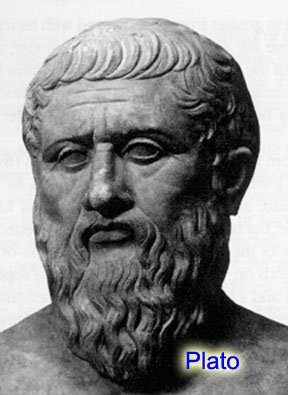
To Plato, the world of nature that we can perceive with our senses is not “reality” at all. Instead, the truest reality can only be found in what Plato called “ideal forms.” These were essentially ideas or concepts that were related to actual, natural objects, but existed in the mind rather than in nature. Who's mind? To Plato, the ideal forms ultimately existed in the mind of a supernatural entity or entities, which he often equated with the Greek gods or with a creator he referred to as the “demiurge”.

Plato's clearest expression of this relationship between natural objects and ideal forms is contained in the Phaedo, which Plato presents as a record of a discussion between Socrates and several of his followers on the day of his execution. In the Phaedo, Socrates (and, by extension, Plato) argues that the natural objects and processes we observe around us are crude reflections of an underlying ideal reality, one that does not exist in the natural world. He argues that most people perceive these ideal forms dimly if at all. However, philosophers should dedicate their lives to identifying these ideal forms or “essences”, and demonstrating their reality to others.

This philosophical worldview has been called essentialism, because it emphasizes the “essences” of things, rather than their differences. Central to this worldview is the idea that such “essences”, including the human soul, are eternal and unchanging. In the Platonic worldview, the most “real” things - the “essences” - cannot be perceived with the senses at all, but only with the mind, imperfect as it might be in any individual person. Whereas, in the worldview of the natural sciences, and especially naturalism, only natural objects and processes that can be either directly sensed or inferred indirectly from sensory observation are assumed to exist - to be “real”.

Notice here, too, the emphasis on the unchanging, eternal quality of the “essences”, as opposed to natural objects and processes. Natural phenomena (i.e. the non-essential) are always changing, but “real” phenomena are not. Here we see the root of the opposition between the evolutionary worldview - one based on continuous change in nature - and the Platonic worldview - one based on unchanging, timeless, and universal “essences”.

The Platonic essentialist worldview largely replaced the earlier Ionian naturalist worldview, partly because of the predominance of Athens and Athenian culture in the ancient Mediterranean world. This replacement had a serious and long-lasting effect on the development of the natural sciences in western culture. This was because Plato didn't restrict his essentialist doctrine to emotional or abstract philosophical ideals as implied in the Phaedo, such as truth, beauty, and the human “soul”. In other dialogues and in his lectures, he applied the concept of “essences” to natural phenomena as well, arguing that all natural phenomena are imperfect representations of “ideal forms” that exist outside of nature. According to Plato, these “ideal forms” are universal and necessarily unchanging and unchangeable.

Plato also argued that the universe formed a complete and harmonious whole, in which any real change could only result in the annihilation of everything. As noted earlier, he also asserted that the ideal forms that participate in this harmony did not arise spontaneously from nature, but rather were originally created by a supernatural entity often translated as the “demiurge”. Plato taught that the demiurge created the universe and the ideal forms with a purpose in mind, and that all things (i.e. all “essences” and their imperfect representations) were therefore the product of a preexisting plan. Finally, Plato argued for the existence of a human soul, which cannot be perceived with the senses at all, but which is the “real essence” of each person.

**********************************************************************************

This is why I have asserted that Darwin's most "dangerous" idea was his recognition of the reality of the variations that exist between individuals in populations. This variation is produced by various genetic processes, including mutation, recombination, and developmental/phenotypic plasticity, and is the source of all evolutionary innovations (i.e. it is the "creative force" in evolution). Natural selection simply weeds out all of the variations that don't work, and preserves the ones that do (which is why Darwin wanted to call this process "natural preservation", but the term "natural selection" had already gotten stuck to the process).

But to Plato (and his most important student, Aristotle) the variations don't matter; it is the "ideal form" of which those variations are only imperfect representations that really matters. That is, the variations aren't "real," and so for almost three centuries they were ignored. Furthermore, since the "ideal forms" are eternal and unchanging, things like species are as well. Indeed, I believe that the concept of biological species can be traced back directly to Plato's "ideal forms," and that this explains much of the resistance to Darwin's theory. In essence, Darwin argued in the Origin of Species that species aren't fixed entities, but rather can change over time. Furthermore, this change is "real," implying that the variant forms upon which such change depends are "real" as well. Darwin doesn't take his ideas to their logical conclusion, however: that "species" are purely figments of the human imagination (especially as trained in Platonic philosophy, as all of us are).

To believe that "species" don't really exist in nature, and that the only "real" entities in biology are individual organisms is pretty radical stuff. Most taxonomists would bristle at the very suggestion. However, this idea has a long and honorable pedigree as well; it is a variety of nominalism, a philosophical position often said to have been founded by William of Ockham (of "Occam's Razor" fame). Nominalism directly challenges the fundamental basis of Platonic philosophy in the same way that darwinism challenges it in biology. In the long run, I believe that the paradigm shift to the darwinian worldview has been and will continue to be the most important one since the founding of Platonic philosophy (and therefore of the dominant position in western philosophy).

--Allen

**********************************************************************************
ORIGINAL PUBLICATION REFERENCE:

Location Online: Darwinian Conservatism
URL: http://darwinianconservatism.blogspot.com/2006/02/leo-strauss-darwinian-natural-right.html

Original posting/publication date timestamp:
Saturday, February 25, 2006

Labels: , , , , , , , ,

Thursday, February 23, 2006

Incommensurate Worldviews


AUTHOR: Allen MacNeill

SOURCE: Original essay

COMMENTARY: That's up to you...

I am beginning to understand more about the differences between the physical sciences (such as astronomy, chemistry, and physics) and the biological sciences, and why the worldview of a physical scientist with a strongly mathematical predilection is apparently so different from mine and that of most other biologists (at least, of those biologists of whom I have personal and/or reputable knowledge). Furthermore, it seems to me that these differences are central to the apparent inability of non-biologists to fully comprehend the "darwinian" worldview upon which much of biology (and all of evolutionary theory) has been constructed (and vice versa, of course).

To me, these appear to be the basic differences that inform our worldviews:

1) CONTINGENCY: The biological sciences (i.e. anatomy & physiology, parts of biochemistry, botany, development & embryology, ecology, ethology, evolution, genetics, marine biology, neurobiology, and the allied subdisciplines), like the "earth sciences" (i.e. atmospheric sciences, geology, etc.) are both contingent and historical. That is, they cannot be derived from "first principles" in the way that algebra, calculus, geometry (both euclidean and non-euclidean), probability, symbolic logic, topology, trigonometry, and other "non-empirical" sciences can be. As both Ernst Mayr and Karl Popper have pointed out, historical contingency is inextricably intertwined with biological causation, in a way that it is not in mathematics and the physical sciences. This would appear to be true, by the way, for both "darwinist" and ID models of biological evolution and the fields derived from them. Indeed, even the Judeo-Christian-Muslim worldview is contingent and historical, in ways antithetical to both mathematics and pre-"big bang" cosmological physics.

2) UNIVERSALITY: The biological sciences are also not "universal" in the way that chemistry and physics are. We assume that the processes described by physical "laws" are universal and ahistorical. that is, we assume that they are the same regardless of where, when, and by whom they are investigated. Furthermore, it is tacitly assumed by physical scientists that the "laws" they discover apply everywhere and everywhen, without empirical verification that this is, in fact, the case. It seems to me that this assumption is reinforced by the mathematical precision with which physical processes can be analyzed and described.

By contrast, the entities and processes studied by biologists are necessarily "messy" and often "non-quantifiable," in the sense that they cannot be entirely reduced to purely mathematical abstractions. The great beauty and elegance of Newton's physics and Pauling's chemistry are that the objects and processes they describe can be so reduced, and when they are, they reveal an underlying mathematical regularity, a regularity so precise and so elegant that one is tempted to believe that the mathematical formalism is what is "real" and the physical entities and processes that they describe are, at best, somewhat imperfect expressions of the underlying perfect regularities.

To me, however, what has always been appealing about biology is its very "messiness." As the so-called Law of Experimental Psychology states "Under carefully controlled conditions, the organism does whatever it damn well pleases." Biological entities and processes are not quantifiable in the same way that physical ones are. This is probably due to the immensely greater complexity of biological entities and processes, in which causal mechanisms are tangled and often auto-catalytic.

3) STOCHASTICITY: The biological sciences are irreducibly statistical/stochastic, in ways that neither the physical nor mathematical sciences generally are (although they are becoming moreso as they intrude deeper into biology). R. A. Fisher was not only the premier mathematical modeler of evolution, he was also the founder of modern statistical biometry. This is no accident: both field and laboratory biology (but not 19th century natural history) depend almost completely on statistical analysis. Again, this is probably because the underlying causes for biological processes are so multifarious and intertwined.

Physicists, chemists, and astronomers can accept hypotheses at confidence levels that biologists can never aspire to. Indeed, until recently the whole idea of "confidence levels" was generally outside the vocabulary of the physical sciences. When you repeatedly drop a rock and measure its acceleration, the measurements you get are so precise and fit so well with Newton's descriptive formalism that the idea that one would necessarily need to statistically verify that they do not depart significantly from predictions derived from that formalism seems superfluous. Slight deviations from the predicted behavior of non-living falling objects are considered to be just that: deviations (and most likely the result of observer error, rather than actual deviant causation). Rarely does any physical scientist look at such deviations as indicative of some new, perhaps deeper formalism (but consider, of course, Einstein's explanation of the precession of the orbit of Mercury, which did not fit Newton's predictions).

4) FORMALIZATION: There are many processes in biology, and especially in organismal (i.e. "skin out" biology) that are so resistant to quantification or mathematical formalization that there is the nagging suspicion that they cannot in principle be so quantified or formalized. It is, of course, logically impossible to "prove" a negative assertion like this - after all, our inability to produce a Seldonian "psychohistory" that perfectly formalizes and therefore predicts animal (and human) behavior could simply be the result of a deficiency in our mathematics or our ability to measure and separately analyze all causative factors.

However, my own experience as a field and laboratory biologist (I used to study field voles - Microtus pennsylvanicus - and now I study people) has instilled in me what could be called "Haldane's Suspicion:" that biology "is not only queerer than we imagine, but queerer than we can imagine." That is, given the complexity and interlocking nature of biological causation, it may be literally impossible to convert biology into a mathematically formal science like astronomy, chemistry, or physics.

But that's one of the main reasons I love biology so much. Mathematical formalisms, to me, may be elegant, but they are also sterile. The more perfect the formalism, the more boring and unproductive it seems to me. The physicists' quest for a single unifying "law of everything" is apparently very exciting to people who are enamored of mathematical formalism for its own sake. But to me, it is the very multifariousness – one could even say "cussedness" – of biological organisms and processes that makes them interesting to me. That biology may not have a single, mathematical "grand unifying theory" (yes, evolution isn't it ;-)) means to me that there will always be a place for people like me, who marvel at the individuality, peculiarity, and outright weirdness of life and living things.

5) PLATONIC VS. DARWINIAN WORLDVIEWS: It seems to me that many ID theorists come at science from what could be called a "platonic" approach. That is, a philosophical approach that assumes a priori that platonic "ideal forms" exist and are the basis for all natural forms and processes. To a person with this worldview, mathematics are the most "perfect" of the sciences, as they literally deal only with platonic ideal forms. Astronomy, chemistry, and physics are only slightly less "prefect," as the objects and processes they describe can be reduced to purely mathematical formalisms (without stochastic elements, at least at the macroscopic level), and when they are so reduced, the predictive precision of such formalisms increases, rather than decreases.

By contrast, I come at science from what could be called a "darwinian" approach. Darwin's most revolutionary (and subversive) idea was not natural selection. Indeed, the idea had already been suggested by Edward Blythe. Rather, Darwin's most "dangerous" idea was that the variations between individual organisms (and, by extension, between different biological events) were irreducibly "real." As Ernst Mayr has pointed out, this kind of "population thinking" fundamentally violates platonic idealism, and therefore represents a revolutionary break with mainstream western philosophical traditions.

I am and have always been partial to the "individualist" philosophical stance represented by darwinian variation. It informs everything I think about reality, from the idea that every individual living organism is irreducibly unique to the idea that my life (and, by extension, everybody else's) is irreducibly unique (and non-replicible). Such a philosophical position might seem to lead to a kind of radical "loneliness," and indeed there have been times when that was the case for me. But since all of us are equal in our "aloneness," it paradoxically becomes one of the things we universally share.

And so, I don't think a "darwinian worldview" applies to the physical sciences (and certainly does not apply to non-empirical sciences, such as mathematics), for the reasons I have detailed above. In particular, it seems clear to me that although it may be possible to mathematically model microevolutionary processes (as R. A. Fisher and J. B. S. Haldane first did back in the early 20th century), it is almost certainly impossible to mathematically model macroevolutionary processes. The reason for this impossibility is that macroevolutionary processes are necessarily contingent on non-repeatable (i.e. "historical") events, such as asteroid collisions, volcanic eruptions, sea level alterations, and other large-scale ecological changes, plus the occurrence (or non-occurrence) of particular (and especially major) genetic changes in evolving phylogenies. While it may be possible to model what happens after such an event (e.g. adaptive radiation), the interactions between events such as these are fundamentally unpredictable, and therefore cannot be incorporated in prospective mathematical models of macroevolutionary changes.

It's like that famous cartoon by Sidney Harris: "Then a miracle occurs..." The kinds of events that are often correlated with major macroevolutionary changes (such as mass extinctions and subsequent adaptive radiations) are like miracles, in that they are unpredictable and unrepeatable, and therefore can't be integrated into mathematical models that require monotonically changing dynamical systems (like newtonian mechanics, for example).

So, to sum up, I believe that the "darwinian worldview" applies only to those natural sciences that are both contingent and intrinsically historical, such as biology, geology, and parts of astrophysics/cosmology. Does this make such sciences less "valid" than the non-historical (i.e. physical) sciences? Not at all; given that physical laws now appear to critically depend on historical/unrepeatable events such as the "big bang," it may turn out to be the other way around. In the long run, even the physical sciences may have to be reinterpreted as depending on contingent/historical events, leaving the non-empirical sciences (mathematics and metaphysics) as the only "universal" (i.e. non-contingent/ahistorical) sciences.

To summarize it in a bullet point:

• Platonic/physical scientists describe reality with equations, whereas darwinian/biological scientists describe reality with narratives.

--Allen

P.S. Alert readers may recognize some of the hallmarks of the so-called Apollonian vs. Dionysian dichotomy in the preceding analysis. That such characteristics are recognizable in my analysis is not necessarily an accident.

P.P.S. It is also very important to keep in mind, when considering any analysis of this sort, that sweeping generalizations are always wrong ;-)

Labels: , , , , , , , , , , , ,