Tuesday, June 13, 2006

Are Adaptations "Real?"


AUTHOR: Allen MacNeill

SOURCE: Original essay

COMMENTARY: That's up to you...

In an ongoing thread at Design Paradigm, Salvador Cordova wrote:

“There are many designed features in biology that make no sense in terms of natural selection but make complete sense in terms of design.”


This statement demonstrates a profound misunderstanding of both the concept of “design” and of “natural selection,” a misunderstanding which lies at the heart of the evolution/design debate. What is “design” anyway? Note that I’m not asking the question that Dr. Dembski thought he was answering, i.e. how can we tell if something has been designed. Before one can even ask that question (much less attempt to answer it), one must first agree on what “design” is.

This is not a trivial problem. Michael Ruse, in Darwin and Design: Does Evolution Have a Purpose?, asserts that one of the most important contributions of Darwin’s theory was that it put “design” back into nature (from which it had been removed by the “Newtonians”). To Ruse, “design” is essentially equivalent to “adaptation,” in that adaptations “solve” problems of biological function.

But the problem here is one that Lewontin and Gould addressed almost 30 years ago in their landmark paper “The Spandrels of San Marco...”. Lewontin and Gould pointed out two things: (1) not all of the characteristics of living organisms are adaptations (i.e. some of them are the result of pure “chance,” not necessity), and (2) even the characteristics that are clearly adaptive don’t have to have arisen because they are adaptive, nor will they continue to exist for the same reason. They coined the term “exaptation” to refer to characteristics of organisms that are not necessarily adaptive, but which nonetheless are biologically significant.

I would go much further than Lewontin and Gould: just as Darwin suggested (but did not come right out and say) that there are no such things as “species” (see "Origin of the Specious" in this blog), I believe that in nature there are no such things as “adaptations,” at least not insofar as such "adaptations" are "solutions" to biological "problems." That is, although there are characteristics of organisms that are correlated with relatively high reproductive success (and would therefore be considered by most evolutionary biologists to qualify as “adaptations”), it becomes problematic to decide exactly which of those characteristics are the “real” adaptations and which are merely “accidental.” Indeed, if one is serious about the variation/inheritance/fecundity/differential reproductive success model of evolution (i.e. the genuine article, not the RM+NS straw-man attacked by most IDers), then all of the characteristics of living organisms are “accidental” insofar as their origin cannot be shown to have been “intended” or “pre-destined” ahead of time.

Here is the real crux of the disagreement, as PvM has pointed out: what qualifies as an “adaptation” in biology can only be determined retrospectively, insofar as it has the practical result of causing increased relative survival and reproduction. No characteristics of living organisms can be shown to have come into being because they would eventually have that result; indeed, I would assert that to even make this claim is non-sensical in the extreme. What characteristics of living organisms currently alive will eventually result in their assendance or demise? We have absolutely no way of knowing, nor even of imagining a way of knowing. At some point in the future, we can look back and say “son-of-a-gun, those funny looking scales are correlated with increased survival and reproduction because they allow the animals that have them to fly, and therefore escape predators and capture prey more effectively,” but until this actually happens (and absolutely nothing in nature guarantees that it will), we can’t make any statements about the “value” of any of the characteristics of organisms now living.

This, rather than the rather vapid speculations Salvador cited for the future of genetic engineering, is the real value of genetic engineering to evolutionary biology (and vise versa). We now have the ability to selectively delete individual characteristics from many different organisms. This makes possible something that natural selection does not: the precise determination of the selective “value” of particular characteristics. This has already been done, and the surprising outcome has been that even some gene sequences that were thought to have been very important in selection (due to having been “conserved” over deep evolutionary time) are apparently insiginificant or even useless. We know this because knocking them out of the genome has no discernible effect on the survival or reproduction of the “knock-out” progeny. If one is the kind of “pan-adaptationist” that Lewontin and Gould criticized, this outcome should come as a severe shock, as it should to every IDer. But, if one is a true “Darwinian” (i.e. a devotee to that tradition which questions absolutely all assumptions, including the very existence of “adaptations” and “species”), it should come as no surprise at all.

--Allen

REFERENCES CITED:

Gould, S. J. and Lewontin, R. C. (1974) "The Spandrels of San Marco and the Panglossian Paradigm: A Critique Of The Adaptationist Programme" Proceedings Of The Royal Society of London, Series B, Vol. 205, No. 1161, pp. 581-598.

Labels: , , , , ,

Tuesday, April 11, 2006

Polygamy, De Facto and De Jure


AUTHOR: Charles Krauthammer
SOURCE: Pandora and Polygamy

AUTHOR: Jonathan Rauch
SOURCE: One Man, Many Wives, Big Problems

COMMENTARY: Allen MacNeill

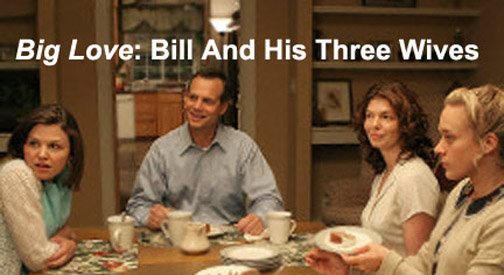
Polygamy has suddenly entered the national consciousness, thanks to HBO's new series, Big Love. We don't have television at my house, so I haven't seen it, but the national news websites have been all over it, and generally gushing with praise. For example, the New York Times recently ran a preview of Big Love , in which the reviewer made generally positive comments about the series.

Now the reaction is setting in. Charles Krauthammer, national columnist for the Washington Post, has a column in which he makes the following comment:

What is historically odd is that as gay marriage is gaining acceptance, the resistance to polygamy is much more powerful. Yet until this generation, gay marriage had been sanctioned by no society that we know of, anywhere at any time in history. On the other hand, polygamy was sanctioned, indeed common, in large parts of the world through large swaths of history, most notably the biblical Middle East and through much of the Islamic world.


Generally a very conservative columnist, Krauthammer's column is surprisingly non-judgmental about the series and the growing social movement for the legalization of polygamy that it reflects. Krauthammer's logic is, in my opinion, difficult to dispute:

I'm not one of those who see gay marriage or polygamy as a threat to, or assault on, traditional marriage. The assault came from within. Marriage has needed no help in managing its own long, slow suicide, thank you. Astronomical rates of divorce and of single parenthood (the deliberate creation of fatherless families) existed before there was a single gay marriage or any talk of sanctioning polygamy. The minting of these new forms of marriage is a symptom of our culture's contemporary radical individualism -- as is the decline of traditional marriage -- and not its cause.


And he's right. As I have often told my students (and usually very much to their consternation), polygyny is the accepted social norm in somewhere around 85% of all known human cultures, according to the Human Relations Area Files. Now, polygyny is what most people mistake for polygamy: that is, one male with more than one female. Polygamy simply means having more than one mate, regardless of sex. There is also polyandry, in which a female has more than one male mate, and polygynandry, in which more than one female mate with more than one male. During the past few decades, ethologists have had to become a lot more careful about how they use these terms. in particular, they now distinguish between reproductive polygamy, in which one individual mates with and produces genetically identifiable offspring with more than one mate, and social polygamy, in which the reproductively polygamous individual is behaviorally associated for extended lengths of time with each of her/his mates.

This distinction is necessary because both females and males in what appear to be monogamous relationships are, when the DNA of their offspring is tested, reproductively polygamous. The phenomenon that produces this pattern of behavior is called "extra-pair matings", and is ubiquitous among vertebrates (especially birds and mammals) and may be the overwhelmingly predominant pattern in all animals previously considered to be "monogamous." Both females and males engage in "extra-pair matings", although for somewhat different evolutionary reasons (more on this in a later post).

Which leads me to another article posted in reaction to the debut of Big Love. This one, by Jonathan Rauch, is much more negative in its evaluation of the HBO series and the social movement it reflects:

The social dynamics of zero-sum marriage are ugly. In a polygamous world, boys could no longer grow up taking marriage for granted. Many would instead see marriage as a trophy in a sometimes brutal competition for wives. Losers would understandably burn with resentment, and most young men, even those who eventually won, would fear losing. Although much has been said about polygamy's inegalitarian implications for women who share a husband, the greater victims of inequality would be men who never become husbands.


By this point it should be obvious that polygamy is, structurally and socially, the opposite of same-sex marriage, not its equivalent. Same-sex marriage stabilizes individuals, couples, communities, and society by extending marriage to many who now lack it. Polygamy destabilizes individuals, couples, communities, and society by withdrawing marriage from many who now have it.


Here is where I believe "full disclosure" is necessary, and where Rauch has been less than forthright. As this link indicates, Rauch is a gay activist whose most recent book, Gay Marriage: Why It Is Good For Gays, Good For Straights, And Good For America is a closely argued political endorsement of gay marriage from the standpoint of a gay man. His diatribe against polygamy is not so much motivated by a concern for the institution of marriage, but rather for the fact that polygamy is usually lumped together with gay marriage as "things not to be borne" by conservatives (but not, apparently, by Krauthammer). Gay activists see their hopes for legalization of gay marriage being undermined by the movement to legalize polygamy.

Which gets me to the real topic of this post. In the real world, both gay marriage and polygamy are already widespread, with or without legal recognition. Indeed, the latter is the norm in America, and probably the rest of the world as well.

Yep, you read that right: polygamy is the numerical norm, not the behavior of some religious nutcases in Utah. How can I say this? Because I've been collecting data on the subject for almost three decades. What Americans and many other people around the world call their marriage system is monogamy. However, in reality it is serial monogamy; that is, most people are married to more than one person during their lifetime, but in series rather than simultaneously. Serial monogamy is the predominant form of marriage in the United States, and has been for several decades.

What my research has indicated is that serial monogamy isn't monogamy at all; as I tell my students, "if it's 'serial', it may be breakfast food, but it sure ain't monogamy." From the standpoint of reproductive success (the ultimate criterion for evolution by natural selection), having offspring with more than one mate is polygamy, regardless of whether one has them in sequence or simultaneously. What my research has shown so far is that approximately half of all of the people in my study cohort have been divorced at least once (with slightly more females than males being divorced):


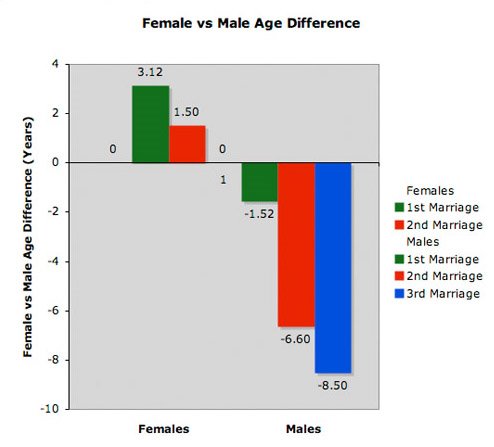
Among those who have divorced, there is a striking asymmetry between the ages and reproductive successes of females and males. That is, males remarry approximately twice as often as females, and have significantly more children than females who do not remarry. Furthermore, the average age difference between females and males decreases in females with second marriages (from about three years to a year and a half), whereas the age differences between females and males increases dramatically in males with second and subsequent marriages (from about a year and a half to greater than eight years):


in other words, when females remarry (which they do much less often than males), they marry a male closer to their age than their first husband. By contrast, when males remarry, (which they do several times, according to my study), they marry a female significantly younger than they are, and this difference increases with each subsequent marriage.

More interesting still is the differences in the number of children per individual:


Females have an average of 1.74 offspring with their first husbands, but only 0.03 with their second (in my study, the number of females marrying more than twice was too small to include in the sample). By contrast, males who have 1.73 offspring with their first wives, have 0.30 offspring with their second wives (i.e. ten times as many), and 0.03 offspring with their third wives (again, the number of males marrying more than three times was too small to include in my study).

What does all this mean? If one considers cumulative numbers of offspring, it means that males who divorce and remarry have almost twice the overall reproductive success of females who do so:


This asymmetry is striking, and argues very strongly for a biologically based cause for the differences in mating patterns in females and males.

I should hasten to add that I haven't submitted the results of this study for publication yet. One problem with it as it currently stands is that the sample size (less than 300 individuals so far) isn't large enough to draw definite conclusions about American society as a whole. Furthermore, as several people who have seen the data have pointed out, my figures seriously underestimate the degree to which such asymmetries may actually exist. The reason for this underestimate is that (for practical reasons having to do mostly with ease of data collection) I have limited my analysis to legal marriages and divorces. As most people are aware, the frequency of cohabitation in the United States is very large and still growing. If I were to include "extra-legal relationships" and breakups, and include the data from those that result in the production of offspring, I'm fairly confident that the patterns I've found so far would be even more significant.

So, what are we to conclude from all this? Several things:
• The "undermining" of traditional marriage has been done by married people, not gays nor polygamists
• The average person in America is already a de facto polygamist
• The political movement to legalize polygamy, like the movement to legalize gay marriage, will continue to grow as more and more people realize the logic of the movement and its application to their own lives

It is clear to me that we will not return to the "golden age" of traditional heterosexual monogamy, not as long as people are allowed to live their lives in private without excessive governmental interference. Somewhere around the turn of the 20th century something changed in American life, something that set in motion the transition through which we are currently passing. That transition accelerated following the two world wars of the 20th century, and shows every sign of accelerating today. That we will eventually reach some new equilibrium in these behaviors is virtually certain. What that new equilibrium will be is anybody's guess.

Labels: , , , , ,