Thursday, February 26, 2009

"Did Anyone Observe the Origin of Eukaryotes?"


AUTHOR: Allen MacNeill

SOURCE: Original essay

COMMENTARY: That's up to you...

A creationist asked the following pretty typical question on another blog:
"Have prokaryotes ever been observed become eukaryotes via endosymbiosis?" [sic]

If by "observed", one means directly observed, then of course the answer is "no". As far as we can tell, this probably happened more than a billion years ago. But if only things that have been directly observed are valid, then virtually all of science, if not almost all human intellectual endeavors, are invalid and pointless.

Did anyone alive today "observe" the decline and fall of the Roman empire? Of course not. So, how do we know it happened? We read about it, or were told about it. We might also have directly observed some ruins in Rome or elsewhere in Europe or Asia Minor, and made some inferences about where they came from and how old they are.


But if direct observation is necessary to validate an assertion, then each of us is trapped in a tiny world whose borders are the limits of our own unaided perceptual apparatus. Not even most forms of logic would survive such an absurd and self-destructive limitation.

However, if one allows for indirect observation and logical inference, then the answer is "yes". There are multiple sources of empirical evidence for the assertion that eukaryotic cells arose as the result of the serial endosymbiosis of several prokaryotic ancestors. You can read a summary of this evidence here (scroll down; it's toward the end of the article).

Furthermore, this inference is made using the most reliable (i.e. "strongest") form of logical inference known to us: consilience. There are multiple, independently discovered and derived lines of empirical evidence pointing to the serially endosymbiotic origin of eukaryotic cells. That is, the evidence for the serial endosymbiosis theory is based on consilience, which is much more reliable that induction, deduction, or even abduction alone.

As in any case having to do with a very complex universe, there are "gaps" in our current model of the serial endosymbiotic origin of eukaryotes. There is also empirical evidence that is not entirely consistent with the model as it now stands. However, as more and more empirical evidence has been discovered, the vast majority of it has supported Lynn Margulis' original theory.

So, which method of validation shall we choose? Shall we voluntarily blind ourselves to the only kind of evidence that can validate things that have happened outside of our immediate perceptual environment, or accept what virtually all thinking people accept – that we must, almost everywhere and at almost all times, accept the validity of empirical evidence that we have not ourselves immediately obtained?

As always, comments, criticisms, and suggestions are warmly welcomed!

--Allen

Labels: , , , , , , , ,

Sunday, January 18, 2009

Martian Rocks and Intelligent Design


AUTHOR: Allen MacNeill

SOURCE: Original essay

COMMENTARY: That's up to you...

Take a good, long look at the photograph at the top of this post (it's from NASA). Does anything about it strike you as odd? Go ahead, I'll wait...

For example, do the rocks in the photograph appear to be simply "randomly" scattered about? How about size; are there patterns in the distribution of the different sizes of rocks in the photo? And how about placement - are any of the rocks in lines, or do they show similar orientation of edges, do any of them have a coating of dust or sand on them, and are any of them stacked on top of each other (or even overlapping)?

Hmm...the more you look at this picture, the less it looks like a random and unrelated collection of objects (that is, rocks). Indeed, it looks as if someone (perhaps Someone "intelligent" with a lot of time on His hands) spent no small amount of time arranging them (after all, such arrangements apparently cover a significant fraction of the surface of the planet Mars).

It's observations like these that lead some "intelligent design theorists" (IDTs) to infer the existence and active interference in natural processes of an "intelligent designer". A significant subset of IDTs go on to infer that this "intelligent designer" is the God of the Judeo-Christian-Muslim-Mormon faith(s). In so doing, they are following the lead of the founder of the neo-Palean "intelligent design and natural theology" movement, the Anglican minister Rev. William Paley. True, what we see in the photograph is rocks, not Rev. Paley's pocketwatch, and that's the windswept plains of Mars, not a windswept heath on Earth, but "design is design" and all design points to the existence of a "designer", right?

Furthermore, many IDTs use a very familiar mode of argument in asserting the existence of "intelligent design". We could call this mode of argument the "duck" argument, as in the old saw "if it looks like a duck, flies like a duck, and quacks like a duck, it's a duck".

What's the operative word here? The word like, of course, which is the tipoff that what is being marshaled is an "argument by analogy".

I have already written about the weaknesses of arguments by analogy (see here, here, and here). Most recently, I pointed out in a critique of a recent blogpost by Dr. Steven Fuller, that arguments by analogy are extremely weak: they lack almost all logical force. Dr. Fuller replied that what IDTs (including himself) use are not, in fact, arguments by analogy. Instead, he argued that what they (and he) were pointing out were "partial identities". That is, a pattern of rocks like the one in the photograph is "partially identical" to, say, a flagstone patio set in place by a "designer" having access to large amounts of dust and sand, but only a few, small rocks.

What, precisely, does the phrase "partial identity" mean? Is it something like being "partially pregnant" or "partially dead"? Or does it mean "only partly identical"? I thought that "identical" meant "identical". That is:
Two things that are identical are the very same in each and every possible way.

Isn't a thing that is "partially identical" to some other thing also "like" that thing? Seems so to me. Indeed, the phrases "partially identical"and "partial identity" seem to me to be oxymorons, plain and simple.

To be as precise as possible:
"Partial identity" is identical to "analogy"

Ergo, Dr. Fuller apparently agrees with me that ID arguments are essentially "arguments by analogy" and therefore have virtually no logical force.

But, to get back to the curious behavior of the rocks on Mars...what's that, you say? The "behavior" of the rocks? Can it be that the rocks are "behaving"?

Indeed, they are. After long and patient analysis, it has become clear that the rocks on Mars (at least the ones in the size range shown in the photograph) "behave". To be specific, they move around on the dusty/sandy surface of the Martian plains.

Furthermore, their movement is not random. On the contrary, there is a very precise pattern to it. The rocks shown in the photograph actually move against the wind, and away from each other. The latter pattern of movement is why they appear to be non-randomly placed on the surface of the Martian plain. Furthermore, they move apart at a rate that is apparently related to their size. Small rocks move apart further and faster than large rocks (very large rocks apparently don't move much at all).

In the parlance of "intelligent design theory", something that acts non-randomly in such a way as to produce non-random patterns of activity is an "agent". Furthermore, according to IDTs, agents are "intelligent" by definition. If it moves like an agent, arranges itself like an agent, and produces patterns that are "partially identical"/analogous to patterns produced by an agent, it's an agent.

Ergo, the rocks in the photograph are either agents, or have been arranged by agents.

Or not.

Here's another explanation for the arrangement of the rocks on Mars:

Wind removes loose sand in front of the rocks, creating pits there and depositing that sand behind the rocks, creating mounds. The rocks then roll forward into the pits, moving into the wind. As long as the wind continues to blow, the process is repeated and the rocks move forward.

The rocks protect the tiny sand mounds from wind erosion. Those piles of sand, in turn, keep the rocks from being pushed downwind and from bunching up with one another....

The process is nearly the same with a cluster of rocks. However, with a cluster of rocks, those in the front of the group shield their counterparts in the middle or on the edges from the wind...

Because the middle and outer rocks are not directly hit by the wind, the wind creates pits to the sides of those rocks. And so, instead of rolling forward, the rocks roll to the side, not directly into the wind, and the cluster begins to spread out.


In other words, the pattern of rocks shown in the photograph is the result of purely natural forces and the explanation presented above is a "naturalistic" explanation.

There is, of course, an essentially infinite number of imaginable explanations for the arrangement of the rocks in the photo. They could have been arranged by an invisible "agent" who prefers rocks to be "organized". They could have been arranged during the creation of Mars (which, of course, happened on 23 October 4004 BC, along with the creation of all of the other planets, asteroids, comets, planetismals, bolides, etc.). They could have been placed by little green men or hexapedal strongly-thewed Barsoomians, taking a break between sword fights. The list of possibilities is quite literally endless.

However, the scientific consensus is that the "naturalistic" explanation in the block quote above is most consistent with observations and with an assumption that natural processes alone are sufficient to explain them. "Agents" may be involved, and so may Barsoomians, but neither are necessary to explain the arrangement and behavior of the Martian rocks, and so they are not included in a scientific explanation of such arrangement and behavior.

The same is the case for biological organisms and the explanation for their existence: the theory of evolution by natural selection. All of the explanations listed above, including not only wind erosion and "intelligent rock placement", but also tiddly-winking six-armed green warriors (and obsessive-compulsive demiurges), are consistent with the pattern shown in the photograph. However, only the scientific explanation contained in the block quote is also consistent with the universal assumption underlying all of the natural sciences: that only natural forces by invoked to explain observed patterns in natural objects and processes, until such forces are shown to be insufficient to explain such things.

It should also go without saying that, if one is in favor of explaining the arrangement and behavior of Martian rocks in the incredibly limited environment of science classes in the public schools, rather than going into all of the imaginable explanations (including Tars Tarkas and Jaweh Elohim), one should stick to the explanation(s) worked out by practicing professional scientists, and confine the other explanations to classes intended for the non-empirical speculations of amateur philosophers and theologians (or am I being redundantly redundant?)

P.S. To Dr. Fuller: contrary to your aspersion, I am not a "closet theistic evolutionist" — like Newton, "I make no hypotheses!" Unlike Newton, I am an anarchist Heinlein-libertarian Zen Quaker evolutionary psychologist who prefers not to be labeled.

As always, comments, criticisms, and suggestions are warmly welcomed!

--Allen

Labels: , , , , , , , ,

Wednesday, June 28, 2006

Inference and the Boundaries of Science


AUTHOR: Hannah Maxson

SOURCE: Evolution and Design

COMMENTARY: Allen MacNeill

The now-notorious Cornell "evolution and design seminar" met for the first time last night, and in my opinion our first meeting was a rousing success. As I had hoped, the participants began to make their opinions and positions known (despite my blathering), and a good time was had by all. We're getting ready to analyze Richard Dawkins' arguments in The Blind Watchmaker, discussion of which will be facilitated by Will Provine (one of our faculty participants).For a brief taste of how things went last night, you should check out the course blog. Here's a sample:

Hannah Maxson (founder of the Cornell IDEA Club) wrote:

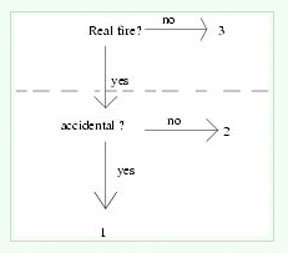
In class last night Allen went over inference and his views of the boundaries of science. He gave us the example of an individual coming upon the remains of what appeared to have been a house fire in the past. Without any prior knowledge of the event or eyewitnesses to question, one might infer any of three things (see diagram, above):

1) accidental house fire
2) arson: purposeful house fire
3) no fire at all; setup job (for film, etc.)

A tentative explanatory filter with which to distinguish between those three causes. But he suggested there is a problem from the very beginning. The first question– was this a real fire, or a setup job? can never be definitely answered. Considering a very powerful film crew, for instance, the setup would look almost like a real fire. Extrapolating slightly, given an omnipotent “designer”, could the scene not be exactly the same as what one would expect from a housefire?

Because there is no way of giving a definite answer based on empirical evidence– to which we, as scientists, are limited– we must throw out that whole node on our explanatory filter. Everything above the dotted line, at least, is outside our realm of knowledge.

I had a quarrel with much of this reasoning, though to begin with I ought to make a strong disclaimer that I’m not at all interested in defending “setup jobs”– I think they are highly uninteresting, for one thing, and not worth spending time in. But a “right” or at least convenient answer doesn’t make the logic that goes into an argument sound.

First, can we throw a question out of the realm of science because we will never be able to get a definite answer? Scarcely anything in science will ever be proved or disproved. In general, we don’t look for certain proofs, but simply for empirical evidence that might favor one or the other, so that we can make an inference to the best explanation. If the evidence is not clear, we often make choices based on conventions, such as parsimony.

If we cannot throw it out for lack of a definite answer, can we at least throw out that node for lack of empirical evidence either way? It is true that if the scene was designed (omnipotently) so that there was absolutely no evidence there had been no real fire, science could do nothing with the question. But we cannot assume a priori that all “setup jobs” have no emperical evidence available; there are a great many other possibilities besides an omnipotent designer who works to make things exactly the same. Consider, for example Einstein’s view: “Nature hides her secrets because of her essential loftiness, but not by means of ruse.”; or in another remark: “God is slick, but he ain’t mean.”

So while we can do away with a “absolutely perfect imitation” possibility as an option that could never have any emperical grounds, that is not justification for demarcating the entire first node out of our field of inquiry. In any research project you learn quickly that things are not always as they first appear. What seems on first analysis to be the remains of a fire may turn out on further investigation to hold evidence of a set-up job. What appears to have been designed may in fact be the product of chance and necessity, and what we are used to thinking of as the products of unguided evolution may contain evidence of purposeful design.

Refusing to consider questions is never good practice; we may reject explanations for lack of warrant, but ought never reject the investigation a priori.


To which I replied:

Thanks, Hannah, for the diagram (it’s clearer than mine was last night) and for your analysis, above. However, I still stand by my position that, given a sufficiently powerful “designer,” a house fire (or anything else) can be simulated to such a degree (as Warren [Warren Allman, director of the Paleontological Research Institute and Museum of the Earth here in Ithaca] said, “right down to the subatomic particles) that there would be absolutely no way to distinguish between such a creation ex nihilo and the real thing.

That is, no amount of empirical evidence could make it possible to get past the first branch point in the explanatory filter in the diagram. Indeed, every piece of empirical evidence one could add would simply amplify one’s assertion of the hypothesis of the Designer’s omnipotence (”Amazing, S/He/It can f/make things right down to the quarks!”). For this reason, rather than agonize over our inability to get past the first branch point in the filter via empirical means, we simply agree to skip that step and move down to the second branch point.

I believe that this “agreement” is something with which most ID supporters would concur, as it gets us out of an empirically insoluble dilemma, and moves us along to the question of accident vs design. Darwin did essentially the same thing in the Origin of Species, by bringing in “the Creator” only at the very end, and by relegating Her/Him/It to setting the whole system in motion in the beginning. Having spent many years reading Darwin’s personal writings (correspondence mostly, but also some of the expurgated sections of his autobiography), it appears to me that Darwin became a Deist about the time he wrote the Origin (or in the process of doing so, which took two decades), but then slowly realized that Deism is essentially equivalent to agnosticism/atheism, as the Deity of Deism plays no part in the actual universe at all, beyond setting up the natural laws that govern it. I find myself in the same situation: assuming that the Deity of Deism exists gets one absolutely nowhere at all in science, and so (like most other scientists), I simply don’t go there anymore.


And now I would go further; while it is a good idea to "not reject explanations for lack of warrant, bu never reject the investigation a priori", the point I was trying to make in my reply was that if one can't get by the first branch point in the "explanatory filter" I posited during the discussion, then we can't really do science at all. Furthermore, agreeing that the remains of what looks like a house fire could have been created ex nihilo by a sufficiently powerful entity gets us absolutely nowhere in terms of explaining the origin of the wreckage. In fact, it forestalls the possibility of any kind of empirically verifiable (or falsifiable) hypothesis, and is therefore a "science stopper" of the first order.

--Allen

Labels: , , , , , , , , , ,