Wednesday, April 22, 2009

Why Intelligent Design Supporters Insist That ID Must Be True


It has taken me a very long while, but I think I finally understand why Intelligent Design (ID) exists, why websites like Uncommon Descent exist, and why the regular commentators who support ID at those websites are so determined to assert the absolute reality of ID, in spite of a complete lack of empirical evidence.

It’s all right here in this quote about the ultimate justification for morality:
“Of course [the validity of an objective moral code] is all dependent upon the truth of the existence of God and the truthfulness of scripture - most of us here are aware of that.”

I believe that this is the crux of the whole science versus ID debate: if there is no empirical evidence for the existence of God, then it all comes down entirely to pure, unsupported supposition. Yes, one can assert that God exists, and can assert that therefore whatever God asserts must, by definition, be the absolute objective truth, but by the standards of scientific logic (which are now almost universally accepted as providing the most reliable evidence for descriptions of reality), arguments based purely and solely on assertion are no longer considered valid.

Ergo, without some independent source of evidence – independent of the original assertion, that is – then it all comes down to dueling assertions, which means that eventually it all comes down to force majeure: whoever can make the most forceful assertion gets to define the Truth.

Therefore, there must be some kind of empirical evidence for the existence of God. The fact that no one has ever found any is completely irrelevant, and will remain so indefinitely. It also explains why it is perfectly legitimate to deliberately distort, misinterpret, omit, or otherwise alter empirical evidence if it does not support the otherwise unsupportable assertion that God exists. [1]

Here is the way it looks to me:

Condition #1:

• If a moral code is not objective, it is ipso facto invalid.

• The moral code asserted by God is the only objective moral code. [2]

• If God does not exist, then there is no basis for the assertion that there is an objective moral code.

• Therefore, if God does not exist, anything is permitted.

Condition #2:

• An argument supported purely by assertion(s) is invalid. [3]

• Ever since Francis Bacon’s Novum Organum, it has generally been considered necessary that there should be empirical evidence (either direct or indirect) in support of arguments.

• Ergo, there must be empirical evidence in support of the assertion that God exists. Otherwise, there can be no objective morals, and therefore anything is permitted.

Conclusion:

Since God must exist (otherwise there are no morals and anything is permitted), then there must be empirical evidence for His existence. Finding none, it is therefore necessary to pretend that some exists, or to make some up. Otherwise there can be no objective basis for morals, society will necessarily collapse into chaos, and we will all inevitably become insatiable, maniacal, cannibalistic, orgiastic mass murderers, rapists, and thieves.

It also seems to me that this is the reason why ethical philosophers now virtually unanimously agree that ethical prescriptions cannot be derived from statements derived from empirical science (i.e. "ought" cannot be derived from "is"). To do so not only conflates two separate domains of logic (i.e. deductive versus inductive), but also requires that there be empirical evidence for something (i.e. ethical prescriptions) that are not and cannot be justified by empirical analysis (i.e. the workings of nature). Yes, we can use empirical analysis to determine if our ethical prescriptions have brought about the goals which we have decided to pursue, but we cannot use empirical analysis to formulate those goals.

Notes:

[1] Unsupportable on the basis of empirical evidence, that is.

[2] An obvious corollary to this is that each and every one of God’s moral prescriptions is both objective and absolutely True, by definition. Hence the argument that anything God prescribes (such as the massacre of the Canaanites) is morally right, simply by virtue of His saying so.

[3] To be specific, arguments based purely on deductive (i.e. Aristotelian) logic have been largely superseded by arguments based on inductive logic.

************************************************

As always, comments, criticisms, and suggestions are warmly welcomed!

--Allen

Labels: , , , , , ,

Friday, April 18, 2008

Evolution and Ethics: Is Morality Natural?


ANNOUNCEMENT: Seminar in History of Biology

AUTHOR: Allen MacNeill

COMMENTARY: Allen MacNeill

First the announcement, followed by a brief commentary:

I am very excited to announce the following course, to be offered this summer in the six-week summer session at Cornell University:

COURSE LISTING: BioEE 467/B&Soc 447/Hist 415/S&TS 447 Seminar in History of Biology

SEMESTER: Cornell Six-Week Summer Session, 06/24/08 to 07/31/08

COURSE TITLE: Evolution and Ethics: Is Morality Natural?

COURSE INSTRUCTOR: Allen MacNeill, Senior Lecturer in Ecology & Evolutionary Biology, Cornell University

COURSE DESCRIPTION: This seminar addresses, in historical perspective, controversies about the cultural, philosophical, and scientific implications of evolutionary biology. Discussions focus upon questions about gods, free will, foundations for ethics, meaning in life, and life after death. Readings range from Charles Darwin to the present (see reading list, below).

In 1871, Charles Darwin wrote in The Descent of Man "…the first foundation of the moral sense lies in the social instincts…and these instincts no doubt were primarily gained…through natural selection.” A century later, Edward O. Wilson, in
Sociobiology: The New Synthesis
, wrote “The biologist…realizes that self-knowledge is constrained and shaped by…natural selection. This simple statement must be pursued to explain ethics and ethical philosophers….”

And so it has: in the past few years the publication of hypotheses for the evolution of ethics and “the moral sense” has become an explosive growth industry and a hot topic of debate. In this seminar course, we will take up this debate by considering two alternative hypotheses:

(1) that ethics can be derived directly from human evolutionary biology, or

(2) that ethics can only be derived from philosophical principles, which are not directly derivable from evolutionary biology.

Included in this debate will be an extended consideration of the hypothesis that the capacity for ethical behavior is an evolutionary adaptation that has evolved by natural selection among our primate ancestors. We will read from some of the leading authors on the subject, including Frans de Waal, Paul Farber, Marc Hauser, T. H. Huxley, Richard Joyce, Elliott Sober, and David Sloan Wilson. Our intent will be to sort out the various issues at play, and to come to clarity on how those issues can be integrated into a perspective of the interplay between philosophy and the natural sciences.

In addition to in-class discussions, course participants will have the opportunity to participate in online debates and discussions via the instructor's weblog. Students registered for the course will also have an opportunity to present their original research paper(s) to the class and to the general public via publication on the course weblog and via THE EVOLUTION LIST.

INTENDED AUDIENCE: This course is intended primarily for students in biology, history, philosophy, and science & technology studies. The approach will be interdisciplinary, and the format will consist of in-depth readings across the disciplines and discussion of the issues raised by such readings.

PREREQUISITES: None, although a knowledge of philosophical ethics, evolutionary psychology, and general evolutionary theory would be helpful.

DAYS, TIMES, & PLACES: The course will meet on Tuesday and Thursday evenings from 6:00 to 9:00 PM in Mudd Hall, Room 409 (The Whittaker Seminar Room), beginning on Tuesday 24 June 2008 and ending on Thursday 31 July 2008. We will also have an end-of-course picnic on Friday 25 July 2008.

CREDIT & GRADES: The course will be offered for 4 hours of credit, regardless of which course listing students choose to register for. Unless otherwise noted, course credit in BioEE 467/B&Soc 447 can be used to fulfill biology/science distribution requirements and Hist 415/S&TS 447 can be used to fulfill humanities distribution requirements (check with your college registrar's office for more information). Letter grades for this course will be based on the quality of written work on original research papers written by students, plus participation in class discussion.

COURSE ENROLLMENT & REGISTRATION: All participants must be registered in the Cornell Six-Week Summer Session to attend class meetings and receive credit for the course (click here for for more information and to enroll for this course). Registration will be limited to the first 18 students who enroll for credit.

REQUIRED TEXTS (all texts will be available at The Cornell Store):

de Waal, Frans (2006) Primates and philosophers: How morality evolved. Princeton University Press, Princeton, NJ, ISBN #0691124477, $22.95 (hardcover), 230 pages.

Farber, Paul (1998) The temptations of evolutionary ethics. University of California Press, Berkeley, CA, ISBN # 0520213696, $25.00 (paperback). 224 pages.

Hauser, Marc (2006) Moral minds: How nature designed our universal sense of right and wrong. Ecco/Harper Collins, New York NY, ISBN #0060780703, $27.95 (hardcover), 512 pages.

Huxley, T. H. (2004). Evolution and ethics & science and morals. Prometheus Books, Amherst, NY, ISBN #159102126X, $13.00 (paperback), 151 pages. Available free online here.

Joyce, Richard (2007) The evolution of morality. MIT Press, Cambridge, MA, ISBN #0262600722, $18.00 (paperback), 288 pages.

Sober, Elliot and Wilson, David Sloan (1999) Unto others: The evolution and psychology of unselfish behavior. Harvard University Press, Cambridge, MA, ISBN #0674930479, $22.50 (paperback), 416 pages.

OPTIONAL TEXTS:
(all texts will be available at The Cornell Store)

Darwin, Charles (E. O. Wilson, ed.) (2006) From So Simple a Beginning: Darwin's Four Great Books. W. W. Norton, New York, NY, ISBN #0393061345, $39.95 (hardcover), 1,706 pages.

Dawkins, Richard (2006) The selfish gene: Thirtieth anniversary edition. Oxford University Press, Oxford, UK, ISBN # 0199291152, $16.95 (paperback), 384 pages.

Dennett, Daniel (1996) Darwin's dangerous idea: Evolution and the meanings of life. Simon & Schuster, New York, NY, ISBN #068482471X, $16.00 (paperback), 586 pages.

Katz, Leonard (ed.) (2000). Evolutionary origins of morality. Imprint Academic, Charlottesville, VA, ISBN # 090784507X, $29.90 (paperback). 352 pages.

MacKinnon, Barbara (2006) Ethics: Theory and contemporary issues. Wadsworth, Boston , MA, ISBN #0495007161, $95.95 (paperback), 504 pages.

Ridley, Matt (1998) The origins of virtue: Human instincts and the evolution of cooperation. Penguin, New York, NY, ISBN #0140264450, $15.00 (paperback), 304 pages.

Wright, Robert (1995) The moral animal: Why we are the way we are: The new science of evolutionary psychology. Vintage, New York, NY, ISBN #0679763996, $15.95 (paperback), 496 pages.

COMMENTARY:

Perhaps the most common fallacy in philosophy and science is the tendency to assume that because something is “natural” (whatever that means) it must, ipso facto, be “good” (whatever that means) as well. In
last summer’s evolution and history of biology seminar, we talked about this tendency at some length. This summer I intend to make it the primary focus of our discussions.

From a historical standpoint, the tendency to conflate “is” and “ought” statements has been one of the ongoing arguments about the implications of evolution ever since Darwin first proposed his theory in 1859. Indeed, Darwin himself wrote much on the subject, especially in The Descent of Man, and Selection in Relation to Sex, his second most popular (and controversial) book. It has also been one of the sources of both confusion and controversy about evolution today. In particular, evolutionary psychologists (among whom I number myself) have struggled with this problem, not always successfully.

Like last summer and the summer before, this is a fascinating topic and I hope that enough people will sign up for the course with opposing viewpoints on this subject to make for a very interesting and stimulating summer seminar.

So, watch this space; when the course blog goes up, I will announce it here and provide links to all and sundry. And remember:

"… the ethical progress of society depends, not on imitating [nature], still less in running away from it, but in combating it." – T. H. Huxley, Evolution and Ethics (1893)

--Allen

Labels: , , , ,

Saturday, March 29, 2008

Godwin's Darwin


AUTHOR: Allen MacNeill

SOURCE: Original essay

COMMENTARY: That's up to you...

There has recently been a huge controversy generated around the upcoming movie, "Expelled: No Intelligence Allowed", featuring Ben Stein. Rather than rehash most of this, I recommend that those who are not yet "up to speed" check out the related posts at The Panda's Thumb.

Ben Stein (a former speech writer for Richard Nixon) interviewed many evolutionary biologists for this film, including Will Provine and me. As the various threads at The Panda's Thumb indicate, he did so under patently false pretenses. Then, when some of the interviews contradicted the particular propaganda point he was trying to make, those "inconvenient" interviews were cut from the film (see here).

But that's not what I want to talk about in this blog. Ben Stein has been quoted repeatedly as saying that the underlying message in "Expelled" is "No Darwin, no Hitler". Yes, this is a particularly egregious example of Godwin's Law, but it is cited so often by creationists and ID supporters that I have prepared the following refutation (including citations, most of which I found here) Enjoy!

While Hitler uses the word "evolution" in Mein Kampf, it is clear that he is not referring to Darwin's theory. Indeed, he never mentions Darwin at all. In fact, a look at his writings reveals his sentiments on the subject to be those of an orthodox creationist.

Like a creationist, Hitler asserts fixity of kinds:

"The fox remains always a fox, the goose remains a goose, and the tiger will retain the character of a tiger." - Adolf Hitler, Mein Kampf, vol. ii, ch. xi.


Like a creationist, Hitler claims that God made man:

"For it was by the Will of God that men were made of a certain bodily shape, were given their natures and their faculties." - Adolf Hitler, Mein Kampf, vol. ii, ch. x.


Like a creationist, Hitler affirms that humans existed "from the very beginning", and could not have evolved from apes:

"From where do we get the right to believe, that from the very beginning Man was not what he is today? Looking at Nature tells us, that in the realm of plants and animals changes and developments happen. But nowhere inside a kind shows such a development as the breadth of the jump , as Man must supposedly have made, if he has developed from an ape-like state to what he is today." - Adolf Hitler, Hitler's Tabletalk (Tischgesprache im Fuhrerhauptquartier).


Like a creationist, Hitler believes that man was made in God's image, and in the expulsion from Eden:

"Whoever would dare to raise a profane hand against that highest image of God among His creatures would sin against the bountiful Creator of this marvel and would collaborate in the expulsion from Paradise." - Adolf Hitler, Mein Kampf, vol ii, ch. i.


Like a creationist, Hitler believes that:

"God ... sent [us] into this world with the commission to struggle for our daily bread." - Adolf Hitler, Mein Kampf, vol ii, ch. xiv.


Like a creationist, Hitler claims Jesus as his inspiration:

"My feeling as a Christian points me to my Lord and Savior as a fighter. It points me to the man who once in loneliness, surrounded only by a few followers, recognized these Jews for what they were and summoned men to fight against them." - Adolf Hitler, speech, April 12 1922, published in My New Order.


Like a creationist, Hitler despises secular schooling:

"Secular schools can never be tolerated because such schools have no religious instruction, and a general moral instruction without a religious foundation is built on air; consequently, all character training and religion must be derived from faith . . . we need believing people." - Adolf Hitler, Speech, April 26, 1933.


Hitler even goes so far as to claim that Creationism is what sets humans apart from the animals:

"The most marvelous proof of the superiority of Man, which puts man ahead of the animals, is the fact that he understands that there must be a Creator." - Adolf Hitler, Hitler's Tabletalk (Tischgesprache im Fuhrerhauptquartier).


Hitler does not mention evolution explicitly anywhere in Mein Kampf. However, after declaring the fixity of the fox, goose, and tiger, as quoted above, he goes on to talk of differences within species:

"[T]he various degrees of structural strength and active power, in the intelligence, efficiency, endurance, etc., with which the individual specimens are endowed." Mein Kampf, vol. ii, ch. xi.


So, like a creationist, there is some evolution he is prepared to concede -- evolution within species, or "microevolution", to which people like Phillip Johnson and Michael Behe have no objection. It is on the basis of the one part of evolutionary theory which creationists accept that Hitler tried to find a scientific basis for his racism and his program of eugenics.

Ergo, Hitler did not base his eugenic and genocidal policies on evolutionary theory, but rather on views that are very similar to those held by most creationists and many ID supporters.


Comments, criticisms, and suggestions are warmly welcomed!

--Allen

Labels: , , , , , ,

Wednesday, November 01, 2006

An Evolutionary Theory Of Right And Wrong


AUTHOR: Nicholas Wade

SOURCE: An Evolutionary Theory Of Right And Wrong

COMMENTARY: Allen MacNeill

Just in time, here is a review of a new book on the subject of the relationship between evolution and ethics/morals. Those of you who are currently students in evolution at Cornell will already be familiar with this topic: Essay #3 asks you to focus your attention on the very same question. Does knowing that our evolutionary past may strongly bias us in the direction of increased sociality have anything at all to do with answering the question "how should we behave?" Read the book review, and then meet me following it for my own opinion:

FULL TEXT OF ARTICLE:

Who doesn’t know the difference between right and wrong? Yet that essential knowledge, generally assumed to come from parental teaching or religious or legal instruction, could turn out to have a quite different origin.

Primatologists like Frans de Waal have long argued that the roots of human morality are evident in social animals like apes and monkeys. The animals’ feelings of empathy and expectations of reciprocity are essential behaviors for mammalian group living and can be regarded as a counterpart of human morality.

Marc D. Hauser, a Harvard biologist, has built on this idea to propose that people are born with a moral grammar wired into their neural circuits by evolution. In a new book, “Moral Minds” (HarperCollins 2006), he argues that the grammar generates instant moral judgments which, in part because of the quick decisions that must be made in life-or-death situations, are inaccessible to the conscious mind.

People are generally unaware of this process because the mind is adept at coming up with plausible rationalizations for why it arrived at a decision generated subconsciously.

Dr. Hauser presents his argument as a hypothesis to be proved, not as an established fact. But it is an idea that he roots in solid ground, including his own and others’ work with primates and in empirical results derived by moral philosophers.

The proposal, if true, would have far-reaching consequences. It implies that parents and teachers are not teaching children the rules of correct behavior from scratch but are, at best, giving shape to an innate behavior. And it suggests that religions are not the source of moral codes but, rather, social enforcers of instinctive moral behavior.

Both atheists and people belonging to a wide range of faiths make the same moral judgments, Dr. Hauser writes, implying “that the system that unconsciously generates moral judgments is immune to religious doctrine.” Dr. Hauser argues that the moral grammar operates in much the same way as the universal grammar proposed by the linguist Noam Chomsky as the innate neural machinery for language. The universal grammar is a system of rules for generating syntax and vocabulary but does not specify any particular language. That is supplied by the culture in which a child grows up.

The moral grammar too, in Dr. Hauser’s view, is a system for generating moral behavior and not a list of specific rules. It constrains human behavior so tightly that many rules are in fact the same or very similar in every society — do as you would be done by; care for children and the weak; don’t kill; avoid adultery and incest; don’t cheat, steal or lie.

But it also allows for variations, since cultures can assign different weights to the elements of the grammar’s calculations. Thus one society may ban abortion, another may see infanticide as a moral duty in certain circumstances. Or as Kipling observed, “The wildest dreams of Kew are the facts of Katmandu, and the crimes of Clapham chaste in Martaban.”

Matters of right and wrong have long been the province of moral philosophers and ethicists. Dr. Hauser’s proposal is an attempt to claim the subject for science, in particular for evolutionary biology. The moral grammar evolved, he believes, because restraints on behavior are required for social living and have been favored by natural selection because of their survival value.

Much of the present evidence for the moral grammar is indirect. Some of it comes from psychological tests of children, showing that they have an innate sense of fairness that starts to unfold at age 4. Some comes from ingenious dilemmas devised to show a subconscious moral judgment generator at work. These are known by the moral philosophers who developed them as “trolley problems.”

Suppose you are standing by a railroad track. Ahead, in a deep cutting from which no escape is possible, five people are walking on the track. You hear a train approaching. Beside you is a lever with which you can switch the train to a sidetrack. One person is walking on the sidetrack. Is it O.K. to pull the lever and save the five people, though one will die?

Most people say it is.

Assume now you are on a bridge overlooking the track. Ahead, five people on the track are at risk. You can save them by throwing down a heavy object into the path of the approaching train. One is available beside you, in the form of a fat man. Is it O.K. to push him to save the five?

Most people say no, although lives saved and lost are the same as in the first problem.

Why does the moral grammar generate such different judgments in apparently similar situations? It makes a distinction, Dr. Hauser writes, between a foreseen harm (the train killing the person on the track) and an intended harm (throwing the person in front of the train), despite the fact that the consequences are the same in either case. It also rates killing an animal as more acceptable than killing a person.

Many people cannot articulate the foreseen/intended distinction, Dr. Hauser says, a sign that it is being made at inaccessible levels of the mind. This inability challenges the general belief that moral behavior is learned. For if people cannot articulate the foreseen/intended distinction, how can they teach it?

Dr. Hauser began his research career in animal communication, working with vervet monkeys in Kenya and with birds. He is the author of a standard textbook on the subject, “The Evolution of Communication.” He began to take an interest in the human animal in 1992 after psychologists devised experiments that allowed one to infer what babies are thinking. He found he could repeat many of these experiments in cotton-top tamarins, allowing the cognitive capacities of infants to be set in an evolutionary framework.

His proposal of a moral grammar emerges from a collaboration with Dr. Chomsky, who had taken an interest in Dr. Hauser’s ideas about animal communication. In 2002 they wrote, with Dr. Tecumseh Fitch, an unusual article arguing that the faculty of language must have developed as an adaptation of some neural system possessed by animals, perhaps one used in navigation. From this interaction Dr. Hauser developed the idea that moral behavior, like language behavior, is acquired with the help of an innate set of rules that unfolds early in a child’s development.

Social animals, he believes, possess the rudiments of a moral system in that they can recognize cheating or deviations from expected behavior. But they generally lack the psychological mechanisms on which the pervasive reciprocity of human society is based, like the ability to remember bad behavior, quantify its costs, recall prior interactions with an individual and punish offenders. “Lions cooperate on the hunt, but there is no punishment for laggards,” Dr. Hauser said.

The moral grammar now universal among people presumably evolved to its final shape during the hunter-gatherer phase of the human past, before the dispersal from the ancestral homeland in northeast Africa some 50,000 years ago. This may be why events before our eyes carry far greater moral weight than happenings far away, Dr. Hauser believes, since in those days one never had to care about people remote from one’s environment.

Dr. Hauser believes that the moral grammar may have evolved through the evolutionary mechanism known as group selection. A group bound by altruism toward its members and rigorous discouragement of cheaters would be more likely to prevail over a less cohesive society, so genes for moral grammar would become more common.

Many evolutionary biologists frown on the idea of group selection, noting that genes cannot become more frequent unless they benefit the individual who carries them, and a person who contributes altruistically to people not related to him will reduce his own fitness and leave fewer offspring.

But though group selection has not been proved to occur in animals, Dr. Hauser believes that it may have operated in people because of their greater social conformity and willingness to punish or ostracize those who disobey moral codes.

“That permits strong group cohesion you don’t see in other animals, which may make for group selection,” he said.

His proposal for an innate moral grammar, if people pay attention to it, could ruffle many feathers. His fellow biologists may raise eyebrows at proposing such a big idea when much of the supporting evidence has yet to be acquired. Moral philosophers may not welcome a biologist’s bid to annex their turf, despite Dr. Hauser’s expressed desire to collaborate with them.

Nevertheless, researchers’ idea of a good hypothesis is one that generates interesting and testable predictions. By this criterion, the proposal of an innate moral grammar seems unlikely to disappoint.

COMMENTARY:

So, do you think that we have an innate predisposition (inherited from our primate ancestors) to behave in ways we would recognize as "moral?" I think so, and so apparently do Franz De Waal and Marc Hauser (not to mention E. O. Wilson, Jane Goodall, and a host of other evolutionary biologists).

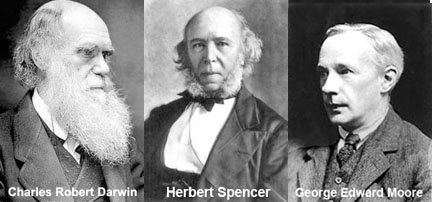
But, does it therefore follow that this predisposition necessarily dictates how we should behave? I believe that the answer to this question is no. More than that, I believe that to make the jump from the former to the latter is to commit a fundamental logical fallacy (indeed, it has a formal name - the "naturalistic fallacy"). It conflates statements about what "is" the case (i.e. what is "natural" behavior for us and our fellow primates) and what "ought" to be the case. This fallacy was pointed out a century ago, most forcefully by G. E. Moore, who pointed out that "is" statements cannot logically be made equivalent to "ought" statements.

This distinction is crucially important, and nowhere more so than in the application of evolutionary theory to human behavior. The economic and social movement known as "social darwinism" was fundamentally based on the "naturalistic fallacy," as exemplified by the words of the well-known English hymn, "All Things Bright And Beautiful," written by Cecil Frances Humphreys Alexander:

All things bright and beautiful,
All creatures great and small,
All things wise and wonderful:
The Lord God made them all.


All well and good, but here's the next verse:

The rich man in his castle,
The poor man at his gate,
God made them, high or lowly,
And ordered their estate.


(Interestingly, if you do a Google search for these particular lyrics, you will not find them. Apparently, the social darwinist overtones of the second verse do not sit well with modern audiences, including those in church.)

Alexander was most emphatically not a "social darwinist," yet the moral equation presented in his hymn is essentially equivalent to that of Herbert Spencer and the other social darwinists: that one's position in life (and, by implication, one's behavior) are determined by a force outside one's self (God or natural selection), and that all that remains for us is to "get with the program."

In a word: bullshit. That way lies the gas chambers at Auschwitz. No amount of science can tell us what we ought to do. At most, scientific knowledge can tell us how difficult (or easy) what we ought to do might be, but to conflate the two is to commit both a logical fallacy and monstrous evil. I sincerely hope that most evolutionary biologists will not agree with either the opinions of Marc Hauser or Franz De Waal on this subject, no matter how encouraging they may be. Long and hard experience has shown us that the "naturalistic fallacy" can be used to justify monstrous injustices (as has the belief in the authority of a "supernatural lawgiver," and for the same reason).

As adults, we must face up to the difficult responsibility of deciding what we "ought" to do, and then do it, no matter how easy or difficult. If it is the former (and if this is because of our evolutionary heritage), then perhaps the road ahead will not be as rocky as the one we have trod to get here. However, if it is the latter (and I suspect it may be, once again based on my understanding of our evolutionary heritage - more on this later), then that's just tough: but (to paraphrase Charles Darwin), one must do one's duty.

--Allen

Labels: , , , , , ,