Tuesday, April 14, 2009

Evolution: The Darwinian Revolutions


Long-time readers of this blog will know that every summer I teach an introductory evolution course for non-scientists at Cornell. This year the focus of the course will be somewhat different. In honor of the bicentennial of the birth of Charles Darwin and the 150th anniversary of the publication of his monumental book, On the Origin of Species..., we will be focusing on the impact of Darwin's concept of evolution by natural selection, both on the sciences and on society as a whole.

Darwin's theory of evolution is the most revolutionary idea ever entertained by the human mind. It fundamentally alters our perception of reality. In profound and unsettling ways the theory of evolution changes our understanding of who we are, where we come from, why we do the things we do, and where we might be going. It does this by making us look carefully and dispassionately at the world around us, asking questions and seeking answers in the things we can observe.

This summer we will explore Darwin's theory and the impact that it has had on the sciences and on human society. Here is the syllabus for the course:

EVOLUTION: THE DARWINIAN REVOLUTIONS
BIOEE 2070 / HIST 2870 / STS 2871
Cornell University Six-Week Summer Session – Summer 2009

PREREQUISITES: None - Intended for non-science majors with an interest in evolutionary theory

CREDIT HOURS: 3 (does not count toward evolution distribution requirement in biological sciences)

CLASS TIMES: Mondays and Wednesdays 6-9 PM, Monday 22 June 2009 to Wednesday 29 July 2009

CLASS LOCATION: Lectures in Morrison Room, Corson-Mudd Atrium. Discussions TBA in class.

COURSE FORMAT: The format for each class will be a two-hour interactive lecture/discussion, in which the professor outlines the major concepts, followed by a one-hour discussion section in which all participants present their interpretations and opinions of the concepts and readings under consideration. Participants will also have the opportunity to make full-length presentations of their original work. Grades will be based on the quality of three essays, due at the end of each two-week segment. Students may also opt to do one essay and a research paper (see description and point scores, below).

GRADE BASED ON: Attendance and participation in lecture and section, plus combined letter grade on three essays (suggested length = 4 to 8 pages) or one essay and one research paper (maximum length = 20 pages), for a total of 100 points (electronic/email submission encouraged, but not required)

COURSE DESCRIPTION: Evolution is the founding concept of the science of biology. This course examines evolution in historical and cultural contexts. Aims of the course include understanding the major issues in the history and current status of evolutionary theory and exploring the implications of evolution for culture and human psychology. Issues range from controversies over mechanisms of evolution in natural populations to the philosophical implications of evolutionary theory.

REQUIRED TEXTS:

Darwin, Charles (E. O. Wilson, ed.) (2006) From So Simple a Beginning: Darwin's Four Great Books. W. W. Norton, ISBN: 0393061345 (hardcover, $39.95), 1,706 pages. Available online here

Goldschmidt, Tijs (1998) Darwin's dreampond: Drama in Lake Victoria, MIT Press, ISBN: 0262571218 (paperback, $27.00), 274 pages.

Jabloka, Eva & Lamb, Marion J. (2006) Evolution in Four Dimensions: Genetic, Epigenetic, Behavioral, and Symbolic Variation in the History of Life, MIT Press, ISBN: 0262600692 (paperback, $19.95), 474 pages.

Raup, David M. (1991) Extinction: Bad genes or bad luck? W.W. Norton, ISBN: 0393309274 (paperback, $14.95), 228 pages.

Ruse, Michael (2004) Darwin and design: Does evolution have a purpose? Harvard University Press, ISBN: 0674016319 (paperback, $19.50), 371 pages.

OPTIONAL TEXTS:

Darwin, Charles (1892) The autobiography of Charles Darwin (Nora Barlow, ed.), W.W. Norton, ISBN: 0393310698 (paperback, $14.95), 365 pages. Available online here

COURSE PACKET:

All of the course packet readings listed below are available from the course website. The password to access the course packet is “evolutioncp” (without the quotation marks). Alternate weblinks are provided for your convenience.

NOTE: Students will not be required to read all of these articles. Your instructor and/or TA will tell you which articles you are responsible for.

Ayala, F. (1970). Teleological explanations in evolutionary biology. Philosophy of Science, vol. 37, pp. 1–7.

Behe, M. (2002) Intelligent design as an alternative explanation for the existence of biomolecular machines. Unpublished manuscript.

Cosmides, L. & Tooby, J. (1997) Evolutionary psychology: A primer. Center for Evolutionary Psychology. Available online here

Dembski, W. (2005) What every theologian should know about creation, evolution, and design. Orthodoxy Today. Available online
here


Dobzhansky, T. (1973) Nothing in biology makes sense except in the light of evolution. The American Biology Teacher, vol. 35 (March 1973), pp. 125–129. Available online
here


Eldredge, N. and Gould, S. J. (1972) Punctuated equilibria: An alternative to phyletic gradualism. In Schopf, T. J. M. (1972) Models in Paleobiology, Freeman, Cooper, & Co., pp. 82–115. Available online here

Gould, S. J. And Lewontin, R. C. (1979) The spandrels of San Marco and the Panglossian paradigm: A critique of the adaptationist programme. Proceedings Of The Royal Society of London, Series B, vol. 205, no. 1161, pp. 581-598. Available online here

Huxley, T. H. (1860) Letter to Charles Kingsley, Available online
here


Jenkin, F. (1867) Review of Origin of Species. The North British Review, June 1867, vol. 46, pp. 277-318.
Available online here

Kaviar, B. (2003) A history of the eugenics movement at Cornell. Unpublished manuscript.

MacNeill, A. (2004) The capacity for religious experience is an evolutionary adaptation for warfare. Evolution and Cognition 10:1, pages 43 to 60.

MacNeill, A. (2005) Natural selection, sparrows, and a stochastic God. Available online here

MacNeill, A. (2006) Vertical polygyny in modern America: An evolutionary perspective. Available online here

Mayr, E. (1974) Telological and teleonomic: A new analysis. Boston Studies in the Philosophy of Science, XIV, pages 91 to 117.

Mayr, E. (1982) The growth of biological thought. Harvard University Press. Chapters 12 & 13, pages 535 to 627.

Pinker, S. (2004) The evolutionary psychology of religion. Freedom From Religion Foundation. Available online here

Wegner, D. (2002) The illusion of conscious will. MIT Press: Cambridge. Chapter 3, pages 63 to 98.

PART ONE: THE ORIGIN OF EVOLUTIONARY THEORY
The science of evolutionary biology began with the publication of Charles Darwin's On the Origin of Species. It is one of the most important books ever written and should be read by any person who wants to understand who we are, where we come from, and why we are here (and how we know).

PART TWO: THE MODERN SYNTHESIS
Darwin's theory was accepted by most scientists of his generation within a surprisingly short time. Then, within just one more generation, it fell out of favor, replaced by genetic theories of evolution suggested by the rediscovered work of Gregor Mendel. Then, in another generation, the pendulum swung the other way, and Darwin's ideas were integrated with Mendel's and codified in the "modern synthesis."

PART THREE: MACROEVOLUTION, EVO-DEVO, AND BEYOND
Evolutionary theory has exploded in the fifty years since the "modern synthesis" was proclaimed. Sociobiology, punctuated equilibrium and new ideas about evolutionary psychology, genetic engineering, macroevolution, speciation…these are just a few of the directions that evolutionary theory and biology have expanded in the second half of the 20th century and the beginning of the 21st.

I would like to invite anyone who has found this blog interesting to take this course, or follow along with us by keeping up with the course materials posted at the course website. Either way, you will find your mind being stretched and your view of reality challenged. What better way could one spend a few summer evenings?

See you this summer!

************************************************

As always, comments, criticisms, and suggestions are warmly welcomed!

--Allen

Labels: , , , ,

Saturday, April 29, 2006

Cornell Summer Session Evolution Courses


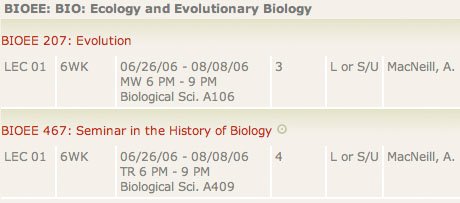
Several people have emailed me requesting information on the Cornell summer seminar on design and purpose in nature. In particular, there seems to be some confusion about the course title and description as it is listed in the online course catalog for the Cornell Summer Session. Here is a link to the page in which the course listing can be found (scroll down to Ecology and Evolutionary Biology/E&EB):

Evolution & Design: Is There Purpose in Nature?

and here is a link to the actual course description:

Course Description

As you can see, the course description in the online catalog is very brief and pretty generic, and the course title ("Seminar in History of Biology") doesn't mention design or purpose. Fear not! This is the correct course listing for the now somewhat notorious "design/purpose in nature seminar."

And, of course, please consider taking my introductory evolution course as well! We will be covering some of the same topics, and will take a historical and philosophical approach to the science of evolution. The class is generally small enough so that there is plenty of interaction between students and instructors (I usually have a couple of graduate student TAs), and we learn a lot about evolution and its implications (and have fun doing it).

There will also be a "course blog", which will be announced on this website soon. Watch this space!

--Allen

Labels: , , , , ,

Wednesday, April 12, 2006

The Capacity for Religious Experience Is An Evolutionary Adaptation to Warfare


AUTHOR: Allen MacNeill

SOURCE: Original essay

COMMENTARY: That's up to you...

Given the sudden increase in readership of this list, I'm going to take the shamelessly opportunistic route and post a summary of my most recent publication: "The capacity for religious experience is an evolutionary adaptation to warfare", in Fitzduff, M. & Stout, C. (eds) (2005) The Psychology of Resolving Global Conflicts: From War to Peace, vol. 1, ch. 10, pp. 257-284. This, like the recent upsurge in interest in polygamy, is a very hot topic. Terrorism is very much in the news, and since a lot of it seems to be at least peripherally associated with extreme religious views, the idea that these can be part of an evolutionary "arms race" seems very timely.

I first gave a version of this paper at the 2004 annual conference of the New England Institute in Portland, Maine. It has since been published among the proceedings of that conference (the citation is: MacNeill, A. (2004) "The capacity for religious experience is an evolutionary adaptation to warfare" Evolution & Cognition, vol. 10, no. 1, pp. 43-60). I was later contacted by Mari Fitzduff and Chris Stout for inclusion in their anthology on peace and war, which was published last December. The latter is a terrific collection, but a little pricey (I'm glad I got a free copy out of the deal). If readers are interested, I can email a pdf of the entire paper. It's pretty good, if I do say so myself.

But why should you take just my word for it? Here's the abstract and the "core of the argument":

ABSTRACT

The criteria for deciding whether a characteristic qualifies as an evolutionary adaptation are discussed: differential survival and reproduction are considered the most appropriate criteria. The pan-specific qualities of both religious experience and warfare indicate that they are both evolutionary adaptations. There is considerable variation between individuals with respect to their capacity for religious experience and motivation to participate in warfare. Selective advantages for participation in warfare accrue to both winners and losers as long as the benefits of participation exceed the average costs. These selective advantages, primarily in the form of differential reproductive success, accrue to males when they are on the winning side in a war, and often to females no matter which side they are on.

Recent work on the evolutionary dynamics of religion have converged on a "standard model" in which religions and the supernatural entities which populate them are treated as epiphenomena of human cognitive processes dealing with the detection of and reaction to agents under conditions of stress, anxiety, and perceived threat. Religious experience at the individual level is characterized by depersonalization, coupled with submission to a super-individual force; the same is essentially the case for participation in warfare. The capacities for both religious experience and participation in warfare are adaptations insofar as they evolve by means of natural selection operating primarily at the level of individuals who are members of groups in which both kin selection and reciprocal altruism are also operative. It is likely that the overall patterns of supernatural organization exist as the result of coevolution between the memetic content of religious beliefs and the underlying neurological matrix within which such beliefs are maintained and transmitted in the context of specific ecological subsistence patterns.

THE CORE OF THE ARGUMENT

War involves violent force, up to and including killing people. To participate in a war means to participate in an activity in which there is a significant probability that one will either kill other people, or will be killed by them.

This means that any participant in warfare is faced with the possibility of painful and violent death as the result of such participation. Given this probability, if natural selection acts at the level of individuals, how can natural selection result in a propensity to participate in warfare? Clearly, either the probability that one will be killed must be perceived as low or the potential payoff from such participation must be perceived as high. If natural selection is to operate at the level of individuals, these two circumstances should ideally be obtained simultaneously,

Here is where the capacity for religious experience is crucial. By making possible the belief that a supernatural entity knows the outcome of all actions and can influence such outcomes, that one's "self" (i.e., "soul") is not tied to one's physical body, and that if one is killed in battle, one's essential self (i.e., soul) will go to a better "place" (e.g., heaven, valhalla, etc.) the capacity for religious experience can tip the balance toward participation in warfare. By doing so, the capacity for religious belief not only makes it possible for individuals to do what they might not otherwise be motivated to do, it also tends to tip the balance toward victory on the part of the religiously devout participant. This is because success in battle, and success in war, hinges on commitment: the more committed a military force is in battle, the more likely it is to win, all other things being equal. When two groups of approximately equal strength meet in battle, it is the group in which the individuals are more committed to victory (and less inhibited by the fear of injury or death) that is more likely to prevail. To give just one example, the battle cry and motto of the clan Neil has always been "Buaidh na bas!" - "Victory or death!"

Religions tell people what they most want to hear: that those agents and processes that they most fear have no ultimate power over them or pose no threat to themselves or the people they care about. In particular, by providing an intensely memorable, emotionally satisfying, and tension-releasing solution to the problem of mortality, religions make it possible for warriors to master their anxieties and do battle without emotional inhibitions. This makes them much more effective warriors, especially in the hand-to-hand combat that humans have fought throughout nearly all of our evolutionary history.

Consider the characteristics that are most often cited as central to religious experience. Newberg and d'Aquili (2001) have presented an integrated model of the neurobiological underpinnings of religious experience. They have pointed out that central to most religious experience is a sensation of awe, combined with "…mildly pleasant sensations to feelings of ecstasy." (Newberg and d'Aquili, 2001, p. 89) They have shown that such sensations can be induced by rhythmic chanting and body movements, combined with loud music and colorful visual displays, all of which produce a condition of sensory overload. This process then induces a neurological condition characterized by a sense of depersonalization and ecstatic union with one's surroundings.

This is precisely what happens as the result of military drill and training. It is no accident that humans preparing for war use exactly the same kinds of sensory stimuli described by Newberg and d'Aquili. They have tied such displays to religious activities, and shown the deep similarities between religious rituals and secular ones: "…patriotic rituals… emphasize the "sacredness" of a nation, or a cause, or even a flag…turn[ing] a meaningful idea into a visceral experience." (Newberg and d'Aquili, p. 90) The two types of activities - religious rituals and patriotic rituals - use the same underlying neurological pathways and chemistry.

Religious experience is often equated with a state of mystical union with the supernatural. But what exactly does this mean, and in the context of this presentation, is there a connection between mystical experience and warfare? The answer is almost certainly yes. That combatants have had experiences that would be classified as mystical before, during, and after battle is a simple historical fact. The Scottish flag is based on just such an experience: the white crossed diagonal bars against a field of azure of the St. Andrew's cross is said to have appeared to King Hungus and his warriors during a battle against in the Saxons. Legend says this so encouraged the Scots and frightened their adversaries that a victory was won.

A common thread in all mystical experiences is a loss of the sense of self and a union with something larger than oneself. (Newberg and d'Aquili, p. 101) Additionally, there is often a sense of submission to a higher power, in which one's personal desires and fears are subordinated to the purposes of that higher power. If that higher power were identified with the leaders of a military hierarchy, it is easy to see how such experiences could be used to increase one's loyalty and submission to that hierarchy.

Wilson (2002) has proposed that the capacity for religion has evolved among humans as the result of selection at the level of groups, rather than individuals. Specifically, he argues that benefits that accrue to groups as the result of individual sacrifices can result in increased group fitness, and this can explain what is otherwise difficult to explain: religiously motivated behaviors (such as celibacy and self-sacrifice) that apparently lower individual fitness as they benefit the group.

At first glance, Wilson's argument seems compelling. Consider the most horrific manifestation of religious warfare: the suicide bomber. A person who blows him or herself up in order to kill his or her opponents has lowered his or her individual fitness. Doesn't this mean that such behavior must be explainable only at the level of group selection? Not at all: the solution to this conundrum is implicit in the basic principles of population genetics. Recall that one of Darwin's requirements for evolution by natural selection was the existence of variation between the individuals in a population. (Darwin, 1859, pp. 7 - 59) Variation within populations is a universal characteristic of life, an inevitable outcome of the imperfect mechanism of genetic replication. Therefore, it follows that if the capacity for religious experience is an evolutionary adaptation, then there will be variation between individuals in the degree to which they express such a capacity.

Furthermore, it is not necessarily true that when an individual sacrifices his or her life in the context of a struggle, the underlying genotype that induced that sacrifice will be eliminated by that act. Hamilton's principle of kin selection (Hamilton, 1964) has already been mentioned as one mechanism, acting at the level of individuals (or, more precisely, at the level of genotypes), by which individual self-sacrifice can result in the increase in frequency of the genotype that facilitated such sacrifice. Trivers (1971) has proposed a mechanism by which apparently altruistic acts on the part of genetically unrelated individuals may evolve by means of reciprocal altruism.

Given these two mechanisms, all that is necessary for the capacity for religious behavior, including extreme forms of self-sacrifice, to evolve is that as the result of such behaviors, the tendency (and ability) to perform them would be propagated throughout a population. The removal of some individuals as the result of suicide would merely lower the frequency of such tendencies and abilities in the population, not eliminate them altogether. If by making the ultimate sacrifice, an individual who shares his or her genotype with those who benefit by that sacrifice will, at the level of his or her genes, become more common over time. (Wilson, 1975, p. 4)

Let us now consider the flip side of war: the benefits that accrue to the winners of warlike conflicts. Given the mechanisms of kin selection, one can see how warfare and the religious beliefs that facilitate it might evolve among the closely related kin groups that constitute the raiding parties characteristic of hunting/gathering and pastoral peoples. It is also possible to construct an explanation for militia warfare and professional warfare on the basis of a blend of kin selection and reciprocal altruism. However, a closer examination of the spoils of war make such explanations relatively unnecessary.

Betzig (1986) performed a cross-cultural analysis of the correlation between despotism and reproductive success in 186 different cultures. Her conclusion was that "…[n]ot only are men regularly able to win conflicts of interest more polygynous, but the degree of their polygyny is predictable from the degree of bias with which the conflicts are resolved. Despotism, defined as an exercised right to murder arbitrarily and with impunity, virtually invariably coincides with the greatest degree of polygyny, and presumably, with a correspondingly high degree of differential reproduction." (Betzig, 1986, p. 88) In other words, males who most successfully use violence and murder as a means of influencing the actions of others have historically had the most offspring. In the context of warfare, this means that the winners of a battle, or even more so, of a war will pass on to their offspring whatever traits facilitated their victory, including the capacity to believe in a supernatural force that guides their destiny and protects them in battle. The effects of such capacities are not trivial; as Betzig points out, the differences between the reproductive success of the winners of violent conflicts and the losers is measured in orders of magnitude. As noted earlier, wars are bottlenecks through which only a relative few may pass, but which reward those who do with immensely increased reproductive success.

Putting all of this together, it appears likely that the capacity for religious experience and the capacity for warfare have constituted a coevolutionary spiral that has intensified with the transitions from a hunting/gathering existence through subsistence agriculture to the evolution of the modern nation-state. As pointed out earlier, there is a correlation between the type of intergroup violence and the ecological context within which that violence occurs. Generally speaking, raiding/rustling is correlated with hunting/gathering and pastoralism, militia warfare with village agriculture, and professional warfare with urban society and the nation-state. There is a corresponding progression in the basic form of religious experience and practice: animism is most common among hunter-gatherers, while polytheism is more common among agriculturalists, and monotheism is most common in societies organized as nation-states. This is not to say there are no exceptions to this correlation. However, the fact that such a correlation can even be made points to the underlying ecological dynamics driving the evolution of subsistence patterns, patterns of warfare, and types of religious experience.

REFERENCES CITED

Betzig, L. (1986). Despotism and differential reproduction: A darwinian view of history. New York: Aldine.

Darwin, C. R. (1859). On the origin of species by means of natural selection, or the preservation of favoured races in the struggle for life. London: Murray.

Hamilton, W. D. (1964). The genetical theory of social behavior. Journal of theoretical biology, 12(1), 1-52.

Newberg, A. B. and d'Aquili, E. G. (2001). Why god won't go away: Brain science and the biology of belief. New York: Ballantine.

Trivers, R. L. (1971). The evolution of reciprocal altruism. Quarterly review of biology, 46(4), 35-57.

Wilson, D. S. (2002). Darwin's cathedral: evolution, religion, and the nature of society. Chicago: University of Chicago Press.

Wilson, E. O. (1975). Sociobiology: The new synthesis. Cambridge, MA: Belknap.

--Allen

Labels: , , , , , , ,