Wednesday, March 04, 2009

Teleology vs Teleonomy: Can a "Program" Exist Before Its "Programmer"?


This post is a follow-up to the previous post on the subject of the "randomness" in the processes that generate the variation that is necessary for biological evolution.

Can a "program" exist before its "programmer" (and therefore bring it into being)? This seems to be the core of the disagreement between ID supporters and mainstream scientists. The former (which include Charles Darwin's very close friend, Asa Gray) advocate the idea that the variation upon which natural selection and other evolutionary processes work is neither random nor unintentional. The latter (which include Darwin and his intellectual heirs) do not disagree with the idea that such variation is not "random". What they disagree with is the idea that there is some "intention" or "plan" guiding the variation that occurs, so that certain outcomes (including, but not limited to, the origin of humans) are more likely than others.

To answer the question that stands at the head of this post, I think it's essential to emphasize (as I did in the original blogpost) that the terms “foresighted” and “goal-oriented” are not equivalent, nor are the processes to which they are applied. As I have pointed out in many posts, there is no inherent contradiction between a process being purely "natural" (i.e. the result of the operation of purely natural processes) and being "goal-oriented".

Ernst Mayr (surely no advocate of "intelligent design") argued forcefully (and, in my opinion, convincingly) that biological organisms are indeed "goal-oriented". That is, their genomes provide a program, the function of which is to bring about a particular state of affairs: the survival and reproduction of the organism via its interactions with its environment.

The origin of the genome (i.e. the "program" itself) is an entirely different situation, however. Ever since Darwin it has been a standard assumption that the evolutionary processes by which the genetic "programs" that direct the assembly and operation of living organisms are not goal-oriented. These evolutionary processes – natural selection, sexual selection, founder effects, genetic bottlenecks, neutral "drift" in deep evolutionary time, exaptation, heterochronic development, changes in homeotic development, interspecific competition, species-level selection, serial endosymbiosis, convergence/divergence, hybridization, phylogenetic fusion, background and mass extinction/adaptive radiation, and internal variance – do not require any kind of "goal orientation" to produce the living entities and processes we observe around and within us. And, since such processes do not require goal-orientation or intentionality, these are not included in evolutionary explanations. Some, but not all, evolutionary biologists extend this idea to the assumption that goal-orientation or intentionality do not exist in nature, in the absence of pre-existing genomic "programs").

The main reason for this assumption has been that it is extremely problematic to agree on how one would go about showing that the aforementioned evolutionary processes have indeed been goal-oriented. The most serious objection to this idea is that there seems to be nowhere for such a "directing agency" to exist in material form, nor any natural means by which its goals could be impressed upon physical organisms.

The genomes of organisms are physical/chemical "stuff", which is translated via physical/chemical "machinery" into biological entities and processes. That is, there is a physical/chemical "vehicle" in which the information for assembling and operating organisms is carried and expressed.

The same would not the case for the putative source of the "evolutionary program" which might direct the evolution of the genomes of living organisms. Since such an "evolutionary program" would cause the evolution of the "genomic programs" which direct the assembly and operation of living organisms, such a program would necessarily have to exist before the origin and evolution of biological genomes, as it would be necessary for it to do so to direct their coming into being.

This presents two serious problems:

• By what mechanism(s) would such an "evolutionary program" cause "genomic programs" to come into existence, and

• Precisely where in the physical universe would such a pre-existing "evolutionary program" itself exist?

We seem to have two direct logical contradictions in terms:

• How can a non-natural "evolutionary program" cause a natural "genomic program" to come into existence, and

• How can a programmer pre-exist the program which brings itself into existence?

There is a proposed answer to these two questions, but one which most ID supporters seem loathe to invoke:

• That the "pre-existing program" that directs the evolution of the genomic programs of living organisms is woven into the structure of physical reality itself.

This is the line of inquiry pursued by Ilya Prigogine and Stuart Kauffman (among others), but which is rejected out-of-hand by nearly all ID supporters (most notably Michael Behe, William Dembski, and Phillip Johnson), who prefer a purely "supernatural" source for the "pre-existing program" by which evolution has been directed).

As always, comments, criticisms, and suggestions are warmly welcomed!

--Allen

Labels: , , , , , , , ,

Sunday, January 18, 2009

Martian Rocks and Intelligent Design


AUTHOR: Allen MacNeill

SOURCE: Original essay

COMMENTARY: That's up to you...

Take a good, long look at the photograph at the top of this post (it's from NASA). Does anything about it strike you as odd? Go ahead, I'll wait...

For example, do the rocks in the photograph appear to be simply "randomly" scattered about? How about size; are there patterns in the distribution of the different sizes of rocks in the photo? And how about placement - are any of the rocks in lines, or do they show similar orientation of edges, do any of them have a coating of dust or sand on them, and are any of them stacked on top of each other (or even overlapping)?

Hmm...the more you look at this picture, the less it looks like a random and unrelated collection of objects (that is, rocks). Indeed, it looks as if someone (perhaps Someone "intelligent" with a lot of time on His hands) spent no small amount of time arranging them (after all, such arrangements apparently cover a significant fraction of the surface of the planet Mars).

It's observations like these that lead some "intelligent design theorists" (IDTs) to infer the existence and active interference in natural processes of an "intelligent designer". A significant subset of IDTs go on to infer that this "intelligent designer" is the God of the Judeo-Christian-Muslim-Mormon faith(s). In so doing, they are following the lead of the founder of the neo-Palean "intelligent design and natural theology" movement, the Anglican minister Rev. William Paley. True, what we see in the photograph is rocks, not Rev. Paley's pocketwatch, and that's the windswept plains of Mars, not a windswept heath on Earth, but "design is design" and all design points to the existence of a "designer", right?

Furthermore, many IDTs use a very familiar mode of argument in asserting the existence of "intelligent design". We could call this mode of argument the "duck" argument, as in the old saw "if it looks like a duck, flies like a duck, and quacks like a duck, it's a duck".

What's the operative word here? The word like, of course, which is the tipoff that what is being marshaled is an "argument by analogy".

I have already written about the weaknesses of arguments by analogy (see here, here, and here). Most recently, I pointed out in a critique of a recent blogpost by Dr. Steven Fuller, that arguments by analogy are extremely weak: they lack almost all logical force. Dr. Fuller replied that what IDTs (including himself) use are not, in fact, arguments by analogy. Instead, he argued that what they (and he) were pointing out were "partial identities". That is, a pattern of rocks like the one in the photograph is "partially identical" to, say, a flagstone patio set in place by a "designer" having access to large amounts of dust and sand, but only a few, small rocks.

What, precisely, does the phrase "partial identity" mean? Is it something like being "partially pregnant" or "partially dead"? Or does it mean "only partly identical"? I thought that "identical" meant "identical". That is:
Two things that are identical are the very same in each and every possible way.

Isn't a thing that is "partially identical" to some other thing also "like" that thing? Seems so to me. Indeed, the phrases "partially identical"and "partial identity" seem to me to be oxymorons, plain and simple.

To be as precise as possible:
"Partial identity" is identical to "analogy"

Ergo, Dr. Fuller apparently agrees with me that ID arguments are essentially "arguments by analogy" and therefore have virtually no logical force.

But, to get back to the curious behavior of the rocks on Mars...what's that, you say? The "behavior" of the rocks? Can it be that the rocks are "behaving"?

Indeed, they are. After long and patient analysis, it has become clear that the rocks on Mars (at least the ones in the size range shown in the photograph) "behave". To be specific, they move around on the dusty/sandy surface of the Martian plains.

Furthermore, their movement is not random. On the contrary, there is a very precise pattern to it. The rocks shown in the photograph actually move against the wind, and away from each other. The latter pattern of movement is why they appear to be non-randomly placed on the surface of the Martian plain. Furthermore, they move apart at a rate that is apparently related to their size. Small rocks move apart further and faster than large rocks (very large rocks apparently don't move much at all).

In the parlance of "intelligent design theory", something that acts non-randomly in such a way as to produce non-random patterns of activity is an "agent". Furthermore, according to IDTs, agents are "intelligent" by definition. If it moves like an agent, arranges itself like an agent, and produces patterns that are "partially identical"/analogous to patterns produced by an agent, it's an agent.

Ergo, the rocks in the photograph are either agents, or have been arranged by agents.

Or not.

Here's another explanation for the arrangement of the rocks on Mars:

Wind removes loose sand in front of the rocks, creating pits there and depositing that sand behind the rocks, creating mounds. The rocks then roll forward into the pits, moving into the wind. As long as the wind continues to blow, the process is repeated and the rocks move forward.

The rocks protect the tiny sand mounds from wind erosion. Those piles of sand, in turn, keep the rocks from being pushed downwind and from bunching up with one another....

The process is nearly the same with a cluster of rocks. However, with a cluster of rocks, those in the front of the group shield their counterparts in the middle or on the edges from the wind...

Because the middle and outer rocks are not directly hit by the wind, the wind creates pits to the sides of those rocks. And so, instead of rolling forward, the rocks roll to the side, not directly into the wind, and the cluster begins to spread out.


In other words, the pattern of rocks shown in the photograph is the result of purely natural forces and the explanation presented above is a "naturalistic" explanation.

There is, of course, an essentially infinite number of imaginable explanations for the arrangement of the rocks in the photo. They could have been arranged by an invisible "agent" who prefers rocks to be "organized". They could have been arranged during the creation of Mars (which, of course, happened on 23 October 4004 BC, along with the creation of all of the other planets, asteroids, comets, planetismals, bolides, etc.). They could have been placed by little green men or hexapedal strongly-thewed Barsoomians, taking a break between sword fights. The list of possibilities is quite literally endless.

However, the scientific consensus is that the "naturalistic" explanation in the block quote above is most consistent with observations and with an assumption that natural processes alone are sufficient to explain them. "Agents" may be involved, and so may Barsoomians, but neither are necessary to explain the arrangement and behavior of the Martian rocks, and so they are not included in a scientific explanation of such arrangement and behavior.

The same is the case for biological organisms and the explanation for their existence: the theory of evolution by natural selection. All of the explanations listed above, including not only wind erosion and "intelligent rock placement", but also tiddly-winking six-armed green warriors (and obsessive-compulsive demiurges), are consistent with the pattern shown in the photograph. However, only the scientific explanation contained in the block quote is also consistent with the universal assumption underlying all of the natural sciences: that only natural forces by invoked to explain observed patterns in natural objects and processes, until such forces are shown to be insufficient to explain such things.

It should also go without saying that, if one is in favor of explaining the arrangement and behavior of Martian rocks in the incredibly limited environment of science classes in the public schools, rather than going into all of the imaginable explanations (including Tars Tarkas and Jaweh Elohim), one should stick to the explanation(s) worked out by practicing professional scientists, and confine the other explanations to classes intended for the non-empirical speculations of amateur philosophers and theologians (or am I being redundantly redundant?)

P.S. To Dr. Fuller: contrary to your aspersion, I am not a "closet theistic evolutionist" — like Newton, "I make no hypotheses!" Unlike Newton, I am an anarchist Heinlein-libertarian Zen Quaker evolutionary psychologist who prefers not to be labeled.

As always, comments, criticisms, and suggestions are warmly welcomed!

--Allen

Labels: , , , , , , , ,

Friday, August 18, 2006

On the Detection of Agency and Intentionality in Nature


AUTHOR: Elena Broaddus

SOURCE: Evolution and Design

COMMENTARY: Allen MacNeill

First, many thanks to the faithful readers who have also continued to pay attention to the Evolution and Design website (the weblog of the "notorious Cornell evolution and design seminar" and the contents contained therein. I am particularly pleased that the hard work and careful thought of the students whose papers have been posted has been recognized, and even moreso that they have been given the highest praise possible: that is, critical analysis.

I would like to draw some more attention to E. Broaddus paper on the “innate” tendency to infer purpose in nature. I have long suspected that humans (and perhaps many vertebrates, especially mammals) have this tendency. As an evolutionary psychologist, I at least partially subscribe to the idea that the human mind is composed primarily of “modules” whose functions are to process particular kinds of sensory information in such a way as to yield adaptive responses to complex environmental information. This is precisely what Broaddus argues for in her paper: that the human mind (and, by extension, the vertebrate “mind” in general) has a module that is adapted specifically for the precise and rapid inference of intentionality in nature. That such an “agency detector” (to use the commonly accepted term for such a module) would have immense adaptive value is obvious. In an environment in which other entities do indeed have “intentions” (i.e. predators, competitors, potential mates, etc.), the ability to detect and infer the possible consequences of acting upon such intentions would confer immense adaptive value on any organism with such an ability.

Furthermore, as Broaddus points out (and as we discussed briefly in the seminar), to be most effective such a detector should be tuned in such a way as to detect virtually all such “intention-indicating” behaviors. This would have the effect of producing a significant number of “false positives,” as any detector that is tuned high enough to detect all actual cases would have such a side-effect.

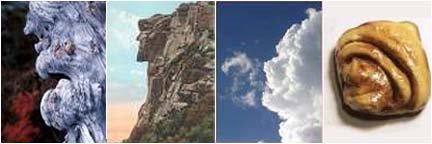
As Broaddus points out, one of the side-effects of such an “agency detector” would be the detection of intentionality in entities that clearly had no such intentions. If, for example, one of the most important functions of such a detector in humans is to quickly “read” and assess the intentions betrayed in human facial expressions, then it would almost certainly detect human facial expressions in objects in the environment that clearly do not have such expressions, such as rocks, foliage, water stains, etc. This would explain the ability of many humans to “see” human facial expressions in such things as water stains, cinnamon buns, rocks, etc.

Clearly, there are some “natural objects” that do, indeed, have human facial expressions impressed upon them: the faces of the presidents at Mount Rushmore are an example cited ad nauseam by ID theorists. However, I am much more interested in “faces” that humans detect in rocks and other environmental objects that are clearly not produced by human agency. Indeed, the faces at Mount Rushmore constitute a kind of “control” for this ability, as they are clearly the result of intentionality, and therefore can be used to anchor that end of the “agency detection” spectrum (at the other end of which are things like “faces” in clouds, tree foliage, etc.). Somewhere in this spectrum is a cross-over point at which actual intentionality/agency disappears and facticious intentionality/agency takes over. It is the location of that cross-over point that constitutes the hinge of the argument between evolutionary biologists and ID theorists.

Broaddus’s analysis of autism as a possible example of malfunctioning “agency detection” is, IMO, brilliant, and presents an immediately testable hypothesis: that autistic children lack well-tuned “agency detectors,” and that this at least partially explains their well-known indifference to intentional agents, such as other people (including their parents), animals, etc. In people with both full-blown autism and the milder Asperger’s syndrome (sometimes called Aspies”), a common attribute is an impaired ability to infer intentionality (or, in many cases, the mere existence of other minds) on the part of autistics and Aspies. As Broaddus points out, there are clear anatomical and functional differences between autistics, Aspies, and non-impaired people, and that these differences may be correlated with the etiology of these conditions. For example, it is very interesting that there appears to be more (rather than less) neurons in the brains of autistics than in non-impaired people.

This lends credence to the generally accepted hypothesis that the information processing “modules” proposed by evolutionary psychologists are the result of “pared down” neural networks that are speciallized for particular cognitive tasks. Clearly, the agency/intentionality detector in humans functions extremely well and, as the parlance goes, “in the background.” We are rarely conscious of its operation, despite the fact that it is virtually always “on.” This explains, for example, something I first noticed as a young child: that no matter how much I tried, I couldn’t NOT see faces in the patterns in the linoleum on the floor of my grandmother’s kitchen, in the foliage of trees, in rocks, and in photographs of billowing smoke, splashing water, etc. The agency/intentionality detector works extremely efficiently in people of all ages, but especially in children. Indeed, as Broaddus points out, part of becoming an adult consists in learning (usually by trial-and-error) which of the seemingly intentional entities which we perceive all the time actually are intentional agents and actually have intentions vis-a vis ourselves. We must learn, in other words, to critically analyze the constant stream of “positive” agency/intentionality detection events, and discriminate between those that affect us and those that do not. It may be that this discrimination process actually involves the neurological “re-wiring” of the parts of the sensory/nervous system that produces such detection events, and this might explain, at least in part, the decreased ability of adults to believe in the existence of intentional agents in the natural environment.

Broaddus not only presents a cogent hypothesis concerning the existence of such an agency/intentionality detector/module in humans, she proposes several possible ways of testing whether or not such a detector actually exists, and to “map” its dimensions, capabilities, biases, and limitations. I believe that this opens up a very fruitful area of empirical research into such detectors, and can ultimately lead to much more clarity about an issue that so far has generated much more heat than light. I hope that her ideas and suggestions will be followed up by others (I certainly intend to do so), and that further empirical research into this fascinating and little-known capability will add to our understanding of what makes us the peculiar creatures we are.

Labels: , , , , , ,

Monday, June 05, 2006

Detailed Syllabus for Cornell Evolution/Design Course

BioEE 467/B&Soc 447/Hist 415/S&TS 447: Seminar in History of Biology

Summer 2006 - Syllabus

PREREQUISITES: None (introductory course in evolutionary biology recommended, but not required)

CREDIT HOURS: 4 (does not count toward evolution distribution requirement in biological sciences)

CLASS TIMES: Tuesdays and Thursdays 6-9 PM

CLASS LOCATION: Whittaker Seminar Room, 409 Corson-Mudd Hall.

COURSE FORMAT: The format for each class will be a 90 minute interactive discussion/seminar, in which all participants present their interpretations and opinions of the concepts and readings under consideration. Participants will also have the opportunity to make presentations of their original work. Grades will be based on the quality of a term research paper, due at the end of the course, plus attendance and class participation.

GRADE BASED ON: Attendance and participation in seminar discussions, plus a letter grade on the final research paper (maximum length = 20 pages), for a total of 100 points (electronic/email submission encouraged, but not required):

Course Grade Components................Due On

Proposal for final research paper.......Fri07Jul06
Draft/outline of research paper.........Thu20Jul06
Final research Paper:= 75 points.......Thu03Aug06
Attendance..............= 10 points........overall
Participation............= 15 points........overall

COURSE TITLE: Evolution and Design: Is There Purpose in Nature?

COURSE DESCRIPTION: This seminar addresses, in historical perspective, controversies about the cultural implications of evolutionary biology. Discussions focus upon questions about gods, free will, foundations for ethics, meaning in life, and life after death. Readings range from Charles Darwin to the present (see reading list, below).

The current debate over "intelligent design theory" is only the latest phase in the perennial debate over the question of design in nature. Beginning with Aristotle's "final cause," this idea was the dominant explanation for biological adaptation in nature until the publication of Darwin's Origin of Species. Darwin's work united the biological sciences with the other natural sciences by providing a non-teleological explanation for the origin of adaptation. However, Darwin's theory has been repeatedly challenged by theories invoking design in nature.

The latest challenge to the neo-darwinian theory of evolution has come from the "intelligent design movement," spearheaded by the Discovery Institute in Seattle, WA. In this course, we will read extensively from authors on both sides of this debate, including Francisco Ayala, Michael Behe, Richard Dawkins, William Dembski, Phillip Johnson, Ernst Mayr, and Michael Ruse. Our intent will be to sort out the various issues at play, and to come to clarity on how those issues can be integrated into the perspective of the natural sciences as a whole.

In addition to in-class discussions, course participants will have the opportunity to participate in online debates and discussions via the instructor's weblog at http://evolutionlist.blogspot.com/. Students registered for the course will also have an opportunity to present their original research paper(s) to the class and to the general public via publication on the course weblog and via THE EVOLUTION LIST.

INTENDED AUDIENCE: This course is intended primarily for students in biology, biology and society, history, philosophy, and science & technology studies. The approach will be interdisciplinary, and the format will consist of in-depth readings across the disciplines and discussion of the issues raised by such readings. Although there are no prerequisites, a knowledge of evolutionary biology (equivalent to BioEE 207 and/or BioEE 278) is highly recommended. In addition to registered students, course participants will also include invited guests from the Department of Ecology & Evolutionary Biology, the Paleontological Research Institute, and the Cornell IDEA Club. Members of the general public may only attend class discussions with prior permission of the instructor.

REQUIRED TEXTS: (all texts will be available at The Cornell Store, http://www.store.cornell.edu/)

Behe, Michael (2006) Darwin's black box: The biochemical challenge to evolution. New York, NY, Free Press, 352 pages.

Dawkins, Richard (1996) The blind watchmaker: Why the evidence of evolution reveals a universe without design. New York, NY, W. W. Norton (reissue edition), 400 pages.

Dembski, William (2006) The design inference : Eliminating chance through small probabilities. Cambridge, UK, Cambridge University Press, 272 pages.

Johnson, Phillip E. (2002) The wedge of truth: Splitting the foundations of naturalism. Downers Grove, IL, InterVarsity Press, 192 pages.

Ruse, Michael (2006) Darwin and design: Does evolution have a purpose? Cambridge, MA, Harvard University Press, 384 pages.

OPTIONAL TEXTS: (all texts will be available at The Cornell Store, http://www.store.cornell.edu/)

Darwin, Charles (1859) On the origin of species by means of natural selection, or the preservation of favoured races in the struggle for life, 1st Edition (E. Mayr, ed.), Cambridge, MA, Harvard University Press, 513 pages.
Available online at: http://pages.britishlibrary.net/charles.darwin/texts/origin1859/origin_fm.html

Darwin, Charles (E. O. Wilson, ed.) (2006) From so simple a beginning: Darwin's four great books. New York, NY, W. W. Norton, 1,706 pages.
Available online at: http://pages.britishlibrary.net/charles.darwin2/texts.html#books

Dembski, William & Ruse, Michael (2004) Debating design: From darwin to DNA. Cambridge, UK, Cambridge University Press, 422 pages.

Forrest, Barbara & Gross, Paul R. (2004) Creationism's trojan horse: The wedge of intelligent design. New York, NY, Oxford University Press USA, 416 pages.

Graffin, Gregory W. (2004) Evolution, monism, atheism, and the naturalist world-view. Ithaca, NY, Polypterus Press (P.O. Box 4416, Ithaca, NY, 14852), 252 pages.
Can be purchased online at: http://www.cornellevolutionproject.org/obtain.html

Perakh, Mark (2003) Unintelligent design. Amherst, NY, Prometheus Books, 459 pages.

Ruse, Michael (2000): The evolution wars: A guide to the debates. New Brunswick, NJ: Rutgers University Press. 326 pages.

COURSE PACKET: (all items will be available online at the course website)

Ayala, F. (1970) Teleological explanations in evolutionary biology. Philosophy of Science, Vol. 37: pages 1-15.

Binswanger, H. (1992) Life-based teleology and the foundations of ethics. The Monist, pages 84-103.

Behe, M. (2002) Intelligent design as an alternative explanation for the existence of biomolecular machines. Unpublished manuscript.

Dembski, W. (2005) What every theologian should know about creation, evolution, and design. Orthodoxy Today. Available online at: http://www.orthodoxytoday.org/articles/DembskiDesign.php

Discovery Institute (1999) The wedge. Available online at: http://www.antievolution.org/features/wedge.html

Kitzmiller v. Dover Area School District (2005) Complete trial documents and references. Available online at:
http://en.wikipedia.org/wiki/Kitzmiller_v._Dover_Area_School_District_trial_documents

Mayr, E. (1974) Telological and teleonomic: A new analysis. Boston Studies in the Philosophy of Science, XIV, pages 91 to 117.

Nagel, E. (1977) Teleology revisited: Goal-directed processes in biology. Journal of Philosophy. Vol. 74, No. 5, pages 261-301.

COURSE SCHEDULE:
As noted in the Course Format (above), each class will be a 90 minute discussion/seminar, in which all participants will have an opportunity to present their interpretations and opinions of the concepts and readings under consideration. Only the first two classes will depart somewhat from this format. In these, the instructor will lay out the ground rules for the course and present some basic information on evolution and some of its philosophical implications. Notice that two classes have been *rescheduled* due to holidays and time conflicts. Also note that there is an optional picnic/campfire scheduled for Friday 28 July 2006 at the instructor’s home.

DAY & DATE: Tuesday 27 June 2006
6:00-7:30 Course ground rules and an introduction to evolution, "Darwin's dangerous idea"
7:30-9:00 The Natural Selection Game and discussion of the results and implications

DAY & DATE: Thursday 29 June 2006 *NO CLASS-SCHEDULING CONFLICT*

DAY & DATE: Friday 30 June 2006 *Rescheduled from Thursday 29 June*
READINGS:
Dawkins/The Blind Watchmaker
Ruse/Darwin and Design: Does Evolution Have a Purpose? chapters 1 & 2
6:00-7:30: Natural selection and scientific reasoning
7:30-9:00: Discussion of natural selection, scientific method, and philosophy of science

DAY & DATE: Tuesday 4 July 2006 *NO CLASS-INDEPENDENCE DAY*

DAY & DATE: Thursday 6 July 2006
READINGS:
Dawkins/The Blind Watchmaker
Ruse/Darwin and Design: Does Evolution Have a Purpose? chapter 3 & 4

DAY & DATE: Friday 7 July 2006 *Rescheduled due to Independence Day Holiday*
READINGS:
Dawkins/The Blind Watchmaker
Ruse/Darwin and Design: Does Evolution Have a Purpose? chapters 5 & 6

RESEARCH PROPOSAL DUE: All students must submit a tentative proposal on Friday 7 July 2006

DAY & DATE: Tuesday 11 July 2006
READINGS:
Behe/"Intelligent Design as an Alternative Explanation for the Existence of Biomolecular Machines" (provided in course packet)
Behe/Darwin’s Black Box
Ruse/Darwin and Design: Does Evolution Have a Purpose? chapter 7

DAY & DATE: Thursday 13 July 2006
READINGS:
Behe/Darwin’s Black Box
Ruse/Darwin and Design: Does Evolution Have a Purpose? chapter 8

DAY & DATE: Tuesday 18 July 2006
READINGS:
Dembski/”What Every Theologian Should Know About Creation, Evolution, and Design” (provided in course packet)
Dembski/The Design Inference
Ruse/Darwin and Design: Does Evolution Have a Purpose? chapters 9 & 10

DAY & DATE: Thursday 20 July 2006
READINGS:
Dembski/The Design Inference
Ruse/Darwin and Design: Does Evolution Have a Purpose? chapters 11 & 12

DRAFT/OUTLINE DUE: All students must submit an outline and references on Thursday 20 July 2006


DAY & DATE: Tuesday 25 July 2006
READINGS:
Discovery Institute/The wedge. Available online at: http://www.antievolution.org/features/wedge.html
Johnson/The Wedge of Truth
Ruse/Darwin and Design: Does Evolution Have a Purpose? chapter 13

DAY & DATE: Thursday 27 July 2006
READINGS: Johnson/The Wedge of Truth
Ruse/Darwin and Design: Does Evolution Have a Purpose? chapter 14

DAY & DATE: Friday 28 July 2006
Optional barbeque/picnic and campfire at professor's home, beginning at 6 PM

DAY & DATE: Tuesday 1 August 2006
READINGS:
Ayala/Teleological explanations in evolutionary biology.
Binswanger/Life-based teleology and the foundations of ethics.
Mayr/Teleological and teleonomic: A new analysis.
Nagel/Teleology revisited: Goal-directed processes in biology.

DAY & DATE: Thursday 3 August 2006
READINGS:
Kitzmiller v. Dover Area School District (2005) Judge Jones’ decision.
Ruse/Darwin and Design: Does Evolution Have a Purpose? chapter 15

RESEARCH PAPER DUE: All assigned written work due by 6:00 PM on Thursday 3 August 2006

PROFESSOR: Allen D. MacNeill
G-24 Stimson Hall
255-3357
adm6@cornell.edu
http://evolutionlist.blogspot.com/

WEBSITES:
For logistical reasons, there are two course websites.

The Course Blog is located online at http://evolutionanddesign.blogsome.com/. This website is administered and moderated by the course instructor (Allen MacNeill, adm6@cornell.edu), in cooperation with the blog webmaster Hannah Maxson (hom4@cornell.edu), founder and president of the Cornell IDEA Club. The course blog is open to the public and contains articles, commentary, papers, etc. by students in the course and participants online. Both the moderator and the webmaster are great admirers of the traditional values of the academy: intellectual freedom, personal responsibility, and respect for others. Therefore, the course blog has several rules, which will be strictly enforced:

1. Ad hominem attacks, blasphemy, profanity, rudeness, and vulgarity will not be tolerated (although heresy will always be encouraged). However, vigorous attacks against a member's position are expected and those who cannot handle such should think twice before they post.

2. Long-running debates that are of interest only to a small number of individuals should be taken elsewhere, preferably via private email (i.e. if the moderator gets tired of reading posts concerning the population density [N] of terpsichorean demigods inhabiting ferrous microalpine environments, the posters will be encouraged to "settle it outside").

3. Pseudonyms are permitted but real names are preferred. However, if the moderator suspects that someone is posting under multiple aliases or pretending to be someone else, they will be permanently banned from the blog.

4. Mutual respect and sensitivity towards those with opposing views is essential. In particular, posts containing what the moderator feels is "creation-bashing" by evolutionists or "evolution-bashing" by creationists, will not be tolerated.

The Course Website is located online at http://www.learningrefined.com/. This website is the source for course packets and lecture notes. All students registered for the course should also register at LearningRefined.com (just follow the onscreen instructions), where they can then download the course readings packet and lecture notes (some course packet items require payment before downloading; these items will also be on free reserve).

In addition to the course blog and website, the following websites are recommended as sources of information:

Access Research Network (information & research/intelligent design): http://www.arn.org/
Adventures in Ethics & Science (blog/evolutionist): http://scienceblogs.com/ethicsandscience/
Answers in Genesis (news & commentary digest/young-Earth creationist) http://www.answersingenesis.org/
Anthro-L list at SUNY Buffalo (anthropology listserve/evolutionist): http://listserv.buffalo.edu/user/sub.shtml
Austringer, The (blog/evolutionist): http://austringer.net/wp/
Concerned Scientist (blog/evolutionist): http://danielrhoads.blogspot.com/
Cornell Idea Club (information/intelligent design): http://www.rso.cornell.edu/idea/
Creation News (news & commentary digest/young-Earth creationist): http://www.nwcreation.net/news.html
Darwinian Conservatism (blog/politics/evolutionist): http://darwinianconservatism.blogspot.com/
Design Paradigm (blog/intelligent design): http://designparadigm.blogsome.com/
Discovery Institute (news & commentary digest/intelligent design): http://www.discovery.org/
Dispatches from the Culture Wars (blog/evolutionist): http://scienceblogs.com/dispatches/
Evolgen (blog/evolutionist): http://scienceblogs.com/evolgen/
Evolution at PBS (TV series/evolutionist): http://www.pbs.org/wgbh/evolution/index.html
Evolution at Wikipedia.com (encyclopedia-wiki): http://en.wikipedia.org/wiki/Evolution
EvolutionBlog (blog/evolutionist): http://www.scienceblogs.com/evolutionblog/
Evolution List (blog/evolutionist): http://evolutionlist.blogspot.com/
Evolution News (news & commentary digest/intelligent design): http://www.evolutionnews.org/
Evolution Update (links & sources/evolutionist): http://users.mstar2.net/spencersa/evolutus/
Evolutionary Psychology (listserve/evolutionist): http://groups.yahoo.com/group/evolutionary-psychology/
Evolving Thoughts (blog/evolutionist): http://evolvethought.blogspot.com/
EvoWiki (encyclopedia-wiki/evolutionist): http://www.evowiki.org/index.php/Main_Page
Hpb. Etc/ (blog/history & philosophy of biology): http://drrob.typepad.com/hpb_etc/
ID in the United Kingdom (Blog/intelligent design): http://www.idintheuk.blogspot.com/
iDesign at UCI (blog/intelligent design): http://www.ics.uci.edu/~aasuncio/idesign.htm
Indian Cowboy (blog/evolutionist): http://www.indiancowboy.net/blog/
Intelligent Design at Wikipedia (encyclopedia-wiki): http://en.wikipedia.org/wiki/Intelligent_design
Intelligent Design The Future (blog/intelligent design): http://www.idthefuture.com/
International Society for Complexity, Information, & Design (info/intelligent design): http://www.iscid.org/
Intersection, The (blog/evolutionist): http://scienceblogs.com/intersection/
Loom, The (blog/evolutionist): http://www.corante.com/loom/
National Center for Science Education (news & commentary digest/evolutionist): http://www.ncseweb.org/
Nature (news, commentary, original research/scientist): http://www.nature.com/nature/index.html
New York Times/Science Online (commentary digest): http://nytimes.com/pages/science/index.html
Panda's Thumb, The (blog/evolutionist): http://www.pandasthumb.org/
Pew Forum on Religion and Public Life (links & sources) http://pewforum.org/docs/?DocID=114
Pharyngula (blog/evolutionist): http://scienceblogs.com/pharyngula/
ResearchID.org (online research/intelligent design): http://www.researchintelligentdesign.org/wiki/Main_Page
Science (news, commentary, original research/scientist): http://www.sciencemag.org/
Science & Technology Daily News (news & commentary digest): http://www.scitechdaily.com/
Science & Theology Daily (news digest): http://www.stnews.org/articles.php?category=commentary
Scientific American (news, commentary, original research/scientist): http://www.sciam.com/
Society for the Study of Evolution (information & links/evolutionist): http://www.evolutionsociety.org/
Stranger Fruit (blog/evolutionist): http://scienceblogs.com/strangerfruit/
Talk.Origins (online FAQs/evolutionist): http://www.talkorigins.org/origins/faqs.html
Telic Thoughts (blog/intelligent design): http://telicthoughts.com/
Terra Daily News (news digest): http://www.terradaily.com/
Understanding Evolution (museum website/evolutionist): http://evolution.berkeley.edu/

Labels: , , , , , , , , ,

Thursday, April 27, 2006

Cornell Daily Sun: Seminar Promises Intelligent Design Discussion


ARTICLE: Seminar Promises Intelligent Design Discussion

AUTHOR: Nadia Chernyak, Cornell Daily Sun Contributor

SOURCE: Cornell Daily Sun

COMMENTARY: Allen MacNeill (following the article)

Prof. Allen MacNeill, biology, will be offering a course about Intelligent Design, entitled "Evolution and Design: Is there a Purpose in Nature?". The course will be offered seminar-style over the summer of 2006, through the ecology and evolutionary biology, history and science and technology studies departments as well as the biology and society program.

The syllabus requires texts from authors both for and against intelligent design and includes optional texts, one of which is by Charles Darwin.

MacNeill first came up with the theme for the seminar when brainstorming with Prof. Will Provine, ecology and evironmental biology, for topics for this summer's seminar class. MacNeill says that the idea was inspired by the Kitzmiller v. Dover case, in which the Dover Area School District in Dover, Pa. was sued for requiring the teaching of intelligent design in high school science classes.

"Given the Dover case, [Provine and I] thought it'd be interesting to teach [this year's seminar] on Intelligent Design," MacNeill said.

MacNeill labels himself a "very vehement critic" of intelligent design but hopes to inspire debate and controversy in his classroom.

"I'm hoping I get people from both sides so that the discussion will be animated. The worst thing you can have is a dull seminar, which is what you have when people have the same belief or don't believe in anything," he said.

As part of the attempt to present both sides of the issue, MacNeill has also invited Hannah Maxson '07, president of the Intelligent Design and Evolution Awareness club, to help with the class. Questions from the students about books by Intelligent Design proponents will be fielded by Maxson. The class is currently capped at eighteen to keep it discussion-based, not a lecture, says MacNeill.

It appears that this is not MacNeill's first delve into the topic of Intelligent Design. MacNeill is also on the IDEA list-serve, keeps consistent email correspondence with the club, holds debates about the issue and has invited the IDEA president to give a lecture in one his classes last year. MacNeill describes his relationship with the IDEA club as an "agreement in a very courteous manner to disagree."

"I'm glad it's being offered," said Maxson. "Intelligent Design needs to be discussed more in academia and not just [as] some 'frightening political movement' that needs to be stopped."

Hannah is currently working with MacNeill to pull together intelligent design articles for the reading list. She's also been invited to the discussions once the class starts to help "provide a cogent case for Intelligent Design theory."

IDEA Executive Director Seth Maxson also gives approval, saying that this "is an example of Intelligent Design being accepted as an intriguing scientific theory by the wider academic community."

Enrollment prospects are also looking up. Seth claims to have already talked with a few students who plan to take the class.

"They all seem very excited," he said.

Despite said excitement, MacNeill appears to have been met with some skepticism from colleagues. Since announcing what his class will be about, MacNeill has received many questions and comments both from students and professors via his personal blog. "Evolutionary biologists tended to be more negative about the course [than Intelligent Design advocates]," MacNeill said.

MacNeill also said that two colleagues have stated that the course shouldn't be offered in biology.

"I respectfully disagree," he said. "Most people in biology have a strong opinion on this, mostly negative. The knee-jerk response is to call the other side ignorant or dishonest; my experience is that that doesn't address the issue."

Though MacNeill claims to be "strongly skeptical of Intelligent Design, at the very least", he says he is not worried about one-sided enrollment.

"What's exciting for me is people taking strong positions. I hope students who haven't made up their minds make up their minds on the subject."

The class will require a detailed research paper in which the student must argue his/her position on the matter.

"Personally I believe if you do that you reject the idea," he chuckled. "But I find sometimes that that's not the case."

MacNeill has no immediate or definite plans to continue this class in the future, claiming that he would like to do other topics such as ethics and the question of free-will. However, there is some room for compromise.

"As long as Intelligent Design is in the news, maybe it makes sense to continue to do this," MacNeill said.

********************************************************************************
COMMENTARY:

Not a bad article, especially for the Sun. From all indications, it now appears that most attempts to "spin" the course in favor of intelligent design have fizzled out, and the true nature of the course is now apparent: as I have posted multiple times before, we will be reading about and discussing various concepts of purpose in nature and their relationship to evolutionary theory, including intelligent design theory. All of these concepts will be examined critically with a view toward determining which (if any) have an impact on the science of evolutionary biology, and what philosophical implications the current theory of evolution has for concepts of purpose in nature.

Not as outrageous or exciting as some of the early press reports would have you believe, but more interesting to me and (I hope) to the students who have already expressed an interest in the course.

--Allen

Labels: , , , , , , , , ,

Is Intelligent Design Distinguishable from Deism?

SOURCE: Dispatches from the Culture Wars

COMMENTARY: Allen MacNeill

There is a very interesting thread at Dispatches from the Culture Wars on the difficulty (and importance) of distinguishing between deism and "intelligent design theory (IDT)." Specifically, there is a long discussion between several posters on whether IDT is fundamentally different from “theistic evolutionary theory (TET)” (which is, IMO, indistinguishable from simple deism).

In particular, several of the posters have argued that if IDT and TET are equivalent, then there is literally no science in IDT at all. That is, if God (remember, as I have posted earlier, it’s easier and more intellectually honest to type "God" than “the intelligent designer”) created the universe with just exactly the right set of natural laws that things like the bacterial flagellum could have evolved by purely natural processes alone (i.e. without further supernatural intervention), then that version of IDT is indistinguishable from deism (DEI). In that event, both would be entirely without scientific value, since both IDT and DEI would thereby accept the operation of all natural laws as both necessary and sufficient to produce all natural objects and processes.*

This means that if we are to distinguish between IDT and DEI (and, by extension, from TET) it must be incontrovertably shown that natural laws as they now exist are insufficient to produce existing natural objects and processes. As many others have pointed out, this requires proving a negative. That is, unless we assume that all currently known natural laws are literally all there are or even can be (as Lord Kelvin infamously did at the end of the 19th century), then it is possible that in the future new versions of purely natural laws will be discovered that can explain the existence of those entities now claimed to be possible only through supernatural intervention.

This, of course, leads to all kinds of logical fallacies, chief among them the problem of “supernatural incompetence.” If IDT = DEI = TET, then God is indeed omnipotent and can create natural laws that make the evolution of all natural entities possible without further intervention. In that case, IDT, DEI, and TET are indistinguishable from each other and none add anything of use to the generally accepted methods and principles of empirical science. This means that nothing more need be said about them by scientists, and we can go on doing science (including evolutionary biology) the way we have been doing up until now.

However, if IDT is not DEI nor TET, then perforce God must not be omnipotent. That is, He cannot create a set of natural laws that can in the fullness of time produce the objects and processes we observe around us.

Therefore, it seems to me that there are only two logical positions to take on this subject:**

1) God is omnipotent and therefore created the universe with natural laws of sufficient power and subtlety to allow purely natural processes to produce all natural objects (and therefore IDT is unnecessary).

or

2) God is not omnipotent and therefore cannot create a universe in which natural laws are sufficient to produce all natural objects and processes. This means that God (who is, by definition, incompetent) must intervene at specific times and places to alter nature in direct contravention of His originally created (and incompletely effective) natural laws.

These two positions have obvious and devastating implications for theology as well:

If (1) is the case, then God is only relevent to nature during it creation. From then on, He does not participate in it in any material way (and therefore prayer is useless, as all intercession by God violates His original created order), or

If (2) is the case, then God has left incontrovertable evidence of both His existence and actions in the structure of nature itself, and therefore faith is no longer necessary (and both justification and salvation through faith are pointless).

--Allen

*It also seems that this version of deism is indistinguishable from what some ID theorists (including Michael Behe) are now referring to as "front-loaded" IDT (FLIDT). That is,

FLIDT = DEI = TET

all of which are irrelevent for and useless to science.

**Alert readers may notice that there is a third option: God is omnipotent, but chooses to create a universe in which His natural laws are insufficient to produce all natural objects and processes without his intervention. This strongly implies that God is either meddlesome or capricious (or both), conclusions that I suspect would not be palatable to most ID theorists, deists, or theistic evolutionists.

Labels: , , , , , , , , , ,

Wednesday, April 12, 2006

The Capacity for Religious Experience Is An Evolutionary Adaptation to Warfare


AUTHOR: Allen MacNeill

SOURCE: Original essay

COMMENTARY: That's up to you...

Given the sudden increase in readership of this list, I'm going to take the shamelessly opportunistic route and post a summary of my most recent publication: "The capacity for religious experience is an evolutionary adaptation to warfare", in Fitzduff, M. & Stout, C. (eds) (2005) The Psychology of Resolving Global Conflicts: From War to Peace, vol. 1, ch. 10, pp. 257-284. This, like the recent upsurge in interest in polygamy, is a very hot topic. Terrorism is very much in the news, and since a lot of it seems to be at least peripherally associated with extreme religious views, the idea that these can be part of an evolutionary "arms race" seems very timely.

I first gave a version of this paper at the 2004 annual conference of the New England Institute in Portland, Maine. It has since been published among the proceedings of that conference (the citation is: MacNeill, A. (2004) "The capacity for religious experience is an evolutionary adaptation to warfare" Evolution & Cognition, vol. 10, no. 1, pp. 43-60). I was later contacted by Mari Fitzduff and Chris Stout for inclusion in their anthology on peace and war, which was published last December. The latter is a terrific collection, but a little pricey (I'm glad I got a free copy out of the deal). If readers are interested, I can email a pdf of the entire paper. It's pretty good, if I do say so myself.

But why should you take just my word for it? Here's the abstract and the "core of the argument":

ABSTRACT

The criteria for deciding whether a characteristic qualifies as an evolutionary adaptation are discussed: differential survival and reproduction are considered the most appropriate criteria. The pan-specific qualities of both religious experience and warfare indicate that they are both evolutionary adaptations. There is considerable variation between individuals with respect to their capacity for religious experience and motivation to participate in warfare. Selective advantages for participation in warfare accrue to both winners and losers as long as the benefits of participation exceed the average costs. These selective advantages, primarily in the form of differential reproductive success, accrue to males when they are on the winning side in a war, and often to females no matter which side they are on.

Recent work on the evolutionary dynamics of religion have converged on a "standard model" in which religions and the supernatural entities which populate them are treated as epiphenomena of human cognitive processes dealing with the detection of and reaction to agents under conditions of stress, anxiety, and perceived threat. Religious experience at the individual level is characterized by depersonalization, coupled with submission to a super-individual force; the same is essentially the case for participation in warfare. The capacities for both religious experience and participation in warfare are adaptations insofar as they evolve by means of natural selection operating primarily at the level of individuals who are members of groups in which both kin selection and reciprocal altruism are also operative. It is likely that the overall patterns of supernatural organization exist as the result of coevolution between the memetic content of religious beliefs and the underlying neurological matrix within which such beliefs are maintained and transmitted in the context of specific ecological subsistence patterns.

THE CORE OF THE ARGUMENT

War involves violent force, up to and including killing people. To participate in a war means to participate in an activity in which there is a significant probability that one will either kill other people, or will be killed by them.

This means that any participant in warfare is faced with the possibility of painful and violent death as the result of such participation. Given this probability, if natural selection acts at the level of individuals, how can natural selection result in a propensity to participate in warfare? Clearly, either the probability that one will be killed must be perceived as low or the potential payoff from such participation must be perceived as high. If natural selection is to operate at the level of individuals, these two circumstances should ideally be obtained simultaneously,

Here is where the capacity for religious experience is crucial. By making possible the belief that a supernatural entity knows the outcome of all actions and can influence such outcomes, that one's "self" (i.e., "soul") is not tied to one's physical body, and that if one is killed in battle, one's essential self (i.e., soul) will go to a better "place" (e.g., heaven, valhalla, etc.) the capacity for religious experience can tip the balance toward participation in warfare. By doing so, the capacity for religious belief not only makes it possible for individuals to do what they might not otherwise be motivated to do, it also tends to tip the balance toward victory on the part of the religiously devout participant. This is because success in battle, and success in war, hinges on commitment: the more committed a military force is in battle, the more likely it is to win, all other things being equal. When two groups of approximately equal strength meet in battle, it is the group in which the individuals are more committed to victory (and less inhibited by the fear of injury or death) that is more likely to prevail. To give just one example, the battle cry and motto of the clan Neil has always been "Buaidh na bas!" - "Victory or death!"

Religions tell people what they most want to hear: that those agents and processes that they most fear have no ultimate power over them or pose no threat to themselves or the people they care about. In particular, by providing an intensely memorable, emotionally satisfying, and tension-releasing solution to the problem of mortality, religions make it possible for warriors to master their anxieties and do battle without emotional inhibitions. This makes them much more effective warriors, especially in the hand-to-hand combat that humans have fought throughout nearly all of our evolutionary history.

Consider the characteristics that are most often cited as central to religious experience. Newberg and d'Aquili (2001) have presented an integrated model of the neurobiological underpinnings of religious experience. They have pointed out that central to most religious experience is a sensation of awe, combined with "…mildly pleasant sensations to feelings of ecstasy." (Newberg and d'Aquili, 2001, p. 89) They have shown that such sensations can be induced by rhythmic chanting and body movements, combined with loud music and colorful visual displays, all of which produce a condition of sensory overload. This process then induces a neurological condition characterized by a sense of depersonalization and ecstatic union with one's surroundings.

This is precisely what happens as the result of military drill and training. It is no accident that humans preparing for war use exactly the same kinds of sensory stimuli described by Newberg and d'Aquili. They have tied such displays to religious activities, and shown the deep similarities between religious rituals and secular ones: "…patriotic rituals… emphasize the "sacredness" of a nation, or a cause, or even a flag…turn[ing] a meaningful idea into a visceral experience." (Newberg and d'Aquili, p. 90) The two types of activities - religious rituals and patriotic rituals - use the same underlying neurological pathways and chemistry.

Religious experience is often equated with a state of mystical union with the supernatural. But what exactly does this mean, and in the context of this presentation, is there a connection between mystical experience and warfare? The answer is almost certainly yes. That combatants have had experiences that would be classified as mystical before, during, and after battle is a simple historical fact. The Scottish flag is based on just such an experience: the white crossed diagonal bars against a field of azure of the St. Andrew's cross is said to have appeared to King Hungus and his warriors during a battle against in the Saxons. Legend says this so encouraged the Scots and frightened their adversaries that a victory was won.

A common thread in all mystical experiences is a loss of the sense of self and a union with something larger than oneself. (Newberg and d'Aquili, p. 101) Additionally, there is often a sense of submission to a higher power, in which one's personal desires and fears are subordinated to the purposes of that higher power. If that higher power were identified with the leaders of a military hierarchy, it is easy to see how such experiences could be used to increase one's loyalty and submission to that hierarchy.

Wilson (2002) has proposed that the capacity for religion has evolved among humans as the result of selection at the level of groups, rather than individuals. Specifically, he argues that benefits that accrue to groups as the result of individual sacrifices can result in increased group fitness, and this can explain what is otherwise difficult to explain: religiously motivated behaviors (such as celibacy and self-sacrifice) that apparently lower individual fitness as they benefit the group.

At first glance, Wilson's argument seems compelling. Consider the most horrific manifestation of religious warfare: the suicide bomber. A person who blows him or herself up in order to kill his or her opponents has lowered his or her individual fitness. Doesn't this mean that such behavior must be explainable only at the level of group selection? Not at all: the solution to this conundrum is implicit in the basic principles of population genetics. Recall that one of Darwin's requirements for evolution by natural selection was the existence of variation between the individuals in a population. (Darwin, 1859, pp. 7 - 59) Variation within populations is a universal characteristic of life, an inevitable outcome of the imperfect mechanism of genetic replication. Therefore, it follows that if the capacity for religious experience is an evolutionary adaptation, then there will be variation between individuals in the degree to which they express such a capacity.

Furthermore, it is not necessarily true that when an individual sacrifices his or her life in the context of a struggle, the underlying genotype that induced that sacrifice will be eliminated by that act. Hamilton's principle of kin selection (Hamilton, 1964) has already been mentioned as one mechanism, acting at the level of individuals (or, more precisely, at the level of genotypes), by which individual self-sacrifice can result in the increase in frequency of the genotype that facilitated such sacrifice. Trivers (1971) has proposed a mechanism by which apparently altruistic acts on the part of genetically unrelated individuals may evolve by means of reciprocal altruism.

Given these two mechanisms, all that is necessary for the capacity for religious behavior, including extreme forms of self-sacrifice, to evolve is that as the result of such behaviors, the tendency (and ability) to perform them would be propagated throughout a population. The removal of some individuals as the result of suicide would merely lower the frequency of such tendencies and abilities in the population, not eliminate them altogether. If by making the ultimate sacrifice, an individual who shares his or her genotype with those who benefit by that sacrifice will, at the level of his or her genes, become more common over time. (Wilson, 1975, p. 4)

Let us now consider the flip side of war: the benefits that accrue to the winners of warlike conflicts. Given the mechanisms of kin selection, one can see how warfare and the religious beliefs that facilitate it might evolve among the closely related kin groups that constitute the raiding parties characteristic of hunting/gathering and pastoral peoples. It is also possible to construct an explanation for militia warfare and professional warfare on the basis of a blend of kin selection and reciprocal altruism. However, a closer examination of the spoils of war make such explanations relatively unnecessary.

Betzig (1986) performed a cross-cultural analysis of the correlation between despotism and reproductive success in 186 different cultures. Her conclusion was that "…[n]ot only are men regularly able to win conflicts of interest more polygynous, but the degree of their polygyny is predictable from the degree of bias with which the conflicts are resolved. Despotism, defined as an exercised right to murder arbitrarily and with impunity, virtually invariably coincides with the greatest degree of polygyny, and presumably, with a correspondingly high degree of differential reproduction." (Betzig, 1986, p. 88) In other words, males who most successfully use violence and murder as a means of influencing the actions of others have historically had the most offspring. In the context of warfare, this means that the winners of a battle, or even more so, of a war will pass on to their offspring whatever traits facilitated their victory, including the capacity to believe in a supernatural force that guides their destiny and protects them in battle. The effects of such capacities are not trivial; as Betzig points out, the differences between the reproductive success of the winners of violent conflicts and the losers is measured in orders of magnitude. As noted earlier, wars are bottlenecks through which only a relative few may pass, but which reward those who do with immensely increased reproductive success.

Putting all of this together, it appears likely that the capacity for religious experience and the capacity for warfare have constituted a coevolutionary spiral that has intensified with the transitions from a hunting/gathering existence through subsistence agriculture to the evolution of the modern nation-state. As pointed out earlier, there is a correlation between the type of intergroup violence and the ecological context within which that violence occurs. Generally speaking, raiding/rustling is correlated with hunting/gathering and pastoralism, militia warfare with village agriculture, and professional warfare with urban society and the nation-state. There is a corresponding progression in the basic form of religious experience and practice: animism is most common among hunter-gatherers, while polytheism is more common among agriculturalists, and monotheism is most common in societies organized as nation-states. This is not to say there are no exceptions to this correlation. However, the fact that such a correlation can even be made points to the underlying ecological dynamics driving the evolution of subsistence patterns, patterns of warfare, and types of religious experience.

REFERENCES CITED

Betzig, L. (1986). Despotism and differential reproduction: A darwinian view of history. New York: Aldine.

Darwin, C. R. (1859). On the origin of species by means of natural selection, or the preservation of favoured races in the struggle for life. London: Murray.

Hamilton, W. D. (1964). The genetical theory of social behavior. Journal of theoretical biology, 12(1), 1-52.

Newberg, A. B. and d'Aquili, E. G. (2001). Why god won't go away: Brain science and the biology of belief. New York: Ballantine.

Trivers, R. L. (1971). The evolution of reciprocal altruism. Quarterly review of biology, 46(4), 35-57.

Wilson, D. S. (2002). Darwin's cathedral: evolution, religion, and the nature of society. Chicago: University of Chicago Press.

Wilson, E. O. (1975). Sociobiology: The new synthesis. Cambridge, MA: Belknap.

--Allen

Labels: , , , , , , ,