Sunday, November 08, 2009

The Darwinian Revolutions Video Series


The Darwinian Revolutions

An online video lecture series
in honor of the 150th anniversary
of the original publication of
Charles Darwin's Origin of Species


Produced by:
The Cybertower at Cornell University

Written, directed and narrated by:
Allen MacNeill, Senior Lecturer
The Biology Learning Skills Center
Ecology & Evolutionary Biology

Videography by:
Dina Banning

Sound Engineering by:
Colbert McClennan

Technical Direction by:
Becky Lane

Videotaped at:
The Museum of the Earth
The Paleontological Research Institution
Ithaca, New York

Voiceover Narration Recorded at:
Fall Creek Studios
1201 North Tioga Street
Ithaca, New York

Images Obtained at:
WikiMedia Commons
Stebbins/Simpson/Dobzhanky photo credit: Martin Tracey

Galapagos Video Credit:
Prof. William Provine

It's finally done! After more than a year of meetings, writing, image acquisition, videotaping, sound recording, editing, revising, captioning, and (most of all) thinking, our video series on the Darwinian revolutions is now online!

This series of six online videos is a brief introduction to Darwin's theory of evolution by natural selection and its implications. Here is a brief synopsis of the six episodes (click on each episode title to go to the linked video):


Episode One: Darwinian Revolutions
We begin with an overview of the series, which has been released to coincide with the 150th anniversary of the publication of Darwin's Origin of Species. Darwin's theory of evolution by natural selection revolutionized both the biological sciences and our understanding of ourselves and the world around us. In this episode we learn that Darwin's theory has itself evolved in the 150 years since it was published. We also learn that Darwin actually presented two theories:
• a theory of descent with modification from common ancestors, and
• the theory of natural selection, Darwin's mechanism for evolution.


Episode Two: Evolutionary Ancestors
Beginning with an overview of Darwin's predecessors, we learn how the idea of evolution by natural means alone goes back more than two thousand years, to ancient Greece and Rome. Democritus of Abdera first proposed the "ground rules" for naturalist evolution, which were later extended by the Roman poet and philosopher, Lucretius. However, these early naturalistic theories were eclipsed for almost two millennia by the ideas of Plato and Aristotle.


Episode Three: Lamarck's Theory
In the 19th century, Jean Baptiste Lamarck set the stage for Darwin's monumental achievement with his Philosophie Zoologique (published in 1809), which advanced a theory of evolution by means of the inheritance of acquired characteristics. Lamarck's theory was the first theory of evolution to include a testable mechanism for evolutionary change — the inheritance of acquired characteristics — and provides a useful comparison with Darwin's theory.


Episode Four: One Long Argument
Darwin, whose academic training at Cambridge University was in Anglican theology, became an acclaimed naturalist and science writer following the five-year voyage of HMS Beagle. Using the notes and specimens that he had collected during the voyage, Darwin spent twenty years refining his theory, first published in 1859, of evolution by natural selection.


Episode Five: Mendel and the Eclipse of Darwin
Darwin's theory of descent with modification was accepted by most scientists worldwide within ten years of its publication in 1859. However, his theory of natural selection was widely criticized, and by the turn of the 20th century was widely considered to be dead. However, the work of Gregor Mendel, who discovered the foundations of what we now call genetics, provided a mechanism by which Darwin's theory could be revived and expanded.


Episode Six: The Evolving Synthesis
In the final segment of this series, we visit the The Museum of the Earth in Ithaca, New York, whose director, Dr. Warren Allman, discusses the importance of such museums to the science of evolutionary biology. We also hear from Cornell professor William Provine, who discusses Darwin's work and its importance to the history and philosophy of biology. He tells us how Darwin's original theory of natural selection was integrated into the sciences of population genetics, ecology, physiology, paleontology, embryology, and botany, to produce a "modern synthesis" of evolutionary theory. Prof. Provine also tells us how the "modern synthesis" has continued to evolve, and that today is the most exciting time yet in the history of Darwin's scientific revolution.

This has been an exciting year: the 200th anniversary of the publication of Lamarck's Philosophy Zoologique, the 200th anniversary of the birth of Charles Darwin, and the 150th anniversary of the publication of Darwin's Origin of Species. There have been many events marking these anniversaries, and there will be many more. As Will Provine says, the theory of evolution is more dynamic, more exciting, more widely accepted, and more widely applied than at any time in the past century and a half. With the accelerating pace of discoveries in evolutionary biology and their applications in biology, medicine, psychology, economics, and even literature and art, the 21st century shows all indications of being what the founders of the "modern synthesis" called it back in 1959: the "century of Darwin" and his theory of evolution by natural selection.

************************************************

As always, comments, criticisms, and suggestions are warmly welcomed!

--Allen

Labels: , , , , , , , , , , , ,

Tuesday, April 14, 2009

Evolution: The Darwinian Revolutions


Long-time readers of this blog will know that every summer I teach an introductory evolution course for non-scientists at Cornell. This year the focus of the course will be somewhat different. In honor of the bicentennial of the birth of Charles Darwin and the 150th anniversary of the publication of his monumental book, On the Origin of Species..., we will be focusing on the impact of Darwin's concept of evolution by natural selection, both on the sciences and on society as a whole.

Darwin's theory of evolution is the most revolutionary idea ever entertained by the human mind. It fundamentally alters our perception of reality. In profound and unsettling ways the theory of evolution changes our understanding of who we are, where we come from, why we do the things we do, and where we might be going. It does this by making us look carefully and dispassionately at the world around us, asking questions and seeking answers in the things we can observe.

This summer we will explore Darwin's theory and the impact that it has had on the sciences and on human society. Here is the syllabus for the course:

EVOLUTION: THE DARWINIAN REVOLUTIONS
BIOEE 2070 / HIST 2870 / STS 2871
Cornell University Six-Week Summer Session – Summer 2009

PREREQUISITES: None - Intended for non-science majors with an interest in evolutionary theory

CREDIT HOURS: 3 (does not count toward evolution distribution requirement in biological sciences)

CLASS TIMES: Mondays and Wednesdays 6-9 PM, Monday 22 June 2009 to Wednesday 29 July 2009

CLASS LOCATION: Lectures in Morrison Room, Corson-Mudd Atrium. Discussions TBA in class.

COURSE FORMAT: The format for each class will be a two-hour interactive lecture/discussion, in which the professor outlines the major concepts, followed by a one-hour discussion section in which all participants present their interpretations and opinions of the concepts and readings under consideration. Participants will also have the opportunity to make full-length presentations of their original work. Grades will be based on the quality of three essays, due at the end of each two-week segment. Students may also opt to do one essay and a research paper (see description and point scores, below).

GRADE BASED ON: Attendance and participation in lecture and section, plus combined letter grade on three essays (suggested length = 4 to 8 pages) or one essay and one research paper (maximum length = 20 pages), for a total of 100 points (electronic/email submission encouraged, but not required)

COURSE DESCRIPTION: Evolution is the founding concept of the science of biology. This course examines evolution in historical and cultural contexts. Aims of the course include understanding the major issues in the history and current status of evolutionary theory and exploring the implications of evolution for culture and human psychology. Issues range from controversies over mechanisms of evolution in natural populations to the philosophical implications of evolutionary theory.

REQUIRED TEXTS:

Darwin, Charles (E. O. Wilson, ed.) (2006) From So Simple a Beginning: Darwin's Four Great Books. W. W. Norton, ISBN: 0393061345 (hardcover, $39.95), 1,706 pages. Available online here

Goldschmidt, Tijs (1998) Darwin's dreampond: Drama in Lake Victoria, MIT Press, ISBN: 0262571218 (paperback, $27.00), 274 pages.

Jabloka, Eva & Lamb, Marion J. (2006) Evolution in Four Dimensions: Genetic, Epigenetic, Behavioral, and Symbolic Variation in the History of Life, MIT Press, ISBN: 0262600692 (paperback, $19.95), 474 pages.

Raup, David M. (1991) Extinction: Bad genes or bad luck? W.W. Norton, ISBN: 0393309274 (paperback, $14.95), 228 pages.

Ruse, Michael (2004) Darwin and design: Does evolution have a purpose? Harvard University Press, ISBN: 0674016319 (paperback, $19.50), 371 pages.

OPTIONAL TEXTS:

Darwin, Charles (1892) The autobiography of Charles Darwin (Nora Barlow, ed.), W.W. Norton, ISBN: 0393310698 (paperback, $14.95), 365 pages. Available online here

COURSE PACKET:

All of the course packet readings listed below are available from the course website. The password to access the course packet is “evolutioncp” (without the quotation marks). Alternate weblinks are provided for your convenience.

NOTE: Students will not be required to read all of these articles. Your instructor and/or TA will tell you which articles you are responsible for.

Ayala, F. (1970). Teleological explanations in evolutionary biology. Philosophy of Science, vol. 37, pp. 1–7.

Behe, M. (2002) Intelligent design as an alternative explanation for the existence of biomolecular machines. Unpublished manuscript.

Cosmides, L. & Tooby, J. (1997) Evolutionary psychology: A primer. Center for Evolutionary Psychology. Available online here

Dembski, W. (2005) What every theologian should know about creation, evolution, and design. Orthodoxy Today. Available online
here


Dobzhansky, T. (1973) Nothing in biology makes sense except in the light of evolution. The American Biology Teacher, vol. 35 (March 1973), pp. 125–129. Available online
here


Eldredge, N. and Gould, S. J. (1972) Punctuated equilibria: An alternative to phyletic gradualism. In Schopf, T. J. M. (1972) Models in Paleobiology, Freeman, Cooper, & Co., pp. 82–115. Available online here

Gould, S. J. And Lewontin, R. C. (1979) The spandrels of San Marco and the Panglossian paradigm: A critique of the adaptationist programme. Proceedings Of The Royal Society of London, Series B, vol. 205, no. 1161, pp. 581-598. Available online here

Huxley, T. H. (1860) Letter to Charles Kingsley, Available online
here


Jenkin, F. (1867) Review of Origin of Species. The North British Review, June 1867, vol. 46, pp. 277-318.
Available online here

Kaviar, B. (2003) A history of the eugenics movement at Cornell. Unpublished manuscript.

MacNeill, A. (2004) The capacity for religious experience is an evolutionary adaptation for warfare. Evolution and Cognition 10:1, pages 43 to 60.

MacNeill, A. (2005) Natural selection, sparrows, and a stochastic God. Available online here

MacNeill, A. (2006) Vertical polygyny in modern America: An evolutionary perspective. Available online here

Mayr, E. (1974) Telological and teleonomic: A new analysis. Boston Studies in the Philosophy of Science, XIV, pages 91 to 117.

Mayr, E. (1982) The growth of biological thought. Harvard University Press. Chapters 12 & 13, pages 535 to 627.

Pinker, S. (2004) The evolutionary psychology of religion. Freedom From Religion Foundation. Available online here

Wegner, D. (2002) The illusion of conscious will. MIT Press: Cambridge. Chapter 3, pages 63 to 98.

PART ONE: THE ORIGIN OF EVOLUTIONARY THEORY
The science of evolutionary biology began with the publication of Charles Darwin's On the Origin of Species. It is one of the most important books ever written and should be read by any person who wants to understand who we are, where we come from, and why we are here (and how we know).

PART TWO: THE MODERN SYNTHESIS
Darwin's theory was accepted by most scientists of his generation within a surprisingly short time. Then, within just one more generation, it fell out of favor, replaced by genetic theories of evolution suggested by the rediscovered work of Gregor Mendel. Then, in another generation, the pendulum swung the other way, and Darwin's ideas were integrated with Mendel's and codified in the "modern synthesis."

PART THREE: MACROEVOLUTION, EVO-DEVO, AND BEYOND
Evolutionary theory has exploded in the fifty years since the "modern synthesis" was proclaimed. Sociobiology, punctuated equilibrium and new ideas about evolutionary psychology, genetic engineering, macroevolution, speciation…these are just a few of the directions that evolutionary theory and biology have expanded in the second half of the 20th century and the beginning of the 21st.

I would like to invite anyone who has found this blog interesting to take this course, or follow along with us by keeping up with the course materials posted at the course website. Either way, you will find your mind being stretched and your view of reality challenged. What better way could one spend a few summer evenings?

See you this summer!

************************************************

As always, comments, criticisms, and suggestions are warmly welcomed!

--Allen

Labels: , , , ,

Monday, June 05, 2006

Detailed Syllabus for Cornell Evolution/Design Course

BioEE 467/B&Soc 447/Hist 415/S&TS 447: Seminar in History of Biology

Summer 2006 - Syllabus

PREREQUISITES: None (introductory course in evolutionary biology recommended, but not required)

CREDIT HOURS: 4 (does not count toward evolution distribution requirement in biological sciences)

CLASS TIMES: Tuesdays and Thursdays 6-9 PM

CLASS LOCATION: Whittaker Seminar Room, 409 Corson-Mudd Hall.

COURSE FORMAT: The format for each class will be a 90 minute interactive discussion/seminar, in which all participants present their interpretations and opinions of the concepts and readings under consideration. Participants will also have the opportunity to make presentations of their original work. Grades will be based on the quality of a term research paper, due at the end of the course, plus attendance and class participation.

GRADE BASED ON: Attendance and participation in seminar discussions, plus a letter grade on the final research paper (maximum length = 20 pages), for a total of 100 points (electronic/email submission encouraged, but not required):

Course Grade Components................Due On

Proposal for final research paper.......Fri07Jul06
Draft/outline of research paper.........Thu20Jul06
Final research Paper:= 75 points.......Thu03Aug06
Attendance..............= 10 points........overall
Participation............= 15 points........overall

COURSE TITLE: Evolution and Design: Is There Purpose in Nature?

COURSE DESCRIPTION: This seminar addresses, in historical perspective, controversies about the cultural implications of evolutionary biology. Discussions focus upon questions about gods, free will, foundations for ethics, meaning in life, and life after death. Readings range from Charles Darwin to the present (see reading list, below).

The current debate over "intelligent design theory" is only the latest phase in the perennial debate over the question of design in nature. Beginning with Aristotle's "final cause," this idea was the dominant explanation for biological adaptation in nature until the publication of Darwin's Origin of Species. Darwin's work united the biological sciences with the other natural sciences by providing a non-teleological explanation for the origin of adaptation. However, Darwin's theory has been repeatedly challenged by theories invoking design in nature.

The latest challenge to the neo-darwinian theory of evolution has come from the "intelligent design movement," spearheaded by the Discovery Institute in Seattle, WA. In this course, we will read extensively from authors on both sides of this debate, including Francisco Ayala, Michael Behe, Richard Dawkins, William Dembski, Phillip Johnson, Ernst Mayr, and Michael Ruse. Our intent will be to sort out the various issues at play, and to come to clarity on how those issues can be integrated into the perspective of the natural sciences as a whole.

In addition to in-class discussions, course participants will have the opportunity to participate in online debates and discussions via the instructor's weblog at http://evolutionlist.blogspot.com/. Students registered for the course will also have an opportunity to present their original research paper(s) to the class and to the general public via publication on the course weblog and via THE EVOLUTION LIST.

INTENDED AUDIENCE: This course is intended primarily for students in biology, biology and society, history, philosophy, and science & technology studies. The approach will be interdisciplinary, and the format will consist of in-depth readings across the disciplines and discussion of the issues raised by such readings. Although there are no prerequisites, a knowledge of evolutionary biology (equivalent to BioEE 207 and/or BioEE 278) is highly recommended. In addition to registered students, course participants will also include invited guests from the Department of Ecology & Evolutionary Biology, the Paleontological Research Institute, and the Cornell IDEA Club. Members of the general public may only attend class discussions with prior permission of the instructor.

REQUIRED TEXTS: (all texts will be available at The Cornell Store, http://www.store.cornell.edu/)

Behe, Michael (2006) Darwin's black box: The biochemical challenge to evolution. New York, NY, Free Press, 352 pages.

Dawkins, Richard (1996) The blind watchmaker: Why the evidence of evolution reveals a universe without design. New York, NY, W. W. Norton (reissue edition), 400 pages.

Dembski, William (2006) The design inference : Eliminating chance through small probabilities. Cambridge, UK, Cambridge University Press, 272 pages.

Johnson, Phillip E. (2002) The wedge of truth: Splitting the foundations of naturalism. Downers Grove, IL, InterVarsity Press, 192 pages.

Ruse, Michael (2006) Darwin and design: Does evolution have a purpose? Cambridge, MA, Harvard University Press, 384 pages.

OPTIONAL TEXTS: (all texts will be available at The Cornell Store, http://www.store.cornell.edu/)

Darwin, Charles (1859) On the origin of species by means of natural selection, or the preservation of favoured races in the struggle for life, 1st Edition (E. Mayr, ed.), Cambridge, MA, Harvard University Press, 513 pages.
Available online at: http://pages.britishlibrary.net/charles.darwin/texts/origin1859/origin_fm.html

Darwin, Charles (E. O. Wilson, ed.) (2006) From so simple a beginning: Darwin's four great books. New York, NY, W. W. Norton, 1,706 pages.
Available online at: http://pages.britishlibrary.net/charles.darwin2/texts.html#books

Dembski, William & Ruse, Michael (2004) Debating design: From darwin to DNA. Cambridge, UK, Cambridge University Press, 422 pages.

Forrest, Barbara & Gross, Paul R. (2004) Creationism's trojan horse: The wedge of intelligent design. New York, NY, Oxford University Press USA, 416 pages.

Graffin, Gregory W. (2004) Evolution, monism, atheism, and the naturalist world-view. Ithaca, NY, Polypterus Press (P.O. Box 4416, Ithaca, NY, 14852), 252 pages.
Can be purchased online at: http://www.cornellevolutionproject.org/obtain.html

Perakh, Mark (2003) Unintelligent design. Amherst, NY, Prometheus Books, 459 pages.

Ruse, Michael (2000): The evolution wars: A guide to the debates. New Brunswick, NJ: Rutgers University Press. 326 pages.

COURSE PACKET: (all items will be available online at the course website)

Ayala, F. (1970) Teleological explanations in evolutionary biology. Philosophy of Science, Vol. 37: pages 1-15.

Binswanger, H. (1992) Life-based teleology and the foundations of ethics. The Monist, pages 84-103.

Behe, M. (2002) Intelligent design as an alternative explanation for the existence of biomolecular machines. Unpublished manuscript.

Dembski, W. (2005) What every theologian should know about creation, evolution, and design. Orthodoxy Today. Available online at: http://www.orthodoxytoday.org/articles/DembskiDesign.php

Discovery Institute (1999) The wedge. Available online at: http://www.antievolution.org/features/wedge.html

Kitzmiller v. Dover Area School District (2005) Complete trial documents and references. Available online at:
http://en.wikipedia.org/wiki/Kitzmiller_v._Dover_Area_School_District_trial_documents

Mayr, E. (1974) Telological and teleonomic: A new analysis. Boston Studies in the Philosophy of Science, XIV, pages 91 to 117.

Nagel, E. (1977) Teleology revisited: Goal-directed processes in biology. Journal of Philosophy. Vol. 74, No. 5, pages 261-301.

COURSE SCHEDULE:
As noted in the Course Format (above), each class will be a 90 minute discussion/seminar, in which all participants will have an opportunity to present their interpretations and opinions of the concepts and readings under consideration. Only the first two classes will depart somewhat from this format. In these, the instructor will lay out the ground rules for the course and present some basic information on evolution and some of its philosophical implications. Notice that two classes have been *rescheduled* due to holidays and time conflicts. Also note that there is an optional picnic/campfire scheduled for Friday 28 July 2006 at the instructor’s home.

DAY & DATE: Tuesday 27 June 2006
6:00-7:30 Course ground rules and an introduction to evolution, "Darwin's dangerous idea"
7:30-9:00 The Natural Selection Game and discussion of the results and implications

DAY & DATE: Thursday 29 June 2006 *NO CLASS-SCHEDULING CONFLICT*

DAY & DATE: Friday 30 June 2006 *Rescheduled from Thursday 29 June*
READINGS:
Dawkins/The Blind Watchmaker
Ruse/Darwin and Design: Does Evolution Have a Purpose? chapters 1 & 2
6:00-7:30: Natural selection and scientific reasoning
7:30-9:00: Discussion of natural selection, scientific method, and philosophy of science

DAY & DATE: Tuesday 4 July 2006 *NO CLASS-INDEPENDENCE DAY*

DAY & DATE: Thursday 6 July 2006
READINGS:
Dawkins/The Blind Watchmaker
Ruse/Darwin and Design: Does Evolution Have a Purpose? chapter 3 & 4

DAY & DATE: Friday 7 July 2006 *Rescheduled due to Independence Day Holiday*
READINGS:
Dawkins/The Blind Watchmaker
Ruse/Darwin and Design: Does Evolution Have a Purpose? chapters 5 & 6

RESEARCH PROPOSAL DUE: All students must submit a tentative proposal on Friday 7 July 2006

DAY & DATE: Tuesday 11 July 2006
READINGS:
Behe/"Intelligent Design as an Alternative Explanation for the Existence of Biomolecular Machines" (provided in course packet)
Behe/Darwin’s Black Box
Ruse/Darwin and Design: Does Evolution Have a Purpose? chapter 7

DAY & DATE: Thursday 13 July 2006
READINGS:
Behe/Darwin’s Black Box
Ruse/Darwin and Design: Does Evolution Have a Purpose? chapter 8

DAY & DATE: Tuesday 18 July 2006
READINGS:
Dembski/”What Every Theologian Should Know About Creation, Evolution, and Design” (provided in course packet)
Dembski/The Design Inference
Ruse/Darwin and Design: Does Evolution Have a Purpose? chapters 9 & 10

DAY & DATE: Thursday 20 July 2006
READINGS:
Dembski/The Design Inference
Ruse/Darwin and Design: Does Evolution Have a Purpose? chapters 11 & 12

DRAFT/OUTLINE DUE: All students must submit an outline and references on Thursday 20 July 2006


DAY & DATE: Tuesday 25 July 2006
READINGS:
Discovery Institute/The wedge. Available online at: http://www.antievolution.org/features/wedge.html
Johnson/The Wedge of Truth
Ruse/Darwin and Design: Does Evolution Have a Purpose? chapter 13

DAY & DATE: Thursday 27 July 2006
READINGS: Johnson/The Wedge of Truth
Ruse/Darwin and Design: Does Evolution Have a Purpose? chapter 14

DAY & DATE: Friday 28 July 2006
Optional barbeque/picnic and campfire at professor's home, beginning at 6 PM

DAY & DATE: Tuesday 1 August 2006
READINGS:
Ayala/Teleological explanations in evolutionary biology.
Binswanger/Life-based teleology and the foundations of ethics.
Mayr/Teleological and teleonomic: A new analysis.
Nagel/Teleology revisited: Goal-directed processes in biology.

DAY & DATE: Thursday 3 August 2006
READINGS:
Kitzmiller v. Dover Area School District (2005) Judge Jones’ decision.
Ruse/Darwin and Design: Does Evolution Have a Purpose? chapter 15

RESEARCH PAPER DUE: All assigned written work due by 6:00 PM on Thursday 3 August 2006

PROFESSOR: Allen D. MacNeill
G-24 Stimson Hall
255-3357
adm6@cornell.edu
http://evolutionlist.blogspot.com/

WEBSITES:
For logistical reasons, there are two course websites.

The Course Blog is located online at http://evolutionanddesign.blogsome.com/. This website is administered and moderated by the course instructor (Allen MacNeill, adm6@cornell.edu), in cooperation with the blog webmaster Hannah Maxson (hom4@cornell.edu), founder and president of the Cornell IDEA Club. The course blog is open to the public and contains articles, commentary, papers, etc. by students in the course and participants online. Both the moderator and the webmaster are great admirers of the traditional values of the academy: intellectual freedom, personal responsibility, and respect for others. Therefore, the course blog has several rules, which will be strictly enforced:

1. Ad hominem attacks, blasphemy, profanity, rudeness, and vulgarity will not be tolerated (although heresy will always be encouraged). However, vigorous attacks against a member's position are expected and those who cannot handle such should think twice before they post.

2. Long-running debates that are of interest only to a small number of individuals should be taken elsewhere, preferably via private email (i.e. if the moderator gets tired of reading posts concerning the population density [N] of terpsichorean demigods inhabiting ferrous microalpine environments, the posters will be encouraged to "settle it outside").

3. Pseudonyms are permitted but real names are preferred. However, if the moderator suspects that someone is posting under multiple aliases or pretending to be someone else, they will be permanently banned from the blog.

4. Mutual respect and sensitivity towards those with opposing views is essential. In particular, posts containing what the moderator feels is "creation-bashing" by evolutionists or "evolution-bashing" by creationists, will not be tolerated.

The Course Website is located online at http://www.learningrefined.com/. This website is the source for course packets and lecture notes. All students registered for the course should also register at LearningRefined.com (just follow the onscreen instructions), where they can then download the course readings packet and lecture notes (some course packet items require payment before downloading; these items will also be on free reserve).

In addition to the course blog and website, the following websites are recommended as sources of information:

Access Research Network (information & research/intelligent design): http://www.arn.org/
Adventures in Ethics & Science (blog/evolutionist): http://scienceblogs.com/ethicsandscience/
Answers in Genesis (news & commentary digest/young-Earth creationist) http://www.answersingenesis.org/
Anthro-L list at SUNY Buffalo (anthropology listserve/evolutionist): http://listserv.buffalo.edu/user/sub.shtml
Austringer, The (blog/evolutionist): http://austringer.net/wp/
Concerned Scientist (blog/evolutionist): http://danielrhoads.blogspot.com/
Cornell Idea Club (information/intelligent design): http://www.rso.cornell.edu/idea/
Creation News (news & commentary digest/young-Earth creationist): http://www.nwcreation.net/news.html
Darwinian Conservatism (blog/politics/evolutionist): http://darwinianconservatism.blogspot.com/
Design Paradigm (blog/intelligent design): http://designparadigm.blogsome.com/
Discovery Institute (news & commentary digest/intelligent design): http://www.discovery.org/
Dispatches from the Culture Wars (blog/evolutionist): http://scienceblogs.com/dispatches/
Evolgen (blog/evolutionist): http://scienceblogs.com/evolgen/
Evolution at PBS (TV series/evolutionist): http://www.pbs.org/wgbh/evolution/index.html
Evolution at Wikipedia.com (encyclopedia-wiki): http://en.wikipedia.org/wiki/Evolution
EvolutionBlog (blog/evolutionist): http://www.scienceblogs.com/evolutionblog/
Evolution List (blog/evolutionist): http://evolutionlist.blogspot.com/
Evolution News (news & commentary digest/intelligent design): http://www.evolutionnews.org/
Evolution Update (links & sources/evolutionist): http://users.mstar2.net/spencersa/evolutus/
Evolutionary Psychology (listserve/evolutionist): http://groups.yahoo.com/group/evolutionary-psychology/
Evolving Thoughts (blog/evolutionist): http://evolvethought.blogspot.com/
EvoWiki (encyclopedia-wiki/evolutionist): http://www.evowiki.org/index.php/Main_Page
Hpb. Etc/ (blog/history & philosophy of biology): http://drrob.typepad.com/hpb_etc/
ID in the United Kingdom (Blog/intelligent design): http://www.idintheuk.blogspot.com/
iDesign at UCI (blog/intelligent design): http://www.ics.uci.edu/~aasuncio/idesign.htm
Indian Cowboy (blog/evolutionist): http://www.indiancowboy.net/blog/
Intelligent Design at Wikipedia (encyclopedia-wiki): http://en.wikipedia.org/wiki/Intelligent_design
Intelligent Design The Future (blog/intelligent design): http://www.idthefuture.com/
International Society for Complexity, Information, & Design (info/intelligent design): http://www.iscid.org/
Intersection, The (blog/evolutionist): http://scienceblogs.com/intersection/
Loom, The (blog/evolutionist): http://www.corante.com/loom/
National Center for Science Education (news & commentary digest/evolutionist): http://www.ncseweb.org/
Nature (news, commentary, original research/scientist): http://www.nature.com/nature/index.html
New York Times/Science Online (commentary digest): http://nytimes.com/pages/science/index.html
Panda's Thumb, The (blog/evolutionist): http://www.pandasthumb.org/
Pew Forum on Religion and Public Life (links & sources) http://pewforum.org/docs/?DocID=114
Pharyngula (blog/evolutionist): http://scienceblogs.com/pharyngula/
ResearchID.org (online research/intelligent design): http://www.researchintelligentdesign.org/wiki/Main_Page
Science (news, commentary, original research/scientist): http://www.sciencemag.org/
Science & Technology Daily News (news & commentary digest): http://www.scitechdaily.com/
Science & Theology Daily (news digest): http://www.stnews.org/articles.php?category=commentary
Scientific American (news, commentary, original research/scientist): http://www.sciam.com/
Society for the Study of Evolution (information & links/evolutionist): http://www.evolutionsociety.org/
Stranger Fruit (blog/evolutionist): http://scienceblogs.com/strangerfruit/
Talk.Origins (online FAQs/evolutionist): http://www.talkorigins.org/origins/faqs.html
Telic Thoughts (blog/intelligent design): http://telicthoughts.com/
Terra Daily News (news digest): http://www.terradaily.com/
Understanding Evolution (museum website/evolutionist): http://evolution.berkeley.edu/

Labels: , , , , , , , , ,

Saturday, April 29, 2006

Cornell Summer Session Evolution Courses


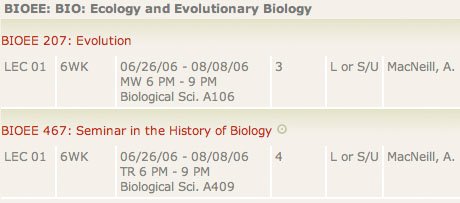
Several people have emailed me requesting information on the Cornell summer seminar on design and purpose in nature. In particular, there seems to be some confusion about the course title and description as it is listed in the online course catalog for the Cornell Summer Session. Here is a link to the page in which the course listing can be found (scroll down to Ecology and Evolutionary Biology/E&EB):

Evolution & Design: Is There Purpose in Nature?

and here is a link to the actual course description:

Course Description

As you can see, the course description in the online catalog is very brief and pretty generic, and the course title ("Seminar in History of Biology") doesn't mention design or purpose. Fear not! This is the correct course listing for the now somewhat notorious "design/purpose in nature seminar."

And, of course, please consider taking my introductory evolution course as well! We will be covering some of the same topics, and will take a historical and philosophical approach to the science of evolution. The class is generally small enough so that there is plenty of interaction between students and instructors (I usually have a couple of graduate student TAs), and we learn a lot about evolution and its implications (and have fun doing it).

There will also be a "course blog", which will be announced on this website soon. Watch this space!

--Allen

Labels: , , , , ,

Thursday, April 27, 2006

Cornell Daily Sun: Seminar Promises Intelligent Design Discussion


ARTICLE: Seminar Promises Intelligent Design Discussion

AUTHOR: Nadia Chernyak, Cornell Daily Sun Contributor

SOURCE: Cornell Daily Sun

COMMENTARY: Allen MacNeill (following the article)

Prof. Allen MacNeill, biology, will be offering a course about Intelligent Design, entitled "Evolution and Design: Is there a Purpose in Nature?". The course will be offered seminar-style over the summer of 2006, through the ecology and evolutionary biology, history and science and technology studies departments as well as the biology and society program.

The syllabus requires texts from authors both for and against intelligent design and includes optional texts, one of which is by Charles Darwin.

MacNeill first came up with the theme for the seminar when brainstorming with Prof. Will Provine, ecology and evironmental biology, for topics for this summer's seminar class. MacNeill says that the idea was inspired by the Kitzmiller v. Dover case, in which the Dover Area School District in Dover, Pa. was sued for requiring the teaching of intelligent design in high school science classes.

"Given the Dover case, [Provine and I] thought it'd be interesting to teach [this year's seminar] on Intelligent Design," MacNeill said.

MacNeill labels himself a "very vehement critic" of intelligent design but hopes to inspire debate and controversy in his classroom.

"I'm hoping I get people from both sides so that the discussion will be animated. The worst thing you can have is a dull seminar, which is what you have when people have the same belief or don't believe in anything," he said.

As part of the attempt to present both sides of the issue, MacNeill has also invited Hannah Maxson '07, president of the Intelligent Design and Evolution Awareness club, to help with the class. Questions from the students about books by Intelligent Design proponents will be fielded by Maxson. The class is currently capped at eighteen to keep it discussion-based, not a lecture, says MacNeill.

It appears that this is not MacNeill's first delve into the topic of Intelligent Design. MacNeill is also on the IDEA list-serve, keeps consistent email correspondence with the club, holds debates about the issue and has invited the IDEA president to give a lecture in one his classes last year. MacNeill describes his relationship with the IDEA club as an "agreement in a very courteous manner to disagree."

"I'm glad it's being offered," said Maxson. "Intelligent Design needs to be discussed more in academia and not just [as] some 'frightening political movement' that needs to be stopped."

Hannah is currently working with MacNeill to pull together intelligent design articles for the reading list. She's also been invited to the discussions once the class starts to help "provide a cogent case for Intelligent Design theory."

IDEA Executive Director Seth Maxson also gives approval, saying that this "is an example of Intelligent Design being accepted as an intriguing scientific theory by the wider academic community."

Enrollment prospects are also looking up. Seth claims to have already talked with a few students who plan to take the class.

"They all seem very excited," he said.

Despite said excitement, MacNeill appears to have been met with some skepticism from colleagues. Since announcing what his class will be about, MacNeill has received many questions and comments both from students and professors via his personal blog. "Evolutionary biologists tended to be more negative about the course [than Intelligent Design advocates]," MacNeill said.

MacNeill also said that two colleagues have stated that the course shouldn't be offered in biology.

"I respectfully disagree," he said. "Most people in biology have a strong opinion on this, mostly negative. The knee-jerk response is to call the other side ignorant or dishonest; my experience is that that doesn't address the issue."

Though MacNeill claims to be "strongly skeptical of Intelligent Design, at the very least", he says he is not worried about one-sided enrollment.

"What's exciting for me is people taking strong positions. I hope students who haven't made up their minds make up their minds on the subject."

The class will require a detailed research paper in which the student must argue his/her position on the matter.

"Personally I believe if you do that you reject the idea," he chuckled. "But I find sometimes that that's not the case."

MacNeill has no immediate or definite plans to continue this class in the future, claiming that he would like to do other topics such as ethics and the question of free-will. However, there is some room for compromise.

"As long as Intelligent Design is in the news, maybe it makes sense to continue to do this," MacNeill said.

********************************************************************************
COMMENTARY:

Not a bad article, especially for the Sun. From all indications, it now appears that most attempts to "spin" the course in favor of intelligent design have fizzled out, and the true nature of the course is now apparent: as I have posted multiple times before, we will be reading about and discussing various concepts of purpose in nature and their relationship to evolutionary theory, including intelligent design theory. All of these concepts will be examined critically with a view toward determining which (if any) have an impact on the science of evolutionary biology, and what philosophical implications the current theory of evolution has for concepts of purpose in nature.

Not as outrageous or exciting as some of the early press reports would have you believe, but more interesting to me and (I hope) to the students who have already expressed an interest in the course.

--Allen

Labels: , , , , , , , , ,

Friday, April 14, 2006

Riding the Evolution-Design Roller Coaster


[Scroll Down For Update]

This has certainly been an educational experience...but what else should one expect at Cornell? The past week has been a roller coaster of media attention, not to mention extreme reactions from both sides of the issue. What started out as an act of kindness toward an old and dear friend (my colleague and mentor, Will Provine, who was originally scheduled to teach this course), turned into a media circus, conducted almost entirely online. Here's the backstory:

For years Will Provine and I have been teaching an undergraduate seminar in the Cornell Summer Session entitled "Seminar in History of Biology." Between ourselves, we have always called the course "philosophical implications of evolution," and have always thought of it in those terms. The course description stayed the same from year to year, but the focus of the course changed, depending on what we found most interesting to discuss with our students. For the past few years, Will has focussed on the implications of evolution for the concept of human free will. When I taught the course, I focused on three topics: the implications of evolution for free will, purpose, and ethics.

Last fall, when we began talking about the focus of the course for this summer, Will (who was scheduled to teach the course) decided to focus exclusively on "intelligent design theory." Anyone who knows Will (or me, for that matter) knows that he always invites people from the opposing side to make a presentation in his course. He has debated Phillip Johnson several times, both at Cornell and Stanford, and several ID theorists (including Michael Behe and John Stanford) have made presentations in his large evolution course at Cornell. And so, since we both know the students in the Cornell IDEA Club, we planned to contact them and see if they would be interested in participating in some way in the seminar course this summer.

Then tragedy struck in Will's family, and he was unable to committ to teaching the seminar this summer. He asked me to fill in for him, and I agreed to do so. I went ahead with our plans to invite the Cornell IDEA folks to participate and submitted the course description and reading list to the department and to the Summer Session.

The Cornell IDEA Club then posted a notice on their blog about the course, pointing out that it would be a seminar in which intelligent design theory would be discussed in the larger framework of its relationship to evolutionary theory. However (perhaps because of the source), this was immediately picked up by several websites supporting ID (most notably World Net Daily) and spun as "Cornell to Offer Course in Intelligent Design."

And that was when the roller coaster crested the top of the "pull" hill and started its free roll down. The Site Meter hit counter at the bottom of my blog, which had been reading < 50 hits/day jumped to > 600 hits/hour. I was unaware of this until I glanced at it early Monday morning and was non-plussed...what in the world was happening? By Tuesday, the spin had become positively centrifugal: the course, the proposed content, the reading list, the venue, and everything else about the course (including my personal character) were being debated by literally thousands of people who knew absolutely nothing about me nor (apparently) about the course.

Luckily my Site Meter shows referrals, and so I quickly found out where most of the traffic to my site was coming from and posted much more detailed clarifications of the course, mostly for the benefit of the vast army of people who don't know me nor where I stand on the issues. The result has been very interesting: although there is less euphoria among the ID supporters, there is respect for the fact that the course is intended to be a forum for free and open discussion on the topic of purpose in nature, with ID as one of the principle examples.

But not the only one, of course. As I pointed out in the course description, the concept of purpose is one that evolutionary biologists have debated and investigated for almost two centuries. Darwin himself talked about the idea of purpose in nature, in both the Origin of Species and The Descent of Man. No less eminent an evolutionary biologist than Ernst Mayr wrote several important papers on the subject, responding to other papers by such luminaries in the field as Francisco Ayala, Colin Pittendrigh, and William Wimsat. Philosophers have also weighed in on the issue, beginning with Aristotle and including Andrew Woodfield, Ernst Nagel, and, most recently, Michael Ruse.

Most disconcerting to me were some of the early comments from evolutionary biologists, who asserted that ID should not even be mentioned in a course in evolutionary biology. Well, I not only teach a course on evolution, I also sit in on the other introductory evolution courses at Cornell and elsewhere, and ID theory is mentioned in all of them. True, it is mentioned in the context of an alternative explanation for adaptation in nature, one that is far outside the boundaries of mainstream science, but mentioned none the less.

The difference between what happens in a lecture course on evolution and what will happen this summer in the seminar course is that, rather than lecturing on the subject, I will (as always) invite the participants in the seminar to inform themselves about the subject and discuss it with as much clarity and vigor as they can muster. I believe (based on past experience) that when the cases for ID and evolutionary biology are fully and fairly made in this way, evolutionary biology will be the winner. After all, it has mountains of empirical evidence to back it up, and empirical evidence is the basis for all of science, as far as I understand it.

In answer to some of my critics from evolutionary biology, therefore, I feel that it is very appropriate for this kind of discussion to take place in a science course, rather than just a history or philosophy of biology course. Students, including science majors, are far too often not given enough credit for their ability to both formulate and judge rational arguments in a free and open forum of ideas. Despite the fact that the topic is ostensibly the philosophy of science, the debate over the validity of ID versus evolutionary theory is fundamentally a scientific debate. If scientists refuse to debate the subject, we will leave the floor open for not-quite-science, pseudoscience, and (worst of all) anti-science to claim victory, and believe me that will be what the general public perceives the ID community has achieved.

Furthermore, the paradox of purpose in nature is one that has not yet been solved by evolutionary biologists. What are evolutionary adaptations if not structural and functional characteristics that serve a purpose in the life of an organism? While it sounds silly to say that rocks fall "in order to" reach the ground, it doesn't sound silly to say that the heart pumps the blood "in order to" circulate it throughout the body. The debate over such explanations is not just semantic, and as Ernst Mayr pointed out in several articles and his book Toward a New Philosophy of Biology, focussing on the "purposefulness" of adaptations has important implications for evolutionary biology, as well as such diverse fields as cognitive psychology, epistemology, and the development of "expert" computer systems (not to mention "smart weapons" like the eminently teleological "Sidewinder" missile).

So, we shall proceed this summer, a little less naive about the "culture wars", but firmly in the belief that courteous, rational, informed discussion is the only reliable way to truth. And then, when we come to the end, we can step off the roller coaster, take a deep breath, and go look for a cotton candy stand.

UPDATE (as of Mon17Apr06@16:59EST)
After a week of riding the roller coaster, several discussions stand out as representing where things were and are (and probably will be, once the course actually starts). Here they are (be sure to scroll down and read the comments):

Design Paradigm: Evolution and Design

Design Paradigm: Teaching ID

Design Paradigm: Why Teach Design

Panda's Thumb: Comments on "Riding the Evolution-Design Roller Coaster"

Panda's Thumb: Neutrality, Evolution, and ID

Sounding the Trumpet: Cornell Offers First Class on Intelligent Design

Telic Thoughts: Cornell Offers Course on Intelligent Design I

Telic Thoughts: Cornell Offers Course on Intelligent Design II

Uncommon Descent: ID at Cornell, John Sanford and Allen MacNeill

Labels: , , , , , , , ,

Thursday, April 13, 2006

Evolution and Design: What Will the Course be About?


ARTICLE: Cornell to Offer Class on Intelligent Design

SOURCE: The Associated Press

COMMENTARY: Allen MacNeill (following the article)

ITHACA, N.Y. (AP) — Cornell University this summer will offer a class on intelligent design, a theory that has sparked heated debate around the country on whether alternatives to evolution should be taught in public schools.

The course will include texts that oppose and support the theory of intelligent design and will be offered through the undergraduate biology program. It will be a history of biology class that looks at ethics and philosophy.

"I'm not going to be bashing (intelligent design), but I'm also not going to be advocating it," said lecturer Allen MacNeill, an evolutionary biologist who will teach the course. "I'm going to be using it — and evolutionary biology too — to think about these very complicated ideas."

Cornell President Hunter Rawlings III in an Oct. 21 speech condemned the teaching of intelligent design as science, calling it "a religious belief masquerading as a secular idea."

Intelligent design is a theory that argues that life is too complex to have developed through evolution, implying a higher power must have had a hand. It has been harshly criticized by The National Academy of Sciences and the American Association for the Advancement of Science, which have called it repackaged creationism.

Around the country, attempts to introduce public school students to alternatives to evolution such as intelligent design have largely failed.

Hannah Maxson, president of the Intelligent Design Evolution Awareness Club at Cornell, said she is glad the issue is being taken seriously.

"We'd just like a place at the table in the scientific give-and-take," she said.

********************************************************************************
COMMENTARY:

Let me assure my faithful readers that I am not “teaching intelligent design” at Cornell Univesity this summer. Rather, I am offering a seminar course in which the participants (including me) will attempt to come to some understanding vis-a-vis the following:

As Ernst Mayr pointed out in his 1974 paper (”Teleological and Teleonomic: A New Analysis.” In Boston Studies in the Philosophy of Science, Volume XIV, pages 91 -117), it may be legitimate for evolutionary biologists to refer to adaptations as teleological. However, such adaptations have evolved by natural selection, which itself is NOT a purposeful process. Therefore, we have a fascinating paradox: purposefulness can evolve (as an emergent property) from non-purposeful matter (and energy, of course) via a process that is itself purposeless (as far as we can tell). This immediately suggests the following questions:

• Is there design or purpose anywhere in nature?
• If so, are there objective empirical means by which it can be detected and its existence explained?
• Can the foregoing questions be answered using methodological naturalism as an a priori assumption?
• What implications do the answers to these questions have for science in general and evolutionary biology in particular?

To answer these questions, we will read several books and a selection of articles on the subject of design and purpose in nature (the course description is available here). As you can see from the reading list, we will be looking at all sides of this very challenging issue. My own position is very strongly on the side of evolutionary biology (i.e. in the tradition of “methodological naturalism”). Consequently, I disagree very strongly with the positions of Michael Behe, William Dembski, Phillip Johnson, and other representatives of the Discovery Institute. I will therefore be attacking both their positions and the metaphysical assumptions upon which they are based with as much logic and vigor as I can muster. At the same time, I have invited members of the Cornell IDEA Club to participate in the course and to explain and defend their beliefs and positions. From my previous interactions with them, I expect that they will make an equally forceful and well-argued case for their position. The students taking the course will be expected to follow the arguments, participate in them, and come to their own conclusions, which they will then be required to defend to the rest of us. Regardless of whether they agree with me or with my opponents, their work will be judged on the basis of logical coherence and marshalling of references in support of their arguments.

As to the question of whether “intelligent design theory” is worthy of study (and is especially appropriate for a science-oriented seminar course), I have several reasons to believe that it is:

First, by clearly drawing a distinction between the traditional scientific approach (i.e. “methodological naturalism”) and the “supernaturalist” approach, we can clarify just what science is capable of (and what it isn’t). Like Ernst Mayr, I believe that the question of the existence of design or purpose in nature can ultimately be answered without resort to supernatural explanations. Indeed, as an evolutionary psychologist, I believe that we do have the ability to recognize design and purpose in nature (and to act purposefully ourselves), and that this ability is the result of natural selection. That is, both of these abilities have adaptive value in a world in which some phenomena are not designed and/or purposeful and others are (the latter having potentially fatal consequences if unrecognized).

Secondly, by studying what I believe to be a flawed attempt at identifying and quantifying design or purpose in nature, we may be able to do a better job of it. Clearly, there are purposeful entities capable of “intelligent design” in the universe: I am one and I infer that you are another. There are also objects and processes that clearly are not: the air we are both currently breathing clearly fall into this class. As a scientist committed to naturalistic explanations for natural phenomena, it is clear to me that there must be some way of discerning between these two classes of objects and processes, as both of them are clearly “natural.” Therefore, we will use several approaches to the identification and explanation of design and purpose to do so.

Thirdly, the recent resurrection of “intelligent design theory” has historical and political, as well as scientific roots. By studying these, we can learn better how science proceeds, how scientific hypotheses are tested, and how scientific theories are validated (and invalidated). In my opinion, “intelligent design theory” as it is currently promulgated falls far short of the criteria for natural science, but is very useful at demonstrating how to distinguish between science and pseudoscience.

Finally, the question of design and purpose in nature is one that goes back to the foundation of western philosophy. The Ionian philosophers - Thales, Anaximander, Democritus, Epicurus, and their Roman descendant Lucretius - were the first people in recorded history to assert that nature can be explained without reference to supernatural causes. Their ideas were overshadowed by the academy of Plato and his student, Aristotle, who proposed that supernatural and teleological causes were primary. Darwin revolutionized western science because he completed the subversion of the Platonic/Aristotelian world view, replacing it with a naturalistic one much more like that of the Ionians. It is this tradition we will investigate, and which I hope we can in some way emulate this summer.

Labels: , , , , , , , ,

Sunday, April 09, 2006

Evolution and Design: Is There Purpose in Nature?


I am very pleased and excited to announce the following new course at Cornell:

COURSE LISTING: BioEE 467/B&Soc 447/Hist 415/S&TS 447 Seminar in History of Biology

SEMESTER: Cornell Six-Week Summer Session, 06/27/06 to 08/03/06

COURSE TITLE: Evolution and Design: Is There Purpose in Nature?

COURSE INSTRUCTOR: Allen MacNeill, Senior Lecturer in Ecology & Evolutionary Biology, Cornell University

COURSE DESCRIPTION: This seminar addresses, in historical perspective, controversies about the cultural, philosophical, and scientific implications of evolutionary biology. Discussions focus upon questions about gods, free will, foundations for ethics, meaning in life, and life after death. Readings range from Charles Darwin to the present (see reading list, below).

The current debate over "intelligent design theory" is only the latest phase in the perennial debate over the question of design in nature. Beginning with Aristotle's "final cause," this idea was the dominant explanation for biological adaptation in nature until the publication of Darwin's Origin of Species. Darwin's work united the biological sciences with the other natural sciences by providing a non-teleological explanation for the origin of adaptation. However, Darwin's theory has been repeatedly challenged by theories invoking design in nature.

The latest challenge to the neo-darwinian theory of evolution has come from the "intelligent design movement," spearheaded by the Discovery Institute in Seattle, WA. In this course, we will read extensively from authors on both sides of this debate, including Francisco Ayala, Michael Behe, Richard Dawkins, William Dembski, Phillip Johnson, Ernst Mayr, and Michael Ruse. Our intent will be to sort out the various issues at play, and to come to clarity on how those issues can be integrated into the perspective of the natural sciences as a whole.

In addition to in-class discussions, course participants will have the opportunity to participate in online debates and discussions via the instructor's weblog. Students registered for the course will also have an opportunity to present their original research paper(s) to the class and to the general public via publication on the course weblog and via THE EVOLUTION LIST.

INTENDED AUDIENCE: This course is intended primarily for students in biology, history, philosophy, and science & technology studies. The approach will be interdisciplinary, and the format will consist of in-depth readings across the disciplines and discussion of the issues raised by such readings.

PREREQUISITES: None, although a knowledge of evolutionary theory and philosophy of biology would be helpful.

DAYS, TIMES, & PLACES: The course will meet on Tuesday and Thursday evenings from 6:00 to 9:00 PM in Mudd Hall Room 409 (The Whittaker Seminar Room), beginning on Tuesday 27 June 2006 and ending on Thursday 3 August 2006. We will also have an end-of-course picnic at a location TBA.

CREDIT & GRADES: The course will be offered for 4 hours of credit, regardless of which course listing students choose to register for. Unless otherwise noted, course credit in BioEE 467/B&Soc 447 can be used to fulfill biology/science distribution requirements and Hist 415/S&TS 447 can be used to fulfill humanities distribution requirements (check with your college registrar's office for more information). Letter grades for this course will be based on the quality of written work on original research papers written by students, plus participation in class discussion.

COURSE ENROLLMENT & REGISTRATION: All participants must be registered in the Cornell Six-Week Summer Session to attend class meetings and receive credit for the course (click here for for more information and to enroll for this course). Registration will be limited to the first 18 students who enroll for credit. Auditors may also be allowed, space permitting (please contact the Summer Session office for permission to audit this course).

REQUIRED TEXTS (all texts will be available at The Cornell Store):

Behe, Michael (2006) Darwin's Black Box: The Biochemical Challenge to Evolution
Paperback: 352 pages
Publisher: Free Press
ISBN: 0743290313

Dawkins, Richard (1996) The Blind Watchmaker: Why the Evidence of Evolution Reveals a Universe Without Design
Paperback: 400 pages
Publisher: W. W. Norton (reissue edition)
ISBN: 0393315703

Dembski, William (2006) The Design Inference : Eliminating Chance through Small Probabilities
Paperback: 272 pages
Publisher: Cambridge University Press
ISBN: 0521678676

Johnson, Phillip E. (2002) The Wedge of Truth: Splitting the Foundations of Naturalism
Paperback: 192 pages
Publisher: InterVarsity Press
ISBN: 0830823956

Ruse, Michael (2006) Darwin and Design: Does Evolution Have a Purpose?
Paperback: 384 pages
Publisher: Harvard University Press
ISBN: 0674016319

OPTIONAL TEXTS (all texts will be available at The Cornell Store):

Darwin, Charles (E. O. Wilson, ed.) (2006) From So Simple a Beginning: Darwin's Four Great Books
Hardcover: 1,706 pages
Publisher: W. W. Norton
ISBN: 0393061345

Dembski, William & Ruse, Michael (2004) Debating Design: From Darwin to DNA
Hardcover: 422 pages
Publisher: Cambridge University Press (July 12,
ISBN: 0521829496

Forrest, Barbara & Gross, Paul R. (2004) Creationism's Trojan Horse: The Wedge of Intelligent Design
Hardcover: 416 pages
Publisher: Oxford University Press, USA
ISBN: 0195157427

Graffin, Gregory W. (2004) Evolution, Monism, Atheism, and the Naturalist World-View
Paperback: 252 pages
Publisher: Polypterus Press (P.O. Box 4416, Ithaca, NY, 14852; can be purchased online at:
http://www.cornellevolutionproject.org/obtain.html)
ISBN: 0830823956

Perakh, Mark (2003) Unintelligent Design
Hardcover: 459 pages
Publisher: Prometheus Books
ISBN: 1591020840

For more information about this course, click here to email me directly.

Labels: , , , , , , , ,

Saturday, February 11, 2006

Princeton President Defends Evolution


AUTHOR: Jeffrey Shallit

SOURCE: The Panda's Thumb

COMMENTARY: Allen MacNeill (following the article)

Apparently 2005 was the year that presidents of Ivy League universities decided to give speeches defending evolutionary biology and attacking "intelligent design theory." The president of Cornell, Hunter Rawlings III, gave a speech to the Cornell board of trustees on 25 October 2005 in which he lambasted "intelligent design theory" (full text of Rawlings' speech). Rawlings comments made international headlines, and stirred the ire of the Discovery Institute, home of "intelligent design theory."

Now comes news that Shirley M. Tilghman, president of Princeton University, delivered the 2005 Romanes Lecture at Oxford University on December 1, 2005. Her lecture was entitled “Strange Bedfellows: Science, Politics and Religion”, and addressed both evolution and intelligent design. Jeffrey Shallit has posted some excerpts from Tilghman's speech at The Panda's Thumb. The full text of president Tilghman's speech can be found here.

Here are the excerpts posted at Panda's Thumb:

“If cosmologists are deciphering the origins of the universe and our solar system in unprecedented ways, biologists are making enormous strides, thanks to the technology that was developed during the Human Genome Project, toward unlocking the origins of life on Earth. Yet here, too, science and politics have found themselves at loggerheads. It is impossible to ignore the increasing assertiveness of elements within American society who have challenged the validity of Darwin’s theory of natural selection and have lobbied for an alternative explanation, which they term “intelligent design,” to be taught in public schools alongside the principles of evolution. This is deeply disturbing, for the theory of natural selection is one of the two pillars, along with Mendel’s laws of inheritance, on which all of modern biology is built. It is virtually impossible to conduct biological research and not be struck by the power of Darwin’s theory of natural selection to shed light on the problem at hand. Time and again in the course of my career, I have encountered a mysterious finding that was explained by viewing it through the lens of evolutionary biology. The power of the theory of natural selection to illuminate natural phenomena, as well as its remarkable resilience to experimental challenge over almost 150 years, has led to its overwhelming acceptance by the scientific community.”

“Today, however, under the banner of “intelligent design,” Christian fundamentalists in the United States have launched a well-publicized assault on the theory of evolution, suggesting that the complexity and diversity of nature is not the product of random mutation and natural selection but rather of supernatural intent. Although exponents of intelligent design have been at pains to distance themselves from overtly religious interpretations of the universe, the intellectual roots of intelligent design can be traced to creationism, which holds that the natural world, including human beings in their present form, is the handiwork of a divine designer — namely, God. Biblical creationists contend that the world was created in accordance with the Book of Genesis — in six short days — while the followers of intelligent design eschew this literalism. They say that their goal is to detect empirically whether the “apparent design” in nature is genuine design, in other words, the product of an intelligent cause. They reject out of hand one of the central tenets of natural selection, namely, that biological change arises solely from selection upon random mutations over long periods of time. For those of you who are not conversant with the literature of intelligent design, the argument usually begins with Darwin himself, who said “If it could be demonstrated that any complex organ existed which could not possibly have been formed by numerous, successive, slight modifications, my theory would absolutely break down.” From there, advocates such as Michael Behe, a professor of physical chemistry at Lehigh University, declare that “natural selection can only choose among systems that are already working, so the existence in nature of irreducibly complex biological systems poses a powerful challenge to Darwinian theory. We frequently observe such systems in cell organelles, in which the removal of one element would cause the whole system to cease functioning.”

“What is wrong with this view? To begin with, it reflects a fundamental misunderstanding of how evolution works. Nature is the ultimate tinkerer, constantly co-opting one molecule or process for another purpose. This is spurred on by frequent duplications in the genome, which occur at random. Mutations can accumulate in the extra copy without disrupting the pre-existing function, and those that are beneficial have the potential to become fixed in the population. In other instances, entirely new functions evolve for existing proteins. My favorite example is lactate dehydrogenase, which functions as a metabolic enzyme in the liver and kidney in one context, and as one of the proteins that makes up the transparent lens of the eye in another. In the first cellular setting, the protein has a catalytic function; in the second, a structural one.”

“A common weapon that is used to advance the “theory” of intelligent design is to posit that evolutionary biology cannot explain everything — that there remains uncertainty in the fossil record and that there is as yet no consensus on the origin or nature of the first self-replicating organisms. This, too, reflects a basic misunderstanding about how science works, for, in fact, all scientific theories, even those that are approaching 150 years of age, are works in progress. Scientists live with uncertainty all the time and are not just reconciled to it but understand that it is an integral part of scientific progress. We know that for every question we answer, there is a new one to be posed. Indeed, the very word, “theory,” is misunderstood by many who take it to mean an “idea” that has no greater or lesser merit than any other idea. The fact that Darwin’s “ideas” on natural selection have stood the test of time through keen experimental challenge does not give his theory special status in their eyes. There are also those who exploit the fact that scientists often disagree over the interpretation of specific findings or the design of experiments to argue that nothing is settled and thus anything is possible. The fact of the matter is that fierce disagreement is the stuff of scientific inquiry, and the constant give-and-take is needed to test the mettle of our ideas and sharpen our thinking. It is not, as many would claim, prima facie evidence for deep fissures in the central tenets of natural selection.”

**********************************************************************************
COMMENTARY:

University presidents, like Rawlings and Tilghman, have a vested interest in maintaining the integrity of science, especially at the college and university level. Yes, I know, universities started out as religious institutions, but that is generally no longer true. It is especially not true of Cornell, which was the first major university in the world to be founded without a sectarian focus. This was due primarily to the fact that Ezra Cornell was a Quaker, and therefore there could be no divinity school at his university. For those who don't know, Quakers have neither formal creeds nor divinity schools or theology programs. Several colleges were founded by Quakers, especially in the United States – Earlham and Swarthmore come to mind – but even there, Quakerism was a background "culture" but was never officially taught as a subject in theology, nor did they ever award degrees in divinity.

Since its founding Cornell has therefore had a reputation as "that godless institution in Ithaca," a reputation that was enhanced early on when its first president, Andrew Dickson White, published a monumental two-volume work on The Warfare Between Science and Theology in Christendom. White's book was immensely influential at the time of its publication, and reinforced the ascendancy of Darwinian theory in the United States.

I hope that this trend continues, and that college and university presidents everywhere will speak out against politically motivated attempts by quasi-Fundamentalist organizations like the Discovery Institute to undermine research and teaching in science. After all, there are plenty of religious colleges and universities in the United States, where Fundamentalists and their supporters can promote their views.

If religiously motivated "scientists" want to try to change the minds of their colleagues, let them do it the old-fashioned way: get out in the field (or in the lab) and do some actual empirical research, analyze the results, and submit them for publication in genuine peer-reviewed journals. If there really is anything observable in nature to back up their hypotheses, this should be no problem. And believe me, the first "intelligent design theorist" who manages to do so will easily become as famous as Darwin or Einstein...after, but not before they make such a breakthrough.

--Allen

**********************************************************************************
ORIGINAL PUBLICATION REFERENCE:

Location Online:
The Panda's Thumb
URL: http://www.pandasthumb.org/archives/2006/02/princeton_presi.html#more

Original posting/publication date timestamp:
February 11, 2006 08:27 AM

**********************************************************************************

Labels: , , , , , , , , , ,