Sunday, May 29, 2011

The Metaphysical Foundations of Modern Science

I started attending the weekly meetings of the Ithaca Friends Meeting in September, 1969. One of the people who made an immediate and lasting impression on me was an older gentlemen, always impeccably dressed, who sometimes spoke in meeting in a quavery, but very determined voice. His "messages" were always very literate, but not necessarily complicated. I was eventually introduced to him, and learned that his name was "Ned" Burtt, and that he was one of the founders of the Ithaca meeting.

After several years we became good friends, but only in the context of the Friends Meeting. I got to know his wife, Marjory, with whom I had many very engaging conversations. She was a retired psychotherapist with an interest in Eastern philosophy, especially Buddhism. I didn't have as many conversations with Ned, not because he wasn't willing, but because he was almost completely deaf. Indeed, after a few years I noticed that Marjory and some of his older friends took turns sitting next to him in meeting, and when someone rose to speak, would write down what they said on a slip of paper and pass it to Ned.

Year later I was co-teaching a course on the history and philosophy of science, for which the teaching staff had chosen as one of the required readings a "classic" in the history of science, The Metaphysical Foundations of Modern Science, by Professor Edwin Arthur Burtt, the Susan Lynn Sage Professor of Philosophy at Cornell University. Translated into dozens of languages and continuously in print since 1924, Burtt's Metaphysical Foundations was often mentioned as the precursor to Thomas Kuhn's The Structure of Scientific Revolutions, and one of the seminal texts in the history of science.

Imagine my surprise (and chagrin) when I discovered that "Ned" Burtt of the Ithaca Friends Meeting was Prof. Edwin Arthur Burtt himself, author of the Metaphysical Foundations and perhaps the most famous historian of science in the first half of the 20th century. Characteristically, he never mentioned it in any of our conversations (brief and halting as they were), and no one else in meeting seemed to think it important enough to mention either.

Ned died in 1989 at the age of 97, and was memorialized at the Ithaca Meeting in our usual way – a silent meeting, punctuated by a few heart-felt "messages" from his friends. I think of him now as I am re-reading once again his Metaphysical Foundations, and am once again struck by his keen insight and masterful use of language. Here's just one sample:
"The glorious romantic universe of Dante and Milton, that set no bounds to the imagination of man as it played over space and time, had now been swept away. Space was identified with the realm of geometry, time with the continuity of number. The world that people had thought themselves living in – a world rich with colour and sound, redolent with fragrance, filled with gladness, love and beauty, speaking everywhere of purposive harmony and creative ideals – was crowded now into minute corners in the brains of scattered organic beings. The really important world outside was a world hard, cold, colourless, silent, and dead, a world of quantity, a world of mathematically computable motions in mechanical regularity. The word of qualities as immediately perceived by man became just a curious and quaint minor effect of that infinite machine beyond. In Newton the Cartesian metaphysics, ambiguously interpreted and stripped of its distinctive claim for serious philosophical consideration, finally overthrew Aristotelianism and became the predominant world-view of modern times.
*Whew* - talk about a splash of cold water in the face. It is this world-view – the one that forms the basis of all of modern science, including biology – that depresses and terrifies those who cannot live without the "old magic" and motivates those who want to tear down "modern" science and go back to the pre-scientific world-view, what Carl Sagan called "the demon-haunted world." But, just like the magic realm of childhood, there is no going back now, not to the innocent and often terrifying universe of the childhood of our cultures. In the words of Bertrand Russell (one of Ned Burtt's contemporaries):
"That Man is the product of causes which had no prevision of the end they were achieving; that his origin, his growth, his hopes and fears, his loves and beliefs, are the outcome of accidental collections of atoms...that all the labours of the ages, all the devotion, all the inspiration, all the noonday brightness of human genius, are destined to extinction in the vast death of the solar system, and that the whole temple of Man's achievement must inevitably be buried beneath the debris of a universe in ruins...only on the firm foundation of unyielding despair can the soul's habitation henceforth be safely built." – A Free Man's Worship [1923]
And so tomorrow (it's Memorial Day once again), I will go walking through the little grave yard out behind the Hector Meeting House where Ned and Marjory are buried, and think once again about the old, deaf gentleman whose messages were so eloquent and whose view of reality so unflinching.

************************************************

As always, comments, criticisms, and suggestions are warmly welcomed!

--Allen

Labels: , , , , ,

Saturday, May 02, 2009

How Not To Fight A "Culture War"


There has been an interesting and often heated discussion about "methodological naturalism" taking place at Uncommon Descent. After more than 350 comments, the dispute about what "methodological naturalism" was, and how long scientists have been practicing it was resolved in the way that most such discussions are resolved: with the participants agreeing to disagree.

I think it would be interesting for both sides in the debate around methodological naturalism (MN) to consider why this term has become so widely used in recent times. For the sake of argument, let us assume that the entire concept of MN only became "solidified" following Paul de Vries' coinage of the term in 1983. Also for the sake of argument, let us concede that prior to that time the use of "non-natural" assumptions was indeed legitimate for at least inspiring scientific research (as, indeed, history shows us was clearly the case). Let us then further assume that the current application of MN does indeed exclude any reference to "non-natural causes", either in the design of experimental tests of hypotheses or in their interpretation.

One might then reasonably ask, "What happened in the early 1980s that prompted such a dramatic shift in the perception of scientists, so dramatic that it led most scientists to reject what had previously been allowable: that is, the use of "non-natural" hypotheses as an inspiration for scientific research (if not necessarily also in the interpretation of the results of such research)?

I believe that if one examines what was happening the early 1980s vis-a-vis evolutionary biology, the answer to this question is obvious: the rise of "scientific creationism" (especially of the "young Earth" variety) as a political force in the U.S., culminating in the Supreme Court of the United States (SCOTUS)'s decision in Edwards v. Aguillard (
482 U.S. 578
) in 1987. During the 1960s, American science was promoted very vigorously, both by the U.S. government and by scientists themselves, as a reaction to scientific advances by the Soviet Union (particularly the launching of Sputnik, the first artificial satellite). Part of this promotion involved the formulation of the Biological Sciences Curriculum Study (BSCS) protocol and its associated textbooks (the "blue", "green", and "yellow" versions). All three versions stressed evolutionary theory as providing a foundation for the biological sciences. This was virtually the first time since 1925 (and the conviction of John T. Scopes for having violated Tennessee's Butler Act by teaching evolution in a public school classroom) that evolutionary theory had been so prominently featured in biology textbooks that were widely promoted in the American public school system.

This caused an immediate negative reaction among American evangelical Christian groups. Legislative bans on the teaching of evolution similar to the Butler Act were either reinstated or promoted in several states. At the same time, Henry Morris and other "scientific creationists" founded and promoted the "scientific creationism" movement, which sought to provide scientific evidence for their version of "young Earth creationism" (YEC). Not much actual science was done by these self-described YECs, but strenuous political efforts were undertaken to have their YEC reinterpretations of existing scientific information incorporated into public school curricula in several states (most notably Arkansas and Louisiana).

In reaction to these efforts by YECs, the scientific community partnered with the American Civil Liberties Union (ACLU) and allied organizations to bring such efforts to the attention of the SCOTUS, with the intention of having them outlawed as violating the first amendment to the US constitution. These efforts were ultimately successful, as both laws banning evolution from public school science classes and the attempts to insert YEC in public school science classes were struck down as unconstitutional by the SCOTUS. These events, and not the subsequent rise of Intelligent Design (ID), are the context within which the adoption of MN by the scientific community in the 1980s can most effectively be viewed.

From my interactions with them, I have found that some ID supporters are very strongly in sympathy with the YECs, and view ID as a way of getting their version of YEC back in the public schools. This was clearly the case in the Dover Area school board's 2005 attempt to provide students with alternative biology textbooks incorporating ID, as shown by the sworn testimony by several of the members of that school board and other members of the board who were present at meetings at which this plan was discussed and approved.

However, in my interactions with other ID supporters (and especially the members of the Cornell IDEA Club and some commentators at Uncommon Descent), I have come to understand that a significant fraction of ID supporters do not accept that YEC is a legitimate empirical science, nor support it's incorporation in public school science curricula.

The dispute that has occurred in this thread (and similar recent disputes elsewhere) seem to me to be examples of people "fighting the last war" rather than dealing with the situation as it exists today. ID supporters who are not YECs need to understand that most evolutionary biologists lump the two together, partly because of the behavior of the Dover Area school board and similar, more local situations in which YECs have persisted in pushing their views into the public schools. At the same time, evolutionary biologists and their political supporters need to understand that there is no necessary connection between YEC and ID, nor are they united in their conviction that YEC and ID must be incorporated into the public school curriculum today.

A recognition of the political contexts within which both evolutionary biologists and Intelligent Design supporters have come to their positions, and what these contexts imply about the value of possible further actions would be valuable for both sides in this debate. I have had many ID supporters say privately to me that Dover was a disaster for ID, and especially for its quest to be accepted as a legitimate empirical science. I have also had many evolutionary biologists express to me their opinion that there is essentially no difference between YEC and ID, a viewpoint that I have learned through experience is clearly in error.

Ergo, I have concluded that the most effective way to move forward in this debate is the way I have been conducting it since the mid-1990s. That is, to invite supporters of both sides of the debate to make presentations in my evolution courses and seminars at Cornell and to conduct such debates in public forums such as this website. Ironically, I find this venue to be much more congenial to such debates than places like AtBC, in which character assassination is the order of the day, rather than the last resort of people who are either confused about their own position or uncertain about its logical force.

And so, I recommend that all participants in this debate avoid name-calling and ad hominem arguments. For each committed commentator on both sides of this issue, there are many thousands of quiet observers who are trying to come to their own conclusions about the issues being debated. While mud-slinging is fun, it's fun in the same way that smoking or drinking heavily is fun; it provides short-term personal gratification, but in the long term it undermines everything one is trying to accomplish.

I believe that clarity should be our goal, not necessarily agreement. If we come to clarity about our positions and agree to disagree, then we have accomplished a great deal more than we would have accomplished if our goal was simply to attack our opponents' characters or to question their personal motives. Going forward I will do my best to pursue this course of action, and recommend that all who genuinely wish to come to clarity on these issues and, by doing so, help the "silent watchers" of this forum to do so as well, treat each other as colleagues (in the "collegiate" sense of that word) in their pursuit of what they perceive to be the truth, rather than as enemies in a culture war.

************************************************

As always, comments, criticisms, and suggestions are warmly welcomed!

--Allen

Labels: , , , , , ,

Monday, July 28, 2008

Phillip Johnson & "Theistic Realism"


AUTHOR: Allen MacNeill

SOURCE: Original essay

COMMENTARY: That's up to you...


Phillip Johnson, one of the founders of the intelligent design movement, has proposed an alternative form of reasoning to that used by modern scientists. He refers to his form of reasoning as "theistic realism", while the alternative could be called "empirical naturalism". In this blog post, I intend to contrast these two forms of reasoning, to determine what assumptions one must hold to apply them, and what consequences flow from adopting one or the other position, which I freely admit at the outset are essentially metaphysical (i.e. not scientific) positions.

According to Charles Darwin, Ernst Mayr (and most other evolutionary biologists), evolution has two stages:
• the origin of variations via various mechanisms
• the origin of adaptations via natural selection

Johnson's critique of evolution centers on the origin and patterns of variation, since he has repeatedly granted in various venues that natural selection occurs. However, according to Johnson, "God" (i.e. the supernatural entity/force behind "theistic realism") causes and/or guides the generation of variations, leaving natural selection as a mere "stabilizing force" that only maintains adaptations by weeding out unfit individuals. In this sense, Johnson's version of "natural selection" is virtually indistinguishable from that proposed in 1835-37 by Edward Blyth.

There are two fundamental problems with Johnson's position, one theological and one metaphysical:

• First, the idea that stabilizing selection maintains God-created variations is essentially a form of "statistical norming", and therefore violates the Judeo-Christian (and presumably, "theistically realistic") principle of "sanctity of the individual". If "not a sparrow falls, but that [God is] mindful of it", then God doesn't (indeed, cannot) treat individuals (including, presumably, individual humans) as instrumental entities (i.e. as means, rather than as ends) by weeding them out if they depart too much from the statistical norm of His created types. But, if God does pay attention and therefore intervenes on behalf of any and all individuals, then stabilizing selection doesn't really exist, and we are back to a theory of "theistic evolution" in which God directly intervenes in nature, controlling and guiding (i.e. determining) absolutely everything that happens at all times and in all places.

• Second, if Johnson grants that God directly intervenes only in the generation of variations (and lets stabilizing selection maintain the particular variations He specifies), there are still two alternatives:

- That God creates a multiplicity of variations, and then lets natural selection operate to choose which ones will become adaptations; or

- That God determines which variations will be adaptive at the instant of their creation, thereby rendering natural selection (and all naturalistic mechanisms of variation) superfluous.

In the first case, God not only commits the sin of "statistical norming" (as described above), the process by which He does so would result in a pattern of evolutionary change that would be virtually indistinguishable from purely naturalistic evolution by natural selection, which does not require God to intervene at all. He would, in other words, render Himself and His actions completely pointless and invisible.

But in the second case, the apparent stabilizing selection described earlier is illusory, since all created individuals would be ipso facto adaptive. Indeed, unless God deliberately intends to create maladaptive individuals that depart significantly from the adaptive norm (and which therefore would be eliminated by selection), there should be virtually no maladaptive individuals at all, which should be easily verifiable by empirical analysis.

Either Johnson must grant that stabilizing selection does, in fact, operate (and God is therefore not mindful of individuals, but only of types), or he must grant that it does not. In the second case, natural selection doesn't really happen at all, at any level, and God must therefore intervene directly in the survival and reproduction of every living organism that has ever existed, exists, or ever will exist. Furthermore, God does this despite the fact that only one type of organism, namely humans, has any choice about its behavior, about its living or dying (as far as we can tell).

To sum up, either:

• God (or the “Intelligent Designer”) intervenes directly in evolution via stabilizing selection, thereby destroying uncountable trillions of His creations (all of them innocent except humans, and even some of them, too) in order to "stabilize" His specified adaptations, or

• God (or the “Intelligent Designer”) doesn't intervene via stabilizing selection, in which case He's either irrelevant (i.e. natural selection "just happens") or He completely determines absolutely every event that occurs throughout all time and space, in which case "free will" (and therefore sin) is an illusion.

Furthermore, since Johnson grants that natural selection really does occur, but only as stabilizing selection, this limits God's intervention in the evolutionary process to the instant of the creation of variations. Under such conditions, the circumstances following this instant are empirically indistinguishable from pure naturalistic processes, regardless of whether God "specifies" such variations. Either that, or such variation is essentially random (and therefore "Godless" and “unspecified”).

But this position puts Johnson inescapably in the position of arguing once again for a "God of the gaps" position, since the only intervention God is capable of under such conditions is into the generation of variations; what happens afterwards is essentially "Godless". This is a "God of the gaps" position because there are only two alternative scenarios:

• A mechanism that produces variations that does not rely upon supernatural intervention will eventually be discovered and applied to the entire fossil and genetic record, the "gap" will be closed, and God (like the Baker) will "softly and silently vanish away"; or

• No matter when one inquires, a mechanism that unambiguously does not rely upon supernatural intervention will not yet have been (and indeed, cannot ever be) discovered.

It would seem like the second situation would validate Johnson's position. However, the second situation involves a fundamental (i.e. metaphysical) problem: the only absolutely validating outcome for the second alternative is that every possible mechanical (i.e. "Godless") explanation for the origin of variations must have been tested and falsified. This is a metaphysical impossibility, as the empirical method relies on induction, and no amount of positive evidence for Johnson's hypothesis (i.e. negative evidence for a "Godless" origin of variations) is enough to absolutely validate it (unless Johnson wishes to declare himself a logical positivist, which seems highly unlikely).

Given the foregoing, it appears that Johnson's assertion that God guides the origin of variations directly violates Popper's falsifiability criterion (just as Johnson claims evolutionary theory does). This is because, no matter how fine a level of discrimination one specifies for ruling out supernatural intervention in the origin of variations, Johnson can claim that God's intervention lies somewhere "deeper" (even if we someday get down to the level of sub-subatomic particles).

But, at some arbitrarily fine level of discrimination, either God's intervention will "jump out" of the statistical analysis (i.e. it will violate accepted principles of statistical reliability) or it won't. If it doesn't, the hypothesis of God's direct intervention in the origin of variations will have once again become unnecessary, and by the standard of parsimony (i.e. "Occam's razor"), if a causal factor is unnecessary, it isn't included in a scientific (i.e. empirically grounded) explanation of a phenomenon.

When one examines Johnson's metaphysical positions on these subjects, it is clear that he doesn't give a damn about empirical validation or falsifiability or statistical reliability or anything else that could conceivably be called "scientific". For example, in Defeating Darwinism by Opening Minds [1], Johnson states quite unequivocally:

"Truth (with a capital T) is truth as God knows it. When God is no longer in the picture there can be no Truth, only conflicting human opinions. (There also can be no sin, and consciousness of sin is that built-in moral compass [pro-Darwinian philosophers] reject...as illusory.)" [Defeating Darwinism by Opening Minds, page 89]


In my opinion, no more succinct a statement of anti-scientific thinking could be imagined. Johnson asserts that the only two alternatives are
(1) God-given Truth and
(2) conflicting human opinions.
Where, in either of these, is empirical verification? Is "God-given Truth" amenable to empirical verification? If Johnson thinks so, he flies in the face of centuries of both scientific and theological metaphysics, which has consistently concluded exactly the opposite. But what about the alternative: is Johnson asserting that all scientific principles, such as the law of gravity, are "human opinions"? This was the position taken by the author of the "Sokol Hoax", which of course was shown to be both a hoax and an indirect validation of the assumption that physical laws are not subject to human opinions. Ergo, if Phillip Johnson were of the opinion that the law of gravity does not apply to him, could he thereby escape its operation? Don't be ridiculous...

Johnson argues that we should, as scientists, conflate two totally incommensurate forms of "knowing":

Deontological Absolutism - a universe in which God's direct intervention in events occurring in the real world is self-evident and does not require empirical verification (in fact, to attempt such verification would qualify as blasphemy), or

Scientific Empiricism - a universe in which the assumption that God intervenes in any event that occurs in the phenomenal/physical universe is unnecessary, and therefore irrelevant to such an explanation.

That's what all this really comes down to: Johnson's "theistic realism" is semantically reducible to "its True because I say so, and I say so because I believe that God says so, too", since no amount of empirical evidence can either validate (or invalidate) his position. The only "proof" he provides (or requires) for his position is his assertion of it. Interesting, perhaps, as an exercise in theological metaphysics (not to mention hubris), but not, by any stretch of the imagination, science.

REFERENCES CITED:

[1] Johnson, Phillip (1997) Defeating Darwinism by Opening Minds, InterVarsity Press, Downers Grove, IL, ISBN #0830813624, 137 pages.

As always, comments, criticisms, and suggestions are warmly welcomed!

--Allen

Labels: , , , , ,

Friday, April 18, 2008

Evolution and Ethics: Is Morality Natural?


ANNOUNCEMENT: Seminar in History of Biology

AUTHOR: Allen MacNeill

COMMENTARY: Allen MacNeill

First the announcement, followed by a brief commentary:

I am very excited to announce the following course, to be offered this summer in the six-week summer session at Cornell University:

COURSE LISTING: BioEE 467/B&Soc 447/Hist 415/S&TS 447 Seminar in History of Biology

SEMESTER: Cornell Six-Week Summer Session, 06/24/08 to 07/31/08

COURSE TITLE: Evolution and Ethics: Is Morality Natural?

COURSE INSTRUCTOR: Allen MacNeill, Senior Lecturer in Ecology & Evolutionary Biology, Cornell University

COURSE DESCRIPTION: This seminar addresses, in historical perspective, controversies about the cultural, philosophical, and scientific implications of evolutionary biology. Discussions focus upon questions about gods, free will, foundations for ethics, meaning in life, and life after death. Readings range from Charles Darwin to the present (see reading list, below).

In 1871, Charles Darwin wrote in The Descent of Man "…the first foundation of the moral sense lies in the social instincts…and these instincts no doubt were primarily gained…through natural selection.” A century later, Edward O. Wilson, in
Sociobiology: The New Synthesis
, wrote “The biologist…realizes that self-knowledge is constrained and shaped by…natural selection. This simple statement must be pursued to explain ethics and ethical philosophers….”

And so it has: in the past few years the publication of hypotheses for the evolution of ethics and “the moral sense” has become an explosive growth industry and a hot topic of debate. In this seminar course, we will take up this debate by considering two alternative hypotheses:

(1) that ethics can be derived directly from human evolutionary biology, or

(2) that ethics can only be derived from philosophical principles, which are not directly derivable from evolutionary biology.

Included in this debate will be an extended consideration of the hypothesis that the capacity for ethical behavior is an evolutionary adaptation that has evolved by natural selection among our primate ancestors. We will read from some of the leading authors on the subject, including Frans de Waal, Paul Farber, Marc Hauser, T. H. Huxley, Richard Joyce, Elliott Sober, and David Sloan Wilson. Our intent will be to sort out the various issues at play, and to come to clarity on how those issues can be integrated into a perspective of the interplay between philosophy and the natural sciences.

In addition to in-class discussions, course participants will have the opportunity to participate in online debates and discussions via the instructor's weblog. Students registered for the course will also have an opportunity to present their original research paper(s) to the class and to the general public via publication on the course weblog and via THE EVOLUTION LIST.

INTENDED AUDIENCE: This course is intended primarily for students in biology, history, philosophy, and science & technology studies. The approach will be interdisciplinary, and the format will consist of in-depth readings across the disciplines and discussion of the issues raised by such readings.

PREREQUISITES: None, although a knowledge of philosophical ethics, evolutionary psychology, and general evolutionary theory would be helpful.

DAYS, TIMES, & PLACES: The course will meet on Tuesday and Thursday evenings from 6:00 to 9:00 PM in Mudd Hall, Room 409 (The Whittaker Seminar Room), beginning on Tuesday 24 June 2008 and ending on Thursday 31 July 2008. We will also have an end-of-course picnic on Friday 25 July 2008.

CREDIT & GRADES: The course will be offered for 4 hours of credit, regardless of which course listing students choose to register for. Unless otherwise noted, course credit in BioEE 467/B&Soc 447 can be used to fulfill biology/science distribution requirements and Hist 415/S&TS 447 can be used to fulfill humanities distribution requirements (check with your college registrar's office for more information). Letter grades for this course will be based on the quality of written work on original research papers written by students, plus participation in class discussion.

COURSE ENROLLMENT & REGISTRATION: All participants must be registered in the Cornell Six-Week Summer Session to attend class meetings and receive credit for the course (click here for for more information and to enroll for this course). Registration will be limited to the first 18 students who enroll for credit.

REQUIRED TEXTS (all texts will be available at The Cornell Store):

de Waal, Frans (2006) Primates and philosophers: How morality evolved. Princeton University Press, Princeton, NJ, ISBN #0691124477, $22.95 (hardcover), 230 pages.

Farber, Paul (1998) The temptations of evolutionary ethics. University of California Press, Berkeley, CA, ISBN # 0520213696, $25.00 (paperback). 224 pages.

Hauser, Marc (2006) Moral minds: How nature designed our universal sense of right and wrong. Ecco/Harper Collins, New York NY, ISBN #0060780703, $27.95 (hardcover), 512 pages.

Huxley, T. H. (2004). Evolution and ethics & science and morals. Prometheus Books, Amherst, NY, ISBN #159102126X, $13.00 (paperback), 151 pages. Available free online here.

Joyce, Richard (2007) The evolution of morality. MIT Press, Cambridge, MA, ISBN #0262600722, $18.00 (paperback), 288 pages.

Sober, Elliot and Wilson, David Sloan (1999) Unto others: The evolution and psychology of unselfish behavior. Harvard University Press, Cambridge, MA, ISBN #0674930479, $22.50 (paperback), 416 pages.

OPTIONAL TEXTS:
(all texts will be available at The Cornell Store)

Darwin, Charles (E. O. Wilson, ed.) (2006) From So Simple a Beginning: Darwin's Four Great Books. W. W. Norton, New York, NY, ISBN #0393061345, $39.95 (hardcover), 1,706 pages.

Dawkins, Richard (2006) The selfish gene: Thirtieth anniversary edition. Oxford University Press, Oxford, UK, ISBN # 0199291152, $16.95 (paperback), 384 pages.

Dennett, Daniel (1996) Darwin's dangerous idea: Evolution and the meanings of life. Simon & Schuster, New York, NY, ISBN #068482471X, $16.00 (paperback), 586 pages.

Katz, Leonard (ed.) (2000). Evolutionary origins of morality. Imprint Academic, Charlottesville, VA, ISBN # 090784507X, $29.90 (paperback). 352 pages.

MacKinnon, Barbara (2006) Ethics: Theory and contemporary issues. Wadsworth, Boston , MA, ISBN #0495007161, $95.95 (paperback), 504 pages.

Ridley, Matt (1998) The origins of virtue: Human instincts and the evolution of cooperation. Penguin, New York, NY, ISBN #0140264450, $15.00 (paperback), 304 pages.

Wright, Robert (1995) The moral animal: Why we are the way we are: The new science of evolutionary psychology. Vintage, New York, NY, ISBN #0679763996, $15.95 (paperback), 496 pages.

COMMENTARY:

Perhaps the most common fallacy in philosophy and science is the tendency to assume that because something is “natural” (whatever that means) it must, ipso facto, be “good” (whatever that means) as well. In
last summer’s evolution and history of biology seminar, we talked about this tendency at some length. This summer I intend to make it the primary focus of our discussions.

From a historical standpoint, the tendency to conflate “is” and “ought” statements has been one of the ongoing arguments about the implications of evolution ever since Darwin first proposed his theory in 1859. Indeed, Darwin himself wrote much on the subject, especially in The Descent of Man, and Selection in Relation to Sex, his second most popular (and controversial) book. It has also been one of the sources of both confusion and controversy about evolution today. In particular, evolutionary psychologists (among whom I number myself) have struggled with this problem, not always successfully.

Like last summer and the summer before, this is a fascinating topic and I hope that enough people will sign up for the course with opposing viewpoints on this subject to make for a very interesting and stimulating summer seminar.

So, watch this space; when the course blog goes up, I will announce it here and provide links to all and sundry. And remember:

"… the ethical progress of society depends, not on imitating [nature], still less in running away from it, but in combating it." – T. H. Huxley, Evolution and Ethics (1893)

--Allen

Labels: , , , ,

Saturday, February 17, 2007

More on Steve Fuller and "Social Epistemology"

SOURCE: Cornell IDEA Club

AUTHOR: Allen MacNeill

The debate begun in my previous post continues...

A poster to the Cornell IDEA Club listserve wrote:

"Fuller '... deserves to have his ideas discussed instead of lambasted.'"

Okay, here's something to discuss (a direct quote from Fuller):

"In this respect, 'our' side pulled its punches in the Science Wars when it refused to come out and say that the scientific establishment may not be the final word on what science is, let alone what it ought to be." [emphasis mine]

In that one sentence alone is encapsulated nearly everything that most practicing scientists find so deeply objectionable about Steve Fuller and his ilk. Let's take it apart:

"'our' side"

What precisely does Fuller mean by this? "Our side" in what way? "Our side" in the evolution/ID debate? The natural science/social science debate? The science/sociology debate? The "culture wars" that Phillip Johnson says ID is part of? What does it mean to say you're on a "side"?

When I debate with other scientists about scientific subjects, those debates can be pretty heated, but generally we're all on the same "side": the "side" of empirical verification/falsification of explanations of natural phenomena. In other words, we're all on the "science side," the side that does what it does based on the premise that such explanations should be grounded in observation of nature and the investigation of natural causes for natural phenomena.

I don't think that's what Fuller means by "our side." Sociologists in general, and "social epistemologists" in particular have as a basic starting assumption that all explanations of all phenomena (natural or otherwise) are ultimately socially constructed.

Now, I have no problem with that idea per se, as I believe as well that such explanations are indeed socially constructed. What I and other scientists have a problem with is the seemingly inevitable logical extension of that idea which most sociologists (and I would put Fuller in this camp) seem prone to: that nature itself is therefore "socially constructed." That's what "social epistemology" means, isn't it? That what we know about reality (i.e. epistemology) is socially constructed, and that therefore we can't actually know anything about nature at all outside of our social construction of it.

But this is precisely what science was and is supposed to be about: the discovery and understanding of what nature is, independent of our opinions and "social constructions." That's why statistical analysis was developed, to remove as much as possible our subjective/socially constrained interpretation of what our observations mean vis-a-vis our explanations about how nature works. That's why we have "double-blind" experimental protocols, and why we argue so vehemently over the validity of data and what it means for theories: because, in the end, all scientists agree that this is the best we can do at understanding how nature works.

But Fuller and his cohorts do not agree; they think that real scientific objectivity (and hence the entire scientific enterprise) is impossible, and that since all scientific explanations are "socially constructed," it all comes down to "sides" and "debates" and, most of all, WINNING. It call comes down to politics, in other words.

"Science Wars"

Here it is in a nutshell. Wars between whom, precisely? Between scientists, who believe that they really are able to say something about the nature of nature, and non-scientists, who believe that it's all really about political power and "hegemony" and "patriarchy" and winning. What happens when you fight a "war", including a "culture war"? Somebody WINS.

"the scientific establishment"

More tired 1970s radical political rhetoric, all dressed up in "scienciness" (like "truthiness" only more "scientific") to impress the gullible and gratify the "politically correct". Yes, I'd be the first to admit that there are "science establishments" - I live and work in one of them. But that's not what Fuller is talking about here. He's talking about the capital E Establishment: the "bad guys" on the other "side", the scientists who believe that they are describing physical reality, when what they are really doing is "oppressing" the poor and downtrodden of the world, the victims of "patriarchy" and "political hegemony" and their advocates, the "social epistemologists", who tell them that there is no objective reality outside of social discourse, and debates are all about WINNING and not about refining our understanding about how nature works.

His mention of the Sokal affair is also telling in this respect. The Sokal affair decisively exposed the intellectual bankruptcy at the heart of sociology and "social epistemology" - the belief that everything is socially constructed. Not just our understanding of reality, but reality itself.

"the final word on what science is"

Hmm, well, what does this tell us about Fuller et al? Who should have the "final word" about anything? The people doing it, or the people criticizing it? Who is the real subject - the monster or the critics (as Tolkein so eloquently put it)? True, scientists sometimes don't completely understand why they do things the way they do (i.e. some of them follow instructions, like an apprentice emulates a master), but this does not mean that scientists don't really understand why we do what we do and need somebody like Fuller to tell us.

Why not? Because social "scientists" like Fuller (and like ID "theorists") don't do natural science. They "interpret" or "criticize" or "analyze" what natural scientists do, but they don't do what natural scientists do. If they did, Alan Sokal's trick would not have worked, but instead it sucked them all in, so deep that some of them still don't realize how completely their intellectual bankruptcy was exposed by the "Sokal affair."

"let alone what it ought to be"

And there it is, right there in plain English. The people who DO science are probably the last people who should have anything to say about how science ought to be practised, right? Because, of course, we're all "blinded by science" and don't understand that it isn't about objective analysis of nature, it's about "social construction of reality" which ultimately is about politics (from the Greek polis, for "people"), which is about WINNING.

So, yes, I find it fascinating that ID advocates, the vast majority of whom are deeply committed Christians, can find common cause with Fuller and other "social epistemologists." Christian belief, as I understand it, is ultimately based on unshakable faith in the truth of the Word: the logos of the gospel of John. But, to somebody like Fuller, the Word is just another form of "social discourse", just part of a political struggle of which the ultimate point is WINNING. Why does Phillip Johnson call what he's doing part of a "culture war?" Why does William Dembski and Robert Crowther and Stephen Meyer and Jonathan Witt and Benjamin Wiker (but, significantly, not Michael Behe nor Gullielmo Gonzales, both natural scientists) agree with Johnson? Because that's what they're doing, they're fighting a war, and as I said in my last post, wars aren't about truth, they're about WINNING. Truth be damned, so long as your side WINS. "Lying for Jesus" is justified, and no amount of distortion of experimental results or character assassination or egregiously twisted and vicious propaganda is too much, so long as your side WINS.

Isn't the quotation from Fuller that stands at the top of this post an indication that he sees what he and other "social epistemologists" do is ultimately all about winning? Seems like it to me...

--Allen

Labels: , , ,

Thursday, February 15, 2007

On the "Darwin Fetish" and Other Political Oxymorons


SOURCE: Cornell IDEA Club

AUTHOR: Allen MacNeill

The IDEA Club at Cornell has recently been discussing the following quote by Steve Fuller, a sociologist and one of the "experts" who testified in support of "intelligent design" at the Dover trial in Pennsylvania last year:

"If you want to stop use of the word 'Darwinist' to capture modern evolutionary theory, then you should encourage people like Dawkins, Jones, Wilson, Watson, Ridley and (were he alive) Gould to stop talking about 'Origin of Species' etc. as if they were books of some secular Bible. This kind of thing doesn't happen in physics. The world-view implications of physics can be discussed, while giving due respect to Newton, Einstein, etc., without trying to find bits of their texts that anticipate or legitimise what the author wants to say today . From a sociological standpoint, the Darwin fetish is very weird, and doesn't seem to be related to any claims that creationists or ID people are making. Marx and Freud are the only figures who have been treated this way in recent memory – and you've seen what's happened to them…"

Here's my take on all of this:

It sounds to me like Fuller is objecting to the idea that biologists, especially evolutionary biologists, cite Darwin as a published authority when writing (and talking and teaching) about their own work. However, this is exactly what you're supposed to do in science: back up your assertions with citations whenever your assertions are not completely original. Fuller, who is not a natural scientist but rather a sociologist, doesn't seem to understand this basic fact. Indeed, he seems to think that citation is somehow illegitimate in science, even that it may indicate some kind of slavish adherence to dogma, rather than simply an attempt to ground one's own work in previous work on the same subject.

If I were to cite W. D. Hamilton on the subject of kin selection, for example, does that mean that I have some kind of "Hamilton fetish?" What if everyone who works on kin selection does the same thing; does this mean that we're "deifying Hamilton?" No, the whole idea is absurd; citation is both an accepted and indeed required part of standard science writing, teaching, and speaking.

It goes deeper than this, of course. The reason that Fuller was chosen as one of the "experts" in defense of "intelligent design" at the trial in Dover, PA was because Fuller (like many sociologists today) is a "post-modernist." This means that, like post-modernism's founders such as Foucault and Derrida, Fuller believes and promotes the idea that "all knowledge is reducible to 'discourse'" in which politics is the ultimate force, and political victory over one's intellectual opponents is the ultimate goal. Fuller and others like him argue that there is no such thing as "objective knowledge" at all, only competing ideologies. According to this view, science is just another way for the "dominant white patriarchal class to extend its hegemony" by forcing others to believe in its politically motivated view of reality, and that all intellectual debates are really just part of the ongoing class struggle for political power.

It surprises me, therefore, that "intelligent design" supporters would cite Fuller and promote his ideas, which are of course ultimately based on Marxist (and therefore atheist) theories. Politics indeed makes for strange bedfellows, and to see Christian supporters of ID cite Fuller and others like him as authorities and supporters of their world view strikes me as laughable and ultimately self-defeating.

Yet at the same time, it doesn't surprise me, because that's what "intelligent design theory" started out as and has remained: not science, not the legitimate search for knowledge derived from empirical analysis of nature, but rather politics, pure and simple. This is why IDers don't publish in scientific journals, but rather push their agenda in the media, the courts, and in elections. ID isn't science, it's politics, conducted by press release and lawsuit, and its goal isn't the expansion of knowledge or understanding, it's winning by whatever means possible: distortion, misrepresentation, mischaracterization, even character assassination and outright lying are sanctioned, so long as they promote the ultimate goal: the victory of ID (and therefore the forces of "good," i.e. Christianity) over evolution (and therefore the forces of "evil," i.e. evangelical atheism).

How else to explain such masterpieces of political propaganda as Phillip Johnson's The Wedge of Truth or Benjamin Wiker's Moral Darwinism? The former was written by the acknowledged founder of "intelligent design theory," and the latter was published with a foreword by William Dembski in which he lavishly praises Wiker for getting down to the real issues in the evolution/intelligent design debate. IOW, it's not about knowledge, it's all about winning folks, and cultural warfare (Johnson's term) is just politics by other means. And in cultural warfare as in war in general, the first casualty is the truth...

--Allen

Labels: , , ,

Friday, November 10, 2006

Thank Goodness! for Daniel Dennett


SOURCE: The Edge.com

AUTHOR: Daniel Dennett

COMMENTARY: Allen MacNeill

I thought readers of this blog might be interested in the fact that notorious atheist (and "Darwinist") Daniel Dennett very nearly died of a dissecting aortic aneurism last week. Did he "find God" like Anthony Flew and A. J. Ayer? Not quite…

THANK GOODNESS!
by Daniel C. Dennett

There are no atheists in foxholes, according to an old but dubious saying, and there is at least a little anecdotal evidence in favor of it in the notorious cases of famous atheists who have emerged from near-death experiences to announce to the world that they have changed their minds. The British philosopher Sir A. J. Ayer, who died in 1989, is a fairly recent example. Here is another anecdote to ponder.

Two weeks ago, I was rushed by ambulance to a hospital where it was determined by c-t scan that I had a "dissection of the aorta"—the lining of the main output vessel carrying blood from my heart had been torn up, creating a two—channel pipe where there should only be one. Fortunately for me, the fact that I'd had a coronary artery bypass graft seven years ago probably saved my life, since the tangle of scar tissue that had grown like ivy around my heart in the intervening years reinforced the aorta, preventing catastrophic leakage from the tear in the aorta itself. After a nine-hour surgery, in which my heart was stopped entirely and my body and brain were chilled down to about 45 degrees to prevent brain damage from lack of oxygen until they could get the heart-lung machine pumping, I am now the proud possessor of a new aorta and aortic arch, made of strong Dacron fabric tubing sewn into shape on the spot by the surgeon, attached to my heart by a carbon-fiber valve that makes a reassuring little click every time my heart beats.

As I now enter a gentle period of recuperation, I have much to reflect on, about the harrowing experience itself and even more about the flood of supporting messages I've received since word got out about my latest adventure. Friends were anxious to learn if I had had a near-death experience, and if so, what effect it had had on my longstanding public atheism. Had I had an epiphany? Was I going to follow in the footsteps of Ayer (who recovered his aplomb and insisted a few days later "what I should have said is that my experiences have weakened, not my belief that there is no life after death, but my inflexible attitude towards that belief"), or was my atheism still intact and unchanged?

Yes, I did have an epiphany. I saw with greater clarity than ever before in my life that when I say "Thank goodness!" this is not merely a euphemism for "Thank God!" (We atheists don't believe that there is any God to thank.) I really do mean thank goodness! There is a lot of goodness in this world, and more goodness every day, and this fantastic human-made fabric of excellence is genuinely responsible for the fact that I am alive today. It is a worthy recipient of the gratitude I feel today, and I want to celebrate that fact here and now.

To whom, then, do I owe a debt of gratitude? To the cardiologist who has kept me alive and ticking for years, and who swiftly and confidently rejected the original diagnosis of nothing worse than pneumonia. To the surgeons, neurologists, anesthesiologists, and the perfusionist, who kept my systems going for many hours under daunting circumstances. To the dozen or so physician assistants, and to nurses and physical therapists and x-ray technicians and a small army of phlebotomists so deft that you hardly know they are drawing your blood, and the people who brought the meals, kept my room clean, did the mountains of laundry generated by such a messy case, wheel-chaired me to x-ray, and so forth. These people came from Uganda, Kenya, Liberia, Haiti, the Philippines, Croatia, Russia, China, Korea, India—and the United States, of course—and I have never seen more impressive mutual respect, as they helped each other out and checked each other's work. But for all their teamwork, this local gang could not have done their jobs without the huge background of contributions from others. I remember with gratitude my late friend and Tufts colleague, physicist Allan Cormack, who shared the Nobel Prize for his invention of the c-t scanner. Allan—you have posthumously saved yet another life, but who's counting? The world is better for the work you did. Thank goodness. Then there is the whole system of medicine, both the science and the technology, without which the best-intentioned efforts of individuals would be roughly useless. So I am grateful to the editorial boards and referees, past and present, of Science, Nature, Journal of the American Medical Association, Lancet, and all the other institutions of science and medicine that keep churning out improvements, detecting and correcting flaws.

Do I worship modern medicine? Is science my religion? Not at all; there is no aspect of modern medicine or science that I would exempt from the most rigorous scrutiny, and I can readily identify a host of serious problems that still need to be fixed. That's easy to do, of course, because the worlds of medicine and science are already engaged in the most obsessive, intensive, and humble self-assessments yet known to human institutions, and they regularly make public the results of their self-examinations. Moreover, this open-ended rational criticism, imperfect as it is, is the secret of the astounding success of these human enterprises. There are measurable improvements every day. Had I had my blasted aorta a decade ago, there would have been no prayer of saving me. It's hardly routine today, but the odds of my survival were actually not so bad (these days, roughly 33 percent of aortic dissection patients die in the first twenty-four hours after onset without treatment, and the odds get worse by the hour thereafter).

One thing in particular struck me when I compared the medical world on which my life now depended with the religious institutions I have been studying so intensively in recent years. One of the gentler, more supportive themes to be found in every religion (so far as I know) is the idea that what really matters is what is in your heart: if you have good intentions, and are trying to do what (God says) is right, that is all anyone can ask. Not so in medicine! If you are wrong—especially if you should have known better—your good intentions count for almost nothing. And whereas taking a leap of faith and acting without further scrutiny of one's options is often celebrated by religions, it is considered a grave sin in medicine. A doctor whose devout faith in his personal revelations about how to treat aortic aneurysm led him to engage in untested trials with human patients would be severely reprimanded if not driven out of medicine altogether. There are exceptions, of course. A few swashbuckling, risk-taking pioneers are tolerated and (if they prove to be right) eventually honored, but they can exist only as rare exceptions to the ideal of the methodical investigator who scrupulously rules out alternative theories before putting his own into practice. Good intentions and inspiration are simply not enough.

In other words, whereas religions may serve a benign purpose by letting many people feel comfortable with the level of morality they themselves can attain, no religion holds its members to the high standards of moral responsibility that the secular world of science and medicine does! And I'm not just talking about the standards 'at the top'—among the surgeons and doctors who make life or death decisions every day. I'm talking about the standards of conscientiousness endorsed by the lab technicians and meal preparers, too. This tradition puts its faith in the unlimited application of reason and empirical inquiry, checking and re-checking, and getting in the habit of asking "What if I'm wrong?" Appeals to faith or membership are never tolerated. Imagine the reception a scientist would get if he tried to suggest that others couldn't replicate his results because they just didn't share the faith of the people in his lab! And, to return to my main point, it is the goodness of this tradition of reason and open inquiry that I thank for my being alive today.

What, though, do I say to those of my religious friends (and yes, I have quite a few religious friends) who have had the courage and honesty to tell me that they have been praying for me? I have gladly forgiven them, for there are few circumstances more frustrating than not being able to help a loved one in any more direct way. I confess to regretting that I could not pray (sincerely) for my friends and family in time of need, so I appreciate the urge, however clearly I recognize its futility. I translate my religious friends' remarks readily enough into one version or another of what my fellow brights have been telling me: "I've been thinking about you, and wishing with all my heart [another ineffective but irresistible self-indulgence] that you come through this OK." The fact that these dear friends have been thinking of me in this way, and have taken an effort to let me know, is in itself, without any need for a supernatural supplement, a wonderful tonic. These messages from my family and from friends around the world have been literally heart-warming in my case, and I am grateful for the boost in morale (to truly manic heights, I fear!) that it has produced in me. But I am not joking when I say that I have had to forgive my friends who said that they were praying for me. I have resisted the temptation to respond "Thanks, I appreciate it, but did you also sacrifice a goat?" I feel about this the same way I would feel if one of them said "I just paid a voodoo doctor to cast a spell for your health." What a gullible waste of money that could have been spent on more important projects! Don't expect me to be grateful, or even indifferent. I do appreciate the affection and generosity of spirit that motivated you, but wish you had found a more reasonable way of expressing it.

But isn't this awfully harsh? Surely it does the world no harm if those who can honestly do so pray for me! No, I'm not at all sure about that. For one thing, if they really wanted to do something useful, they could devote their prayer time and energy to some pressing project that they can do something about. For another, we now have quite solid grounds (e.g., the recently released Benson study at Harvard) for believing that intercessory prayer simply doesn't work. Anybody whose practice shrugs off that research is subtly undermining respect for the very goodness I am thanking. If you insist on keeping the myth of the effectiveness of prayer alive, you owe the rest of us a justification in the face of the evidence. Pending such a justification, I will excuse you for indulging in your tradition; I know how comforting tradition can be. But I want you to recognize that what you are doing is morally problematic at best. If you would even consider filing a malpractice suit against a doctor who made a mistake in treating you, or suing a pharmaceutical company that didn't conduct all the proper control tests before selling you a drug that harmed you, you must acknowledge your tacit appreciation of the high standards of rational inquiry to which the medical world holds itself, and yet you continue to indulge in a practice for which there is no known rational justification at all, and take yourself to be actually making a contribution. (Try to imagine your outrage if a pharmaceutical company responded to your suit by blithely replying "But we prayed good and hard for the success of the drug! What more do you want?")

The best thing about saying thank goodness in place of thank God is that there really are lots of ways of repaying your debt to goodness—by setting out to create more of it, for the benefit of those to come. Goodness comes in many forms, not just medicine and science. Thank goodness for the music of, say, Randy Newman, which could not exist without all those wonderful pianos and recording studios, to say nothing of the musical contributions of every great composer from Bach through Wagner to Scott Joplin and the Beatles. Thank goodness for fresh drinking water in the tap, and food on our table. Thank goodness for fair elections and truthful journalism. If you want to express your gratitude to goodness, you can plant a tree, feed an orphan, buy books for schoolgirls in the Islamic world, or contribute in thousands of other ways to the manifest improvement of life on this planet now and in the near future.

Or you can thank God—but the very idea of repaying God is ludicrous. What could an omniscient, omnipotent Being (the Man Who has Everything?) do with any paltry repayments from you? (And besides, according to the Christian tradition God has already redeemed the debt for all time, by sacrificing his own son. Try to repay that loan!) Yes, I know, those themes are not to be understood literally; they are symbolic. I grant it, but then the idea that by thanking God you are actually doing some good has got to be understood to be just symbolic, too. I prefer real good to symbolic good.

Still, I excuse those who pray for me. I see them as like tenacious scientists who resist the evidence for theories they don't like long after a graceful concession would have been the appropriate response. I applaud you for your loyalty to your own position—but remember: loyalty to tradition is not enough. You've got to keep asking yourself: What if I'm wrong? In the long run, I think religious people can be asked to live up to the same moral standards as secular people in science and medicine.

DANIEL C. DENNETT is University Professor, Professor of Philosophy, and Director of the Center for Cognitive Studies at Tufts University. His most recent book is Breaking the Spell: Religion as a Natural Phenomenon.

See also: The Brights

COMMENTARY:

While I have sometimes found myself disagreeing rather vehemently with Daniel Dennett, in this case I think he is absolutely right on. I had a somewhat similar experience last month - I was rushed to the hospital with my right ureter blocked by a HUGE kidney stone. It was extraordinarily painful, and was causing my right kidney to swell, and would probably have eventually caused it to die, with me following not long after. But, with the help of the ER staffs in two hospitals, an ambulance crew who drove me from the little town of Howell, Michigan to the University of Michigan Hospital, and my urologist and the surgical staff at my home hospital here in Ithaca, I am now much better. Anyway, while I lay there in a drug-induced haze (dilaudid, a morphine analog), I too mused on the question of prayer and the efficacy of religious belief versus "belief" in the protocols and practices of modern medicine (which is, of course, entirely based on the empirical sciences), and concluded just what Daniel Dennett did: that I would much rather have an atheist medical doctor, well trained in medical science, operating on me than a deeply religious person without such training.

Don't get me wrong: I don't begrudge religious believers their beliefs. But, if I had to make a choice and my life (or the life of someone I loved) were on the line, I would choose science every time. In other words, if it were a choice between a deeply religious but poorly trained doctor without much "bedside manner" and an atheist but highly trained doctor with the bedside manner of a Marine drill sargeant, I would choose the latter every time.

And would I appreciate anyone praying for me? I would of course appreciate the sentiment, but would not expect it to have any effect whatsoever on the outcome. Unlike science, prayer has no observable effect on the course of events in the real, physical world...which is, as far as I know, the only world there is.

--Allen

Labels: , , , , , ,

Wednesday, November 01, 2006

An Evolutionary Theory Of Right And Wrong


AUTHOR: Nicholas Wade

SOURCE: An Evolutionary Theory Of Right And Wrong

COMMENTARY: Allen MacNeill

Just in time, here is a review of a new book on the subject of the relationship between evolution and ethics/morals. Those of you who are currently students in evolution at Cornell will already be familiar with this topic: Essay #3 asks you to focus your attention on the very same question. Does knowing that our evolutionary past may strongly bias us in the direction of increased sociality have anything at all to do with answering the question "how should we behave?" Read the book review, and then meet me following it for my own opinion:

FULL TEXT OF ARTICLE:

Who doesn’t know the difference between right and wrong? Yet that essential knowledge, generally assumed to come from parental teaching or religious or legal instruction, could turn out to have a quite different origin.

Primatologists like Frans de Waal have long argued that the roots of human morality are evident in social animals like apes and monkeys. The animals’ feelings of empathy and expectations of reciprocity are essential behaviors for mammalian group living and can be regarded as a counterpart of human morality.

Marc D. Hauser, a Harvard biologist, has built on this idea to propose that people are born with a moral grammar wired into their neural circuits by evolution. In a new book, “Moral Minds” (HarperCollins 2006), he argues that the grammar generates instant moral judgments which, in part because of the quick decisions that must be made in life-or-death situations, are inaccessible to the conscious mind.

People are generally unaware of this process because the mind is adept at coming up with plausible rationalizations for why it arrived at a decision generated subconsciously.

Dr. Hauser presents his argument as a hypothesis to be proved, not as an established fact. But it is an idea that he roots in solid ground, including his own and others’ work with primates and in empirical results derived by moral philosophers.

The proposal, if true, would have far-reaching consequences. It implies that parents and teachers are not teaching children the rules of correct behavior from scratch but are, at best, giving shape to an innate behavior. And it suggests that religions are not the source of moral codes but, rather, social enforcers of instinctive moral behavior.

Both atheists and people belonging to a wide range of faiths make the same moral judgments, Dr. Hauser writes, implying “that the system that unconsciously generates moral judgments is immune to religious doctrine.” Dr. Hauser argues that the moral grammar operates in much the same way as the universal grammar proposed by the linguist Noam Chomsky as the innate neural machinery for language. The universal grammar is a system of rules for generating syntax and vocabulary but does not specify any particular language. That is supplied by the culture in which a child grows up.

The moral grammar too, in Dr. Hauser’s view, is a system for generating moral behavior and not a list of specific rules. It constrains human behavior so tightly that many rules are in fact the same or very similar in every society — do as you would be done by; care for children and the weak; don’t kill; avoid adultery and incest; don’t cheat, steal or lie.

But it also allows for variations, since cultures can assign different weights to the elements of the grammar’s calculations. Thus one society may ban abortion, another may see infanticide as a moral duty in certain circumstances. Or as Kipling observed, “The wildest dreams of Kew are the facts of Katmandu, and the crimes of Clapham chaste in Martaban.”

Matters of right and wrong have long been the province of moral philosophers and ethicists. Dr. Hauser’s proposal is an attempt to claim the subject for science, in particular for evolutionary biology. The moral grammar evolved, he believes, because restraints on behavior are required for social living and have been favored by natural selection because of their survival value.

Much of the present evidence for the moral grammar is indirect. Some of it comes from psychological tests of children, showing that they have an innate sense of fairness that starts to unfold at age 4. Some comes from ingenious dilemmas devised to show a subconscious moral judgment generator at work. These are known by the moral philosophers who developed them as “trolley problems.”

Suppose you are standing by a railroad track. Ahead, in a deep cutting from which no escape is possible, five people are walking on the track. You hear a train approaching. Beside you is a lever with which you can switch the train to a sidetrack. One person is walking on the sidetrack. Is it O.K. to pull the lever and save the five people, though one will die?

Most people say it is.

Assume now you are on a bridge overlooking the track. Ahead, five people on the track are at risk. You can save them by throwing down a heavy object into the path of the approaching train. One is available beside you, in the form of a fat man. Is it O.K. to push him to save the five?

Most people say no, although lives saved and lost are the same as in the first problem.

Why does the moral grammar generate such different judgments in apparently similar situations? It makes a distinction, Dr. Hauser writes, between a foreseen harm (the train killing the person on the track) and an intended harm (throwing the person in front of the train), despite the fact that the consequences are the same in either case. It also rates killing an animal as more acceptable than killing a person.

Many people cannot articulate the foreseen/intended distinction, Dr. Hauser says, a sign that it is being made at inaccessible levels of the mind. This inability challenges the general belief that moral behavior is learned. For if people cannot articulate the foreseen/intended distinction, how can they teach it?

Dr. Hauser began his research career in animal communication, working with vervet monkeys in Kenya and with birds. He is the author of a standard textbook on the subject, “The Evolution of Communication.” He began to take an interest in the human animal in 1992 after psychologists devised experiments that allowed one to infer what babies are thinking. He found he could repeat many of these experiments in cotton-top tamarins, allowing the cognitive capacities of infants to be set in an evolutionary framework.

His proposal of a moral grammar emerges from a collaboration with Dr. Chomsky, who had taken an interest in Dr. Hauser’s ideas about animal communication. In 2002 they wrote, with Dr. Tecumseh Fitch, an unusual article arguing that the faculty of language must have developed as an adaptation of some neural system possessed by animals, perhaps one used in navigation. From this interaction Dr. Hauser developed the idea that moral behavior, like language behavior, is acquired with the help of an innate set of rules that unfolds early in a child’s development.

Social animals, he believes, possess the rudiments of a moral system in that they can recognize cheating or deviations from expected behavior. But they generally lack the psychological mechanisms on which the pervasive reciprocity of human society is based, like the ability to remember bad behavior, quantify its costs, recall prior interactions with an individual and punish offenders. “Lions cooperate on the hunt, but there is no punishment for laggards,” Dr. Hauser said.

The moral grammar now universal among people presumably evolved to its final shape during the hunter-gatherer phase of the human past, before the dispersal from the ancestral homeland in northeast Africa some 50,000 years ago. This may be why events before our eyes carry far greater moral weight than happenings far away, Dr. Hauser believes, since in those days one never had to care about people remote from one’s environment.

Dr. Hauser believes that the moral grammar may have evolved through the evolutionary mechanism known as group selection. A group bound by altruism toward its members and rigorous discouragement of cheaters would be more likely to prevail over a less cohesive society, so genes for moral grammar would become more common.

Many evolutionary biologists frown on the idea of group selection, noting that genes cannot become more frequent unless they benefit the individual who carries them, and a person who contributes altruistically to people not related to him will reduce his own fitness and leave fewer offspring.

But though group selection has not been proved to occur in animals, Dr. Hauser believes that it may have operated in people because of their greater social conformity and willingness to punish or ostracize those who disobey moral codes.

“That permits strong group cohesion you don’t see in other animals, which may make for group selection,” he said.

His proposal for an innate moral grammar, if people pay attention to it, could ruffle many feathers. His fellow biologists may raise eyebrows at proposing such a big idea when much of the supporting evidence has yet to be acquired. Moral philosophers may not welcome a biologist’s bid to annex their turf, despite Dr. Hauser’s expressed desire to collaborate with them.

Nevertheless, researchers’ idea of a good hypothesis is one that generates interesting and testable predictions. By this criterion, the proposal of an innate moral grammar seems unlikely to disappoint.

COMMENTARY:

So, do you think that we have an innate predisposition (inherited from our primate ancestors) to behave in ways we would recognize as "moral?" I think so, and so apparently do Franz De Waal and Marc Hauser (not to mention E. O. Wilson, Jane Goodall, and a host of other evolutionary biologists).

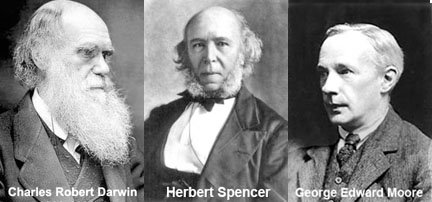
But, does it therefore follow that this predisposition necessarily dictates how we should behave? I believe that the answer to this question is no. More than that, I believe that to make the jump from the former to the latter is to commit a fundamental logical fallacy (indeed, it has a formal name - the "naturalistic fallacy"). It conflates statements about what "is" the case (i.e. what is "natural" behavior for us and our fellow primates) and what "ought" to be the case. This fallacy was pointed out a century ago, most forcefully by G. E. Moore, who pointed out that "is" statements cannot logically be made equivalent to "ought" statements.

This distinction is crucially important, and nowhere more so than in the application of evolutionary theory to human behavior. The economic and social movement known as "social darwinism" was fundamentally based on the "naturalistic fallacy," as exemplified by the words of the well-known English hymn, "All Things Bright And Beautiful," written by Cecil Frances Humphreys Alexander:

All things bright and beautiful,
All creatures great and small,
All things wise and wonderful:
The Lord God made them all.


All well and good, but here's the next verse:

The rich man in his castle,
The poor man at his gate,
God made them, high or lowly,
And ordered their estate.


(Interestingly, if you do a Google search for these particular lyrics, you will not find them. Apparently, the social darwinist overtones of the second verse do not sit well with modern audiences, including those in church.)

Alexander was most emphatically not a "social darwinist," yet the moral equation presented in his hymn is essentially equivalent to that of Herbert Spencer and the other social darwinists: that one's position in life (and, by implication, one's behavior) are determined by a force outside one's self (God or natural selection), and that all that remains for us is to "get with the program."

In a word: bullshit. That way lies the gas chambers at Auschwitz. No amount of science can tell us what we ought to do. At most, scientific knowledge can tell us how difficult (or easy) what we ought to do might be, but to conflate the two is to commit both a logical fallacy and monstrous evil. I sincerely hope that most evolutionary biologists will not agree with either the opinions of Marc Hauser or Franz De Waal on this subject, no matter how encouraging they may be. Long and hard experience has shown us that the "naturalistic fallacy" can be used to justify monstrous injustices (as has the belief in the authority of a "supernatural lawgiver," and for the same reason).

As adults, we must face up to the difficult responsibility of deciding what we "ought" to do, and then do it, no matter how easy or difficult. If it is the former (and if this is because of our evolutionary heritage), then perhaps the road ahead will not be as rocky as the one we have trod to get here. However, if it is the latter (and I suspect it may be, once again based on my understanding of our evolutionary heritage - more on this later), then that's just tough: but (to paraphrase Charles Darwin), one must do one's duty.

--Allen

Labels: , , , , , ,

Thursday, August 03, 2006

Follow-up Post on Analogies in Science

In comment # 20 in a thread at http://specifiedcomplexity.freehostia.com/?p=232, PvM said:

"ID relies on the concept of analogy to infer design. Science does the hard work to provide mechanisms, pathways and provides analyses of the data to support their conclusions. That’s the big difference. How do we know an analogy really exists?"


This was precisely my point in my blogpost on identity and analogy (see http://evolutionlist.blogspot.com/2006/06/identity-analogy-and-logical-argument.html)
For example, do we have any objective way to determine if one rock is analogous with another? Or whether an anatomical feature (or a protein/substrate binding site) is analogous to another? As in the case of telology, we think we can do this very easily (just as we can easily identify what looks like design), but I would argue that this is because both "finding" analogies and "finding" design/purpose are capabilities of the human mind/nervous system that have conferred enormous adaptive value on our ancestors. As in the case of our putative innate "agency/design/purpose detector" (which first becomes active in very early infancy), our "analogy detector" also appears to become active at a very early age, and operates entirely "in the background." That is to say, we are almost totally unaware of its operation, and concentrate only on its output.

Our ability to detect (and construct) analogies is probably the core of our "intelligence," as demonstrated by the fact that identifying analogies has been traditionally used as one of the most sensitive guages of general intelligence (i.e. "g") in intelligence tests (such as the Miller Analogies Test). As more than one participant in this thread has pointed out (Sal, I think you were first), doing mathematics is essentially the construction of highly compact analogies, in which numerical (and sometimes physical) relationships are expressed as abstract symbols.

Interestingly, in the case of some analogies in biological systems we have an independent double-check on our identification of analogous things. This is based on the evolutionary concept of homology, or derivation from a common ancestor. If two structures on two different organisms (say a small bone of the jaw of a reptile and the even smaller bone in the middle ear of a mammal) appear to be analogous (on the basis of size, location, relationship to other bones, etc.) there are at least two different, though related, methods of verifying that these structures are indeed analogous (and not just accidentally similar). One way is by means of comparative paleoanatomy, in which a series of fossils of known age are compared to determine if there is a connection between the evolutionary pathways of derivation of the structures. If such a pathway can be empirically shown to exist, this would be strong evidence for both the analogous and homologous nature of the objects. Alternatively one could compare the nucleotide sequences that code for the structures to determine if they are sufficiently similar to warrant a conclusion of homologous derivation. In both cases, evidence for homology, combined with our intuitive "identification" of analogous structure and/or function, both point to the same conclusion: that the two structures are both analogous and homologous.

BTW, this is why structures that appear to be analogous, but for which there is no convincing evidence of homology (as in the wings of birds and insects) can present a serious problem to evolutionary biologists, and especially systematists/taxonomists and those engaged in cladistic analysis. Such apparent similarities (technically called homoplasies) can either be the result of "true" (i.e. partial) analogy at the functional (and/or structural) level (and therefore assumed to be the result of convergent evolution) or they can be completely accidental. Simple inspection can be insufficient to separate these two hypotheses, and lacking either fossil or genomic evidence, conclusions about actual analogy can be extremely difficult to draw. However, if there is fossil and/or genomic evidence and it points away from homology (i.e. descent from a common ancestor), then the structures can be considered to be analogous but not homologous.

In the same comment, PvM also wrote:

"I also think that Sal is overusing the concept of analogy to mean almost anything."


Indeed, it is essential in discussions such as these that we be as precise as possible about our definitions, as imprecision can only lead to confusion (at best) and unsupportable conclusions (at worst). Perhaps the most essential distinction to be made in this regard is between "anaologies of description" (which could also be called "semantic analogies") and "analogies of function/structure" (which could also be called "natural analogies"). The former (i.e. "semantic analogies") are merely artifacts of the structure of human cognition and language, as happens whenever we describe an analogy that we have perceived. By contrast, the latter (i.e. "natural analogies") are the actual similarities in function/structure that we are describing (i.e. that resulted in our identification and description in the first place). As in the Zen koan about the roshi and the novice in the moonlit garden, much of the confusion about which of the two types of analogies we are discussing seems to stem from confusion between the moon that illuminates the garden and the finger pointing at the moon.

Labels: , , , , , ,

Thursday, July 06, 2006

Doggies are Better than Weasels


AUTHOR: Dave Thomas

SOURCE: Target? We don't need no stinking target!

COMMENTARY: Allen MacNeill

Over at The Panda’s Thumb, Dave Thomas has posted the results of another computer simulation of natural selection, this time applied to the classical “Traveling Salesman” problem. No, that isn’t the lead-in to an old dirty joke, it’s a classical problem in optimization. The basic idea is to calculate the shortest possible route for a traveling salesman to follow when visiting more than three cities (i.e. sales territories). Clearly, when there are only two cities, the solution is obvious to anyone with a knowledge of Euclidian geometry: a straight line connecting the two cities. However, as more cities are added, the number of possible solutions expands exponentially, making calculations of optimal pathways extraordinarily difficult.

This is where Dave Thomas (and a dish of soap bubbles) comes in. In his post, Thomas first shows the classical solution to a five-node traveling salesman problem (TSP), as demonstrated by the Swiss mathematician Jakob Steiner. He then illustrates the optimal solution using a soap film generator, which uses free-standing posts and soap films to generate the optimal solution.

Thomas then goes on to formulate a “solution engine” for higher-level Steiner problems (i.e with more than five asymmetrically placed nodes), using natural selection operating on a computer-generated “TSP solver.” The results are truly astonishing: although the theoretical number of possible solutions is fantastically large, the TSP solver using simple natural selection (call it the NS_TSPS) found several optimal solutions with amazing speed. The same thing happened when Thomas tested the computer-generated solutions using soap films. Indeed, he was able to show that the NS_TSPS was actually more efficient at finding solutions than the soap film generator, a result that surprised him (and most of the commentators on the Thumb). One of the soap-film solutions took the shape of a “doggie,” a solution that the NS_TSPS didn’t find. Thomas was able to show that, although the soap-film solution was stable, it was actually sub-optimal to an alternative solution generated by the NS_TSPS (hence the title of this post)

Why is all of this important, in the context of the ongoing debate over design in nature, as exemplified by Richard Dawkins' book The Blind Watchmaker? Because, unlike Dawkins’ WEASEL program, which used a pre-specified “target,” thereby opening his model to accusations that it simply “found” a pre-specified outcome (and was therefore actually an example of “intelligent design”), the NS_TSPS had no pre-specified solution at all, and found the optimal solutions the same way natural selection “finds” them in the wild: by simple trial and error, combined with preservation of partially successful outcomes.

In other words, the objections that some of us had to Dawkins’ WEASEL program have been addressed in Thomas’ NS_TSPS, and natural selection has been shown once again to be all that is necessary to “find” an optimal solution to a “problem,” even in the absence of a pre-specified outcome.

This is important to the ongoing discussion about design in nature for several reasons:

• It decisively undercuts the objections commonly voiced by advocates of ID, that all simulations of natural selection are actually simulating ID, as they all include pre-specified “target” outcomes.

• It shows the extraordinary (and somewhat counterintuitive) power of natural selection to “find” adaptive optima, even in the absence of pre-specified solutions.

• It reinforces a finding that has increasingly been coming out of research into computerized “genetic algorithms”: that selection processes that incorporate non-directed natural selection can find solutions to problems that are highly resistent to more “classical” targeted computation.

• It demonstrates that the common assertion by ID theorists that ID theory is logically necessary as an alternative to evolutionary theory, since the latter has failed to demonstrate empirically that it can solve such optimization problems in real time, is empirically false. That is, ID theory isn’t necessary to explain adaptation, even in cases where the computation of adaptive optima appears to be beyond the capability of any real-time computing system.

And this, in turn, emphasizes the point that I have made in several other posts to this blog: that rather than ID theory being a logically necessary alternative to evolutionary theory, it is a logically unnecessary addition to standard evolutionary theory, and one that furthermore is not supported by the empirical evidence.

FOR FURTHER READING:

There are other simulations of evolution by natural selection that are immune to the common objections voiced by ID theorists. To learn more about the most powerful one developed to date, check out Avida.

--Allen

Labels: , , , ,